
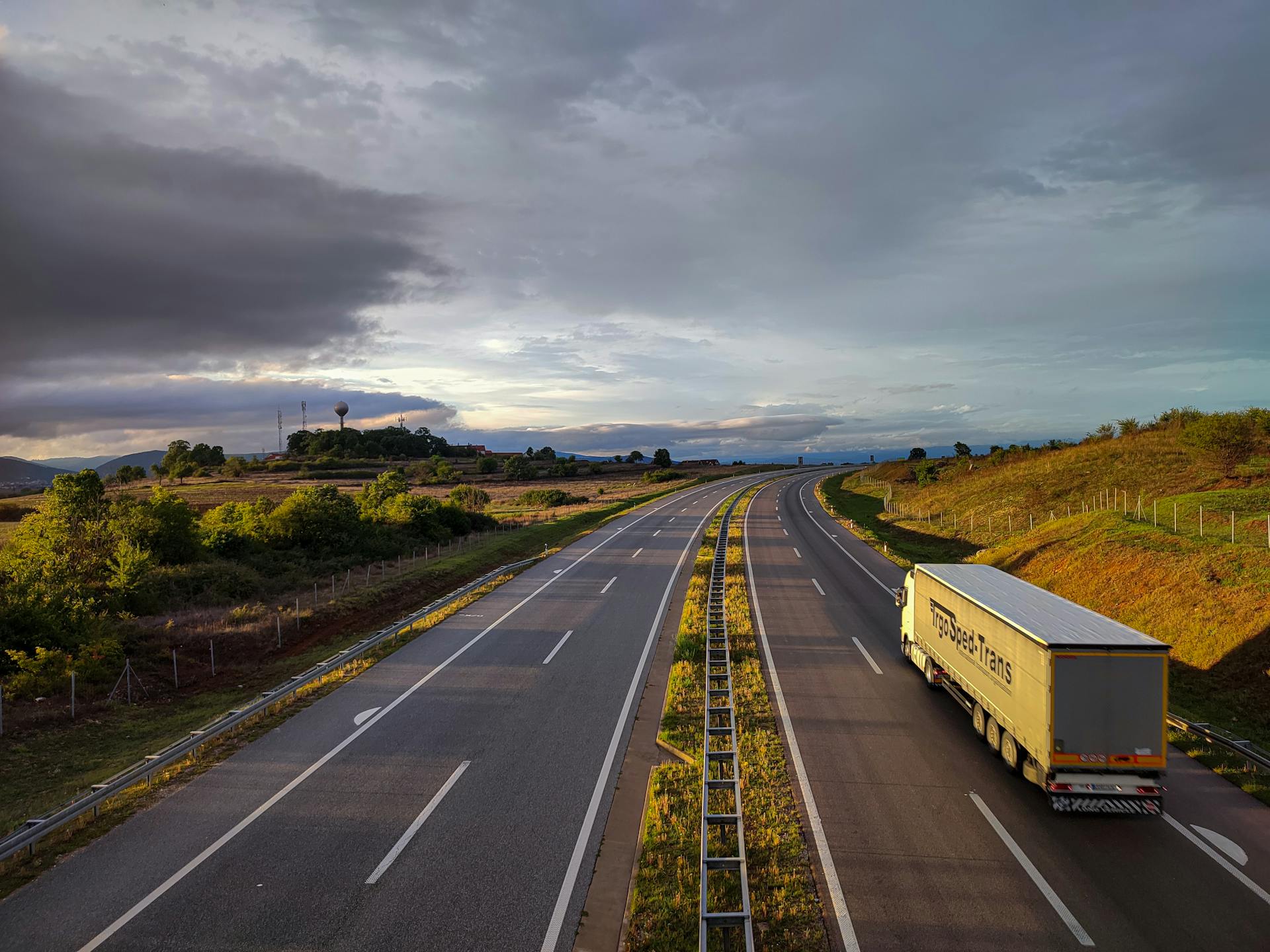
Illinois Truck Dispatch | Chicago Intermodal & Joliet Inland Port
Dispatch services for Illinois's Chicago intermodal hub. The largest and busiest in North America. The Joliet/Will County inland port complex, and the state's dense manufacturing and food/beverage freight base.
How much do truck dispatch rates run in Illinois?
Illinois-origin freight currently pays about $2.30-$2.75/mi for dry van, more for reefer and flatbed. Demand is driven by Intermodal & Rail, Manufacturing and Food & Beverage Processing. Grow Trucking dispatches Illinois owner-operators and small fleets across 15 tracked lanes on a transparent percentage-of-gross fee, disclosed upfront.
- Tracked lanes
- 15
- Major freight hubs
- Chicago, Rockford and Peoria
- Top industries
- Intermodal & Rail and Manufacturing
Illinois rate and market data reviewed September 2026. See our dispatch fee structure.
Illinois Truck Dispatch Services
Illinois sits at the center of the North American freight rail network. Seven Class I railroads meet in the Chicago terminal district, more than anywhere else in the country. I-90, I-94, I-80, I-55, I-65, and I-57 make Chicagoland the most-connected inland freight market in the U.S. The Joliet/Will County corridor is the largest inland port complex in the nation. It is anchored by BNSF's Logistics Park Chicago and Union Pacific's Joliet intermodal terminal. It moves millions of containers between rail and truck each year. Roughly 25% of all U.S. freight and 50% of all intermodal trains pass through Chicago. One trucking executive called the city 'the freight equalizer.' Food ingredients move in from California, and finished goods move out. Loads stay balanced in both directions, which sets Chicago apart from more import-heavy coastal markets.
Illinois has the densest, best-connected freight market in the country. Chicago's rail hub and the Joliet/Will County inland port anchor it. Freight moves strongly both ways across dry van, reefer, and flatbed.
The most-connected inland freight market in the U.S. Seven Class I railroads and six interstates converge here
Chicago's two-way freight profile ('the freight equalizer') lowers the imbalance risk seen in import-heavy coastal markets
The Joliet/Will County inland port complex is the largest in the nation. It creates massive drayage and long-haul freight volume
Some of the largest freight brokerages in the country are based here, so load availability runs deep
What is the Illinois freight market like?
As of 2026, Chicago intermodal rail volume keeps pulling long-haul freight from truck to rail. That tightens drayage demand around Chicago's terminals. Truckload and intermodal prices move in related cycles. Because Chicago is central to freight flow, price changes there are often the first signal before they spread across the Midwest.
Average Rates
Illinois-origin rates (mid-2026): dry van roughly $2.30-$2.75/mile out of Chicago. That is often a premium over other Midwest cities because of city congestion and terminal costs. Flatbed runs $2.60-$3.20/mile (Rockford/Bloomington manufacturing). Reefer runs $2.60-$3.00/mile (Chicago's cold-chain/food-processing network).
Market Trends
- •
Will County's Joliet intermodal corridor (BNSF Logistics Park Chicago, Union Pacific's Joliet terminal) is the largest inland port complex in the nation. It moves millions of containers each year
- •
Chicago is 'the freight equalizer.' Food ingredients move in from California, and finished goods move out. That gives it a more balanced two-way freight profile than many import-heavy coastal markets
- •
The American Transportation Research Institute named a notorious Chicago-area interchange the nation's worst truck bottleneck. It adds real cost and time pressure to freight moving through the metro
- •
More intermodal rail volume keeps shifting long-haul freight from truck to rail. That tightens drayage competition around Chicago's terminals
- •
Illinois brokers based in Chicago (Echo Global Logistics, Coyote Logistics, MoLo Solutions, Arrive Logistics) handle a huge share of national freight brokerage
What are the busiest freight lanes out of Illinois?
Price these lanes with our free Trip Pre-Cost Calculator, Should I Take This Load? Calculator and Lane Profitability Analyzer.
Chicago to Dallas
Freight route connecting Chicago, IL to Dallas, TX (935 miles). One of Chicago's classic long-haul corridors via I-55/I-44, connecting two major distribution hubs.
Rate: $2,010 - $2,384
Distance: 935 miles
Chicago to Atlanta
Freight route connecting Chicago, IL to Atlanta, GA (715 miles). Atlanta's distribution hub status mirrors Chicago's, supporting a strong two-way lane via I-65/I-24.
Rate: $1,609 - $1,895
Distance: 715 miles
Chicago to Philadelphia
Freight route connecting Chicago, IL to Philadelphia, PA (760 miles). Connects Chicago's intermodal reach to Philadelphia's port and pharma corridor via I-80.
Rate: $1,710 - $2,014
Distance: 760 miles
Chicago to Minneapolis
Freight route connecting Chicago, IL to Minneapolis, MN (405 miles). It reaches Minneapolis's food-processing and medical device manufacturing base via I-90/I-94.
Rate: $992 - $1,154
Distance: 405 miles
Chicago to Detroit
Freight route connecting Chicago, IL to Detroit, MI (280 miles). Detroit's auto-supplier base creates real two-way automotive-parts freight via I-94.
Rate: $714 - $826
Distance: 280 miles
Chicago to St. Louis
Freight route connecting Chicago, IL to St. Louis, MO (300 miles). St. Louis's tri-modal hub status provides a dependable mid-distance lane via I-55.
Rate: $750 - $870
Distance: 300 miles
Chicago to Indianapolis
Freight route connecting Chicago, IL to Indianapolis, IN (185 miles). Connects two of the Midwest's biggest crossroads cities via I-65.
Rate: $481 - $555
Distance: 185 miles
Chicago to New York
Freight route connecting Chicago, IL to New York, NY (790 miles). The Northeast's largest consumer market, reached via I-80/I-90.
Rate: $1,738 - $2,054
Distance: 790 miles
Chicago to Los Angeles
Freight route connecting Chicago, IL to Los Angeles, CA (2015 miles). West Coast port and consumer freight, connected via the classic I-80/I-40 corridor.
Rate: $3,728 - $4,534
Distance: 2015 miles
Chicago to Kansas City
Freight route connecting Chicago, IL to Kansas City, MO (510 miles). KC's rail hub status and agricultural freight base provide dependable backhaul via I-55/I-70.
Rate: $1,224 - $1,428
Distance: 510 miles
Chicago to Memphis
Freight route connecting Chicago, IL to Memphis, TN (535 miles). Memphis's FedEx hub and inland port make this a dependable time-sensitive freight lane via I-55.
Rate: $1,284 - $1,498
Distance: 535 miles
Chicago to Nashville
Freight route connecting Chicago, IL to Nashville, TN (470 miles). Nashville's automotive and distribution base supports steady freight via I-65.
Rate: $1,128 - $1,316
Distance: 470 miles
Chicago to Columbus
Freight route connecting Chicago, IL to Columbus, OH (355 miles). Rickenbacker Inland Port and e-commerce DC growth make Columbus a strong reload market via I-65/I-70.
Rate: $888 - $1,030
Distance: 355 miles
Chicago to Denver
Freight route connecting Chicago, IL to Denver, CO (995 miles). Denver's distribution and energy-sector freight supports a solid I-80 connection.
Rate: $2,090 - $2,488
Distance: 995 miles
Chicago to Milwaukee
Freight route connecting Chicago, IL to Milwaukee, WI (90 miles). A short, high-frequency corridor connecting two major Great Lakes freight markets via I-94.
Rate: $248 - $284
Distance: 90 miles
Search brokers & carriers in Illinois
Browse active freight brokers and for-hire carriers based in Illinois. The list comes live from FMCSA and updates weekly. Check bond, authority, and fleet size before you haul.
Freight Brokers
Active, FMCSA-bonded freight brokers based in Illinois.
Browse directoryDry Van Carriers
For-hire dry van carriers operating out of Illinois.
Browse directoryFlatbed Carriers
For-hire flatbed carriers operating out of Illinois.
Browse directoryReefer Carriers
For-hire reefer carriers operating out of Illinois.
Browse directoryTruck Parking
Official NHS rest stops and truck parking capacity across Illinois.
Browse directoryWhich industries drive freight demand in Illinois?
Intermodal & Rail-to-Truck Logistics (Chicago is the largest hub in North America)
Manufacturing (Rockford, Bloomington - industrial/heavy equipment)
Food & Beverage Processing (Chicago cold-chain network)
Retail Distribution (Joliet/Will County big-box DCs)
Agriculture (statewide grain/farm products)
Freight Brokerage (Chicago-based national brokers)
How does Illinois freight change by season?
Rates and weather change with the seasons. Here is a quarter-by-quarter look at rates, weather, and what to do in Illinois.
Q1 (Jan-Mar)
Rate Movement
Rates ease 5-10% in January-February after the Q4 holiday surge. Winter weather can cause short spikes
Weather Impact
Winter storms and lake-effect snow are the biggest disruption risk in the state
Strategy
Position near Chicago/Joliet early in the week for the best rates, and build in weather buffer
Q2 (Apr-Jun)
Rate Movement
Rates get stronger as manufacturing/flatbed freight and retail restocking ramp up
Weather Impact
Generally favorable. Spring severe weather (tornado risk) can cause short disruptions
Strategy
Focus on Rockford/Bloomington manufacturing freight and Chicago intermodal drayage
Q3 (Jul-Sep)
Rate Movement
Rates hold near seasonal highs on retail restocking ahead of Q4
Weather Impact
Minimal. Illinois has low direct severe-weather exposure in summer
Strategy
Focus on Chicago's intermodal drayage volume and get ready for statewide harvest season
Q4 (Oct-Dec)
Rate Movement
Highest rates of the year, peaking in November-December on intermodal/distribution and holiday retail volume
Weather Impact
Winter weather starts hitting Chicago-area freight by late November
Strategy
Book capacity early. Chicago's intermodal base makes this the tightest capacity window of the year
Additional Seasonal Considerations
- •
Winter weather (lake-effect snow, ice storms) can badly disrupt Chicago-area freight Dec-Feb
- •
The Q4 holiday freight surge (Nov-Dec) is especially strong because of Chicago's intermodal and distribution base
- •
Harvest season (Sep-Nov) drives statewide grain and farm freight volume
- •
Summer construction season raises flatbed demand for Rockford/Bloomington manufacturing freight
Where are the major freight hubs in Illinois?
The ports, inland ports, intermodal terminals, and distribution cities that move freight across Illinois. See where most of the freight is.
Distribution Cities
- Chicago
- Rockford
- Peoria
- Springfield
- Joliet
Ports & Intermodal Terminals
BNSF Logistics Park Chicago (Joliet/Elwood)
Part of the largest inland port complex in the nation. It moves millions of containers each year between rail and truck.
Union Pacific Joliet Intermodal Terminal
One of the busiest rail-to-truck hubs in the world. It anchors the Will County corridor.
CenterPoint Intermodal Center (Will County)
A 6,400-acre intermodal/logistics complex that is turning Will County into a national intermodal hub.
Where can trucks park and fuel in Illinois?
Truck parking and fuel info to help you plan your routes through Illinois.
Estimate fuel, tolls, and fuel tax with our free Fuel Cost Calculator, IFTA Tax Calculator and Toll Cost Estimator with Route Comparison.
Major Truck Stops
Love's Travel Stop — Joliet (I-80, Exit 127)
📍 2501 McDonough Street, Joliet, IL 60436
180 truck parking spaces ($15/day fee), 24/7 fuel, full repair shop. It sits at the heart of the Joliet/Will County intermodal corridor. It is the main staging point for BNSF Logistics Park and Union Pacific drayage freight. Reserve-It truck parking is available through Love's mobile app.
Pilot Travel Center — Elwood (I-55, Exit 241)
📍 22493 West Schweitzer Road, Elwood, IL 60421
160 truck parking spaces (free), 24/7 fuel, repair services. It serves the southern edge of the Will County inland port complex, with direct access to CenterPoint Intermodal Center freight.
TA Travel Center — Gary, IN (I-80/I-94, Exit 10)
📍 3701 Grant Street, Gary, IN 46408
220 truck parking spaces ($12/day fee), full-service truck stop with 24/7 fuel, restaurant, and CAT-certified truck service center. It is in Indiana, but it is the main eastern Chicago-area staging spot for carriers avoiding inner-city Chicago fees.
Flying J Travel Plaza — Rochelle (I-39, Exit 99)
📍 1701 North 7th Street, Rochelle, IL 61068
140 truck parking spaces (free), 24/7 fuel, Denny's restaurant. Its location is halfway between Chicago and Rockford. It serves the I-39/I-88 industrial corridor, with access to heavy manufacturing/flatbed freight.
Love's Travel Stop — Bloomington (I-39, Exit 8)
📍 30001 North 3150 East Road, Bloomington, IL 61705
130 truck parking spaces ($15/day fee), 24/7 fuel, Subway, WiFi. It serves central Illinois manufacturing freight and the I-39/I-74/I-55 interchange, one of the state's busiest crossroads outside Chicago.
Petro Stopping Center — South Holland (I-80/I-94, Exit 160)
📍 1601 East 170th Street, South Holland, IL 60473
190 truck parking spaces ($18/day fee), Iron Skillet restaurant, 24/7 repair, showers. A prime Chicago metro location for southbound freight on I-57/I-94, with quick access to Indiana and Michigan lanes.
Road Ranger — Peru (I-80, Exit 75)
📍 4104 Venture Drive, Peru, IL 61354
110 truck parking spaces (free), 24/7 fuel, diesel exhaust fluid (DEF), convenience store. It serves the I-80 corridor west of Chicago and the Starved Rock industrial corridor. It has quick access to Ottawa and LaSalle manufacturing freight.
Shell - Springfield (I-55, Exit 92)
📍 3180 S Dirksen Pkwy, Springfield, IL 62703
80 truck parking spaces (free), diesel, convenience store. Central Illinois state capital area.
Parking Difficulty
High. Chicago metro and the Joliet/Will County corridor see very high parking demand because of intermodal drayage and distribution traffic
- •Plan ahead for parking in metro areas
- •Use rest areas as a backup
- •Use parking apps to find available spots
Strategic Positioning Advice
Park where you can find loads fast and cut deadhead miles:
- •
Major Distribution Centers: Position near major distribution hubs in Chicago for quick access to outbound loads.
- •
Busy Freight Routes: Stay near busy freight corridors to catch backhaul loads.
- •
Timing: Arrive when booking is busiest (usually early morning) to get the best rates.
Fuel price trend
How has the diesel price changed in Illinois?
EIA does not publish a separate diesel price for Illinois, so this is the weekly average for the Midwest region that Illinois is part of, over the last 12 months.
- Price this week
- $6.35/gal
- Since last week
- Up 9 cents
- Versus a year ago
- Up 78%
- Versus the U.S. average
- 8 cents above
Week of October 19, 2026
+$2.79 a gallon
U.S. average $6.28
Source: U.S. Energy Information Administration weekly retail on-highway diesel prices. Averages, not the price at one pump.
What are Illinois's truck weight limits and regulations?
Weight limits, permits, and emission rules. Know these rules to stay legal. Also see what to expect at a DOT roadside inspection, the federal size and weight limits, and the full federal trucking regulations reference.
Check weights and permits with our free Scale / Weigh Station Guide, Weight & Axle Load Calculator and Oversize / Overweight Permit Estimator.
Weight Limits
Federal limits on the Interstate System (23 CFR 658.17):
- Single Axle: 20,000 lbs
- Tandem Axle: 34,000 lbs
- Gross Vehicle Weight: 80,000 lbs, or less where the bridge formula sets a lower total
Other highways follow Illinois law, and some states allow more on non-Interstate roads. Check with the state's size and weight office before you load.
Size Limits
Width is a federal limit. Height and trailer length depend on the state:
- Width: 8.5 feet (102 inches) on the National Network (23 CFR 658.15)
- Height: Set by each state. There is no federal height limit, and FHWA says most states are between 13 ft 6 in and 14 ft. Check Illinois's limit for your route.
- Length: 53 ft semitrailers are common, but a state can apply its own kingpin-to-rear-axle rule
State-Specific Rules
- •
Illinois State Police and IDOT jointly enforce commercial vehicle safety. They check trucks at weigh stations and with roving patrols
- •
Federal weight limits on the Interstate System: 80,000 lbs gross vehicle weight, 20,000 lbs single axle, 34,000 lbs tandem axle. Other highways follow state law, so check the state's size and weight office. Some Illinois routes allow higher configurations, so verify with IDOT
- •
Size limits: 8.5 ft (102 in) width. Legal height is set by each state, and FHWA says most are 13 ft 6 in to 14 ft, so check the state's size and weight office. A 53 ft semitrailer is common, but state kingpin-to-rear-axle rules apply
- •
Oversize/overweight permits issued through the Illinois DOT
- •
Illinois's diesel fuel tax is among the higher state rates, about $0.47-0.50/gallon including state motor fuel tax parts. It indexes to inflation each year, so verify the current rate with Illinois DOR
Permits
Illinois may require special permits for:
- •Oversized/overweight loads
- •Hazardous materials
- •Special route rules
Illinois: freight facts a driver should know
Illinois's legal weight limits and 5-axle threshold
Illinois caps single axles at 20,000 pounds and tandem axles at 34,000 pounds, with no single axle inside a tandem allowed over 20,000 pounds. The full 80,000-pound gross weight limit applies to combinations running 5 or more axles.
Source: Illinois Compiled Statutes, 625 ILCS 5/15-111. Checked 30 Sep 2026.
Illinois permits run through a 24/7 online system
Illinois issues oversize and overweight permits through its ITAP online system, available around the clock instead of only during office hours. Illinois also breaks out a separate permit category just for loads that are over on a single axle's weight but still under the legal gross — a distinction most states don't bother making.
Source: Illinois Department of Transportation, oversize/overweight permits. Checked 30 Sep 2026.
How have Illinois freight rates moved, and what's next?
How Illinois freight rates have moved through recent market cycles, and what owner-operators and fleets should expect next. Use this to time lane commitments and rate negotiations. Before you accept a load, check it against our free rate benchmarker.
Recent Rate Cycles
Rate cycles that shaped the current Illinois freight market:
2018-2019
Strong market. Rates hit their peak because trucks were in short supply
2020
Rates swung at first because of the pandemic. Freight demand then bounced back hard
2021-2022
Record-high rates. E-commerce demand surged and trucks were in short supply
2023-2024
Rates fell sharply as truck supply passed demand. Smaller carriers left the market
2025-2026
The national market is recovering. Chicago's intermodal strength and Will County's inland port growth have kept Illinois freight demand strong
Market Correction Periods
Knowing when corrections hit Illinois helps with strategic planning:
- •
Q1 2023: Rates fell hard as trucks were added faster than freight grew
- •
Mid-2024: The market is settling, with supply and demand more in balance
- •
Pattern: Rate drops usually last 6–12 months before rates recover
Illinois Market Outlook
As of mid-2026, Illinois's freight market benefits from Chicago's rail/highway hub and continued Will County inland port investment. Growing intermodal rail volume is slowly shifting some long-haul freight away from truck.
What Drives Rates in Illinois
- •Freight volume and demand (intermodal drayage, manufacturing, food/beverage, retail distribution)
- •Truck supply, which tightened a lot from last year across the nation
- •Fuel costs and Illinois's diesel fuel tax (~$0.47-0.50/gallon, indexed to inflation)
- •Chicago intermodal rail volume trends and Will County inland port growth
How do I cut deadhead miles running freight in Illinois?
How to cut empty miles when you haul in and out of Illinois. See the outbound and inbound freight balance, the best return lanes, and where to park your truck. Run your own numbers with our free deadhead miles calculator.
Outbound Freight
50%
Roughly 50% of Illinois freight moves outbound. Outbound loads from Illinois's production and distribution centers typically book fastest early in the week.
Inbound Freight
50%
About 50% of the freight balance is inbound. Book your return load before you deliver. It is the biggest way to raise your rate-per-mile on these lanes.
Best Backhaul Lanes into Illinois
The strongest return lanes for repositioning back toward Illinois:
Indianapolis to Chicago
Dense Midwest corridor with steady two-way freight
Rate: $2.45 - $2.85/mile
Minneapolis to Chicago
Strong I-90/I-94 corridor connecting two major Midwest hubs
Rate: $2.40 - $2.80/mile
St. Louis to Chicago
I-55 corridor with reliable two-way freight
Rate: $2.40 - $2.80/mile
Positioning Strategies for Illinois
Where and when to stage to keep your next load close and your deadhead low:
- •
Position in Joliet/Will County for the fastest access to intermodal drayage freight
- •
Chicago is two-way ('the freight equalizer'), so don't assume you need to deadhead. Inbound freight is often available
- •
Use load boards to pre-book backhaul before longer cross-country hauls
What do experienced dispatchers know about running Illinois?
Hands-on tips from years of dispatching in Illinois.
Chicago is a real two-way market. Unlike import-heavy coastal cities, food ingredients move in and finished goods move out. Loads balance in both directions. This 'freight equalizer' status means backhaul chances run stronger here than in most major metros.
The Chicago-area bottleneck (I-290/I-90/I-94 interchange in Hillside) was named the nation's worst by ATRI. It is a real cost. Build a 45-60 minute schedule buffer for any freight moving through it, especially at weekday rush hours (7-9 AM, 4-7 PM).
Will County intermodal drayage is short-haul (often under 100 miles round-trip) but high-volume. Carriers who focus on BNSF Logistics Park or Union Pacific Joliet terminal drayage can run 2-3 loads per day with good pre-booking.
Chicago intermodal drayage and Joliet warehouse freight pay the most on Tuesday mornings, 10-15% above Friday. Shippers clear their week-ahead commitments across the Midwest distribution network.
Position in Joliet, Elgin, or Gary (IN) instead of inner-city Chicago. You avoid urban delivery fees ($75-150/stop) and Chicago-area congestion while keeping full Midwest freight access. Gary, IN offers lower overnight parking costs ($12/day vs $18-20 in Chicago proper).
Rockford and Bloomington manufacturing freight is 20-30% less competitive than Chicago proper. It is worth building direct shipper/broker relationships around if you run flatbed. These cities offer steady industrial/machinery freight without the Chicago carrier density.
Illinois brokers (Echo Global, Coyote, MoLo, Arrive) are headquartered in Chicago and post huge daily volume. Building rapport with 2-3 Chicago-based brokers can keep you running year-round, whatever the national market does.
Winter weather (Dec-Feb) hits Chicago/Will County hard with lake-effect snow and ice. Carriers who show reliability during winter weather events build premium broker relationships that pay off year-round. Don't turn down winter loads if you can run them safely.
Chicago's intermodal rail volume directly affects truck rates. When rail pricing drops, more freight shifts to rail and truck rates soften. Track intermodal spot rates (available via DAT, Freightwaves SONAR) as a leading sign for Chicago truck rate trends.
The I-55 corridor south from Chicago to St. Louis is one of the steadiest two-way freight lanes in the Midwest. If you're deadheading out of Chicago, I-55 south almost always has return freight to reload quickly.
Remember: These tips come from real dispatching work in Illinois. Markets change, but these basics still help you earn more and cut deadhead miles.
How have drivers near Illinois grown with Grow Trucking?
+$1,950/week after moving to $2.65/mi on produce / auto parts freight. Route optimization cut empty miles by 86%.
Read the case study+$3,745/week after moving to N/A/mi on midwest regional freight freight. From $4–5K/week to $9,250 with a Midwest lane strategy.
Read the case study+$3,170/week after moving to $2.90/mi on automotive parts / manufacturing freight. New authority veteran driver fast-tracked to premium rates.
Read the case studyIllinois Freight FAQs
Comprehensive answers to common questions about trucking and dispatch in Illinois. State-specific regulations, costs, and operating strategies.
Yes. You need a USDOT number, an MC number for interstate for-hire carriage, and Illinois-specific IRP/IFTA registration through the Illinois Secretary of State. If you run heavy Chicago-area volume, consider Illinois DOT's PrePass or an E-ZPass Toll transponder. They help you avoid weigh-station delays and toll-booth stops.
Federal minimum liability coverage usually runs $750,000 for general freight or $1,000,000 for certain cargo types (hazmat, high-value goods). You also need cargo insurance ($100,000 minimum) and physical damage coverage. Illinois adds no state insurance minimums beyond federal rules. But confirm current minimums with your insurance provider, and check broker-specific rules before booking loads.
As of mid-2026, flatbed tied to Rockford/Bloomington manufacturing runs $2.60-$3.20/mile. Dry van out of Chicago runs $2.30-$2.75/mile. That is often a 10-15% premium over other Midwest cities because of urban congestion, terminal costs, and Chicago-area bottleneck delays. Reefer freight tied to Chicago's cold-chain/food-processing network runs $2.60-$3.00/mile.
Yes, though Chicago carrier competition is intense because the metro is the largest intermodal hub in North America. New operators do well by specializing in Will County intermodal drayage (2-3 short loads/day vs 1 long-haul load) or Rockford/Bloomington manufacturing freight. That beats competing on Chicago spot rates alone. Illinois's two-way freight profile ('the freight equalizer') lowers deadhead risk compared to more one-directional coastal markets.
Illinois Motor Fuel Tax is $0.558 per gallon for diesel (July-December 2026, CPI adjustment suspended). The Motor Fuel Use Tax (IFTA-relevant) is $0.738 per gallon. Add the federal tax ($0.244/gallon), and total diesel fuel tax is over $0.80 per gallon. Retail diesel in the Midwest region, which includes Illinois, averages $6.35/gallon as of October 19, 2026 (EIA weekly average), about 8 cents above the national average of $6.28. That price is up 9 cents from last week and 78% above a year ago. The Chicago area often has slightly higher prices. Illinois fuel tax adjusts each July 1st, tied to CPI. Verify the current rate with Illinois Department of Revenue (tax.illinois.gov). Source: Illinois DOR, verified September 2026.
The Hillside interchange is where I-290, I-90, and I-94 meet west of downtown Chicago. The American Transportation Research Institute has named it the nation's worst truck bottleneck for several years in a row. Expect 45-60 minute delays at weekday rush hours (7-9 AM, 4-7 PM), and build in schedule buffer. Many carriers route around it via I-294 (the Tri-State Tollway) or I-355 to avoid the congestion. Tolls add $15-25/trip.
Chicago is where seven Class I railroads meet, and it handles roughly 50% of all U.S. intermodal trains. When intermodal rail pricing drops, more freight shifts from truck to rail and Chicago truck rates soften. When rail capacity tightens (for example, during labor talks, extreme weather, or port congestion), freight shifts to truck and Chicago rates spike. Track intermodal spot rates via DAT or Freightwaves SONAR. They lead Chicago truck rates by 2-4 weeks.
Chicago is two-way ('the freight equalizer'). Food ingredients and produce move in from California, and finished goods and consumer products move out. So backhaul chances are stronger here than in most major metros. Pre-book return freight on load boards (DAT, Truckstop.com) before you arrive. Build relationships with Chicago-based brokers (Echo Global, Coyote, MoLo, Arrive). Consider the I-55 south corridor to St. Louis. It is one of the steadiest two-way Midwest lanes, with daily reload availability.
Yes, if you can handle the pace. Will County's Joliet corridor (BNSF Logistics Park, Union Pacific Joliet terminal, CenterPoint Intermodal Center) is the largest inland port complex in the nation. Drayage loads are short-haul (often under 100 miles round-trip) but high-volume. Carriers who specialize in this can run 2-3 loads per day with good pre-booking. That nets higher daily revenue than a single long-haul load, despite lower per-mile rates.
Chicago and northern Illinois get lake-effect snow and ice storms Dec-Feb that can badly disrupt freight schedules. Carriers who show reliability during winter weather (proper equipment, safe driving, realistic transit estimates) build premium broker relationships that pay off year-round. Don't turn down winter loads if you can run them safely. Proving winter reliability is one of the fastest ways to move from spot-rate to dedicated-contract freight with Chicago-based brokers.
Keep exploring dispatch options
Tools, equipment guides and nearby states relevant to running freight in and out of Illinois.
By equipment
Free tools
- Trip Pre-Cost Calculator
- Toll Cost Estimator with Route Comparison
- Load Board Rate Benchmarker
- Deadhead Miles Calculator
- Fuel Cost Calculator
- IFTA Tax Calculator
- Scale / Weigh Station Guide
- Cost Per Mile Calculator
- Diesel prices today
- Diesel tax by state
- Truck idling laws by state
- Truck speed limits by state
- Truck chain laws by state
- Truck lane laws by state
- Truck height and length limits by state
- Rest area parking limits by state
- Midwest diesel prices
- Detention Pay Calculator
- Weekly Profit Target Calculator
- All Free Tools
Services
More from Grow Trucking
Ready to Move Freight in Illinois?
Secure Your Strategy:
Apply for your FREE Custom 90-Day Growth Plan (a $1,500 value). It starts with a Business Audit that finds where you lose money and sets your profit goals.
Guarantee Your GROWTH:
Start your 90-day partnership to implement the plan. We back it with our "Growth or Your Money Back" Guarantee.