
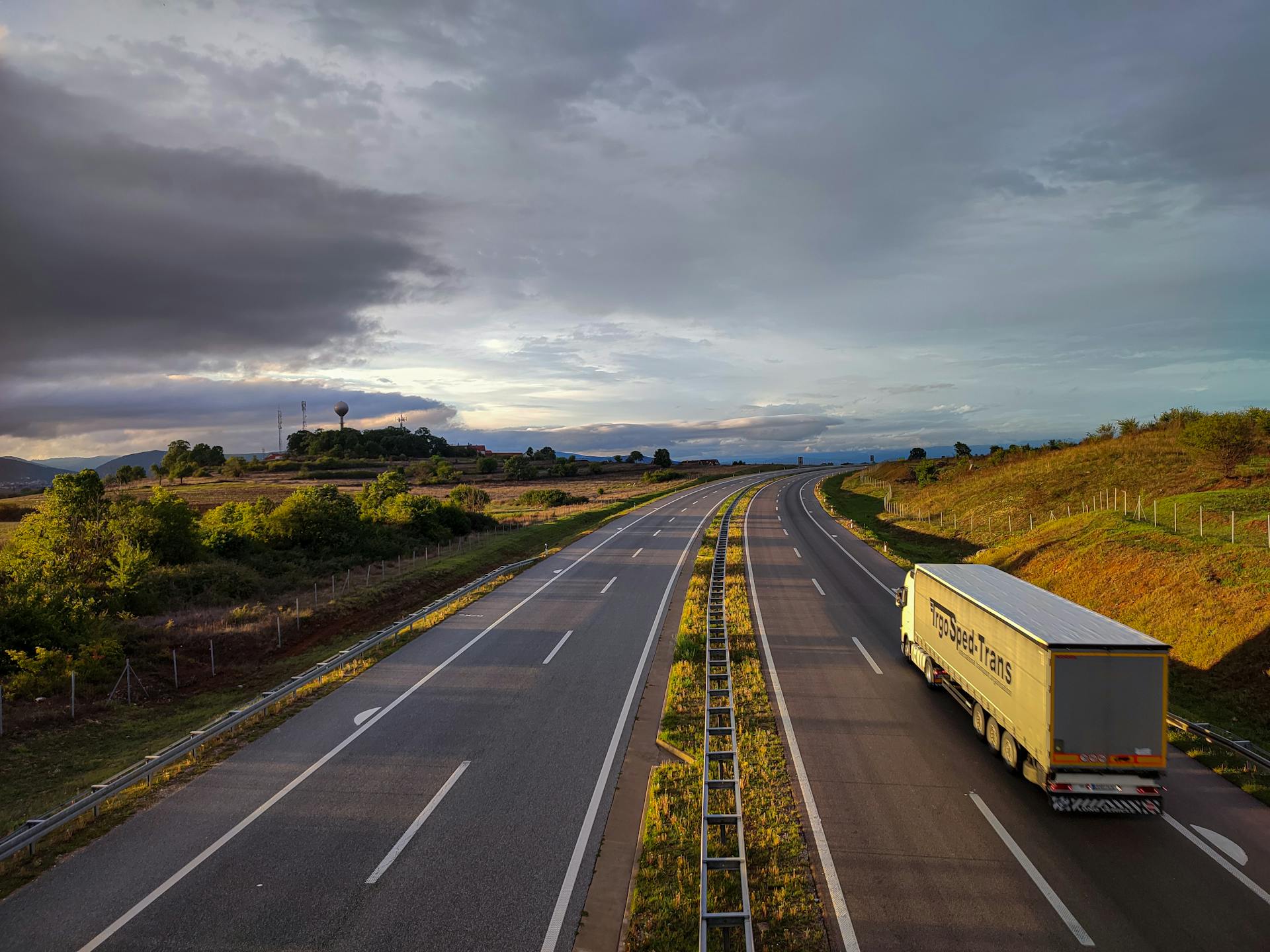
New Jersey Truck Dispatch | Port Newark-Elizabeth & Pharma Freight
We dispatch trucks for New Jersey's Port Newark-Elizabeth, the largest container port on the East Coast. We also cover the NJ Turnpike's unmatched warehouse density and the state's massive pharmaceutical manufacturing cluster.
How much do truck dispatch rates run in New Jersey?
New Jersey-origin freight currently pays about $2.30-$2.75/mi for dry van, more for reefer and flatbed. Demand is driven by Port & Container Logistics, Pharmaceuticals and E. Grow Trucking dispatches New Jersey owner-operators and small fleets across 15 tracked lanes on a transparent percentage-of-gross fee, disclosed upfront.
- Tracked lanes
- 15
- Major freight hubs
- Newark, Elizabeth and Jersey City
- Top industries
- Port & Container Logistics and Pharmaceuticals
New Jersey rate and market data reviewed September 2026. See our dispatch fee structure.
New Jersey Truck Dispatch Services
New Jersey is the most freight-dense state per square mile in the country. Port Newark-Elizabeth is part of the Port of New York and New Jersey complex. It is the largest container port on the East Coast and third-largest in the nation. It sits mostly on the New Jersey side of the Hudson, which makes NJ ground zero for East Coast port freight. The state has the highest warehouse density per square mile in the nation. Over 1.2 billion square feet of industrial space sit along the I-95/NJ Turnpike corridor from Newark to Trenton. They are placed to serve roughly 30 million consumers within a 100-mile radius. New Jersey's I-287 corridor is home to the largest pharmaceutical manufacturing cluster on the East Coast. Johnson & Johnson (New Brunswick), Bristol-Myers Squibb (Princeton), Sanofi (Bridgewater), Novartis (East Hanover), and Bayer (Whippany) all run major facilities here. They create large GDP-compliant, temperature-controlled, and controlled-substance freight. The NJ Turnpike sees over 35,000 trucks daily. The state's dense industrial base creates more LTL freight per square mile than any other state.
New Jersey offers the most freight-dense market per square mile in the country. Port Newark-Elizabeth's massive container volume anchors it. So do the NJ Turnpike corridor's warehouse density and the East Coast's largest pharmaceutical manufacturing cluster.
The highest warehouse density per square mile in the nation gives you unmatched freight volume and load availability
Port Newark-Elizabeth is the largest East Coast container port. That creates dependable, massive drayage freight
The I-287 pharmaceutical corridor is the largest such cluster on the East Coast. It gives you steady, high-value, less cyclical freight
New Jersey sits between New York City and Philadelphia. That makes NJ the real distribution backbone of the Northeast, reaching 30 million consumers within 100 miles
What is the New Jersey freight market like?
As of 2026, New Jersey's industrial vacancy has risen to about 8.9% (Q4 2025). It was a historic low of 2% in 2022. New speculative construction is now delivering. That is a real shift after years of extremely tight warehouse capacity. Warehouse rates in Northern New Jersey can exceed $14/sq ft, among the highest in the region.
Average Rates
New Jersey-origin rates (mid-2026): dry van roughly $2.30-$2.75/mile (port drayage, distribution). Reefer runs $2.55-$2.95/mile (temperature-controlled pharma and perishables). Flatbed runs $2.50-$2.90/mile. NJ Turnpike tolls and driver-cost premiums (labor competition from Amazon and major occupiers) are built into most lane calculations.
Market Trends
- •
New Jersey's industrial vacancy rose to roughly 8.9% in Q4 2025 from historic 2% lows in 2022. New speculative construction finally caught up with years of extremely tight capacity
- •
Port Newark-Elizabeth still handles most of the Port of NY/NJ's 9 million+ TEUs. That cements its position as the largest container port complex on the East Coast
- •
The I-287 pharmaceutical corridor (J&J, Bristol-Myers Squibb, Sanofi, Novartis, Bayer) is still the largest such cluster on the East Coast. It creates steady GDP-compliant freight demand
- •
Exit 8A/Central NJ (Cranbury, Monroe, South Brunswick) has become the largest single industrial submarket in the Northeast. It offers a balance of scale, port-region access, and somewhat lower costs than the port-adjacent submarket
- •
Warehouse rates in Northern New Jersey above $14/sq ft keep pushing some distribution activity toward Central and Southern NJ. So does labor competition from Amazon and major occupiers
What are the busiest freight lanes out of New Jersey?
Price these lanes with our free Trip Pre-Cost Calculator, Should I Take This Load? Calculator and Lane Profitability Analyzer.
Newark to New York
Freight route connecting Newark, NJ to New York, NY (15 miles). An extremely short, extremely high-frequency corridor feeding the NYC metro from Newark's port complex.
Rate: $44 - $51
Distance: 15 miles
Newark to Philadelphia
Freight route connecting Newark, NJ to Philadelphia, PA (90 miles). Short corridor connecting NJ's port complex to Philadelphia's pharma/port freight base via I-95/NJ Turnpike.
Rate: $243 - $279
Distance: 90 miles
Newark to Boston
Freight route connecting Newark, NJ to Boston, MA (225 miles). The Northeast's second-largest consumer market, connected via I-95.
Rate: $585 - $675
Distance: 225 miles
Newark to Washington
Freight route connecting Newark, NJ to Washington, DC (200 miles). The DC metro's government and consumer freight base via the NJ Turnpike/I-95.
Rate: $520 - $600
Distance: 200 miles
Newark to Baltimore
Freight route connecting Newark, NJ to Baltimore, MD (175 miles). The Port of Baltimore and Mid-Atlantic distribution network via I-95.
Rate: $455 - $525
Distance: 175 miles
Newark to Chicago
Freight route connecting Newark, NJ to Chicago, IL (800 miles). Chicago's intermodal hub status extends NJ's Midwest reach via I-80/I-78.
Rate: $1,760 - $2,080
Distance: 800 miles
Newark to Pittsburgh
Freight route connecting Newark, NJ to Pittsburgh, PA (350 miles). Connects NJ's port complex to Pittsburgh's industrial/tech freight base via I-78/I-80.
Rate: $858 - $998
Distance: 350 miles
Newark to Charlotte
Freight route connecting Newark, NJ to Charlotte, NC (620 miles). Charlotte's banking and distribution sector connects well via I-95/I-85.
Rate: $1,457 - $1,705
Distance: 620 miles
Newark to Atlanta
Freight route connecting Newark, NJ to Atlanta, GA (870 miles). Atlanta's distribution hub status rounds out NJ's Southeast reach via I-95/I-85.
Rate: $1,914 - $2,262
Distance: 870 miles
Newark to Cleveland
Freight route connecting Newark, NJ to Cleveland, OH (460 miles). Cleveland's steel manufacturing base connects via I-80.
Rate: $1,104 - $1,288
Distance: 460 miles
Newark to Columbus
Freight route connecting Newark, NJ to Columbus, OH (500 miles). Rickenbacker Inland Port and e-commerce DC growth make Columbus a strong reload market.
Rate: $1,200 - $1,400
Distance: 500 miles
Newark to Rochester
Freight route connecting Newark, NJ to Rochester, NY (330 miles). Rochester's Corning optics/manufacturing base via I-80/I-390.
Rate: $825 - $957
Distance: 330 miles
Newark to Richmond
Freight route connecting Newark, NJ to Richmond, VA (300 miles). Richmond's distribution position connects NJ to the Mid-Atlantic via I-95.
Rate: $750 - $870
Distance: 300 miles
Newark to Hartford
Freight route connecting Newark, NJ to Hartford, CT (130 miles). Connects NJ's port complex to Connecticut's insurance/manufacturing base via I-95/I-91.
Rate: $344 - $396
Distance: 130 miles
Newark to Detroit
Freight route connecting Newark, NJ to Detroit, MI (615 miles). Detroit's auto-supplier base creates real two-way automotive-parts freight via I-80/I-90.
Rate: $1,445 - $1,691
Distance: 615 miles
Search brokers & carriers in New Jersey
Browse active freight brokers and for-hire carriers based in New Jersey. The list comes live from FMCSA and updates weekly. Check bond, authority, and fleet size before you haul.
Freight Brokers
Active, FMCSA-bonded freight brokers based in New Jersey.
Browse directoryDry Van Carriers
For-hire dry van carriers operating out of New Jersey.
Browse directoryFlatbed Carriers
For-hire flatbed carriers operating out of New Jersey.
Browse directoryReefer Carriers
For-hire reefer carriers operating out of New Jersey.
Browse directoryTruck Parking
Official NHS rest stops and truck parking capacity across New Jersey.
Browse directoryWhich industries drive freight demand in New Jersey?
Port & Container Logistics (Port Newark-Elizabeth, largest East Coast container port)
Pharmaceuticals (I-287 corridor: J&J, Bristol-Myers Squibb, Sanofi, Novartis, Bayer)
E-Commerce & Distribution (NJ Turnpike corridor, highest warehouse density per square mile in the U.S.)
Air Cargo (Newark Liberty International Airport - EWR)
Chemical Manufacturing
Food & Consumer Products Distribution
How does New Jersey freight change by season?
Rates and weather change with the seasons. Here is a quarter-by-quarter look at rates, weather, and what to do in New Jersey.
Q1 (Jan-Mar)
Rate Movement
Rates ease 5-10% in January-February after the Q4 holiday surge
Weather Impact
Winter storms can disrupt the NJ Turnpike and I-78/I-80 corridors
Strategy
Position near Newark/Elizabeth or Exit 8A early in the week for the best rates, and build in a weather buffer
Q2 (Apr-Jun)
Rate Movement
Rates get stronger as port import volume and pharma freight continue year-round
Weather Impact
Generally favorable. Spring severe weather can cause short-lived disruptions
Strategy
Focus on Port Newark-Elizabeth drayage and I-287 pharma freight
Q3 (Jul-Sep)
Rate Movement
Rates hold near seasonal highs on retail restocking ahead of the Q4 e-commerce peak
Weather Impact
Minimal. New Jersey has low direct severe-weather exposure in summer
Strategy
Focus on Exit 8A/Central NJ distribution volume and port drayage
Q4 (Oct-Dec)
Rate Movement
Highest rates of the year, peaking in November-December on the state's massive e-commerce and holiday retail concentration
Weather Impact
Winter weather starts hitting the NJ Turnpike corridor by late November
Strategy
Book capacity early. New Jersey's distribution density makes this the tightest capacity window of the year
Additional Seasonal Considerations
- •
The Q4 holiday freight surge (Nov-Dec) is especially strong because of the state's massive distribution concentration
- •
Port Newark-Elizabeth volume usually peaks ahead of the holiday season and after Chinese New Year import cycles
- •
Pharmaceutical freight out of the I-287 corridor runs steady year-round, mostly apart from the broader seasonal cycle
- •
Winter weather can disrupt NJ Turnpike and I-78/I-80 freight Dec-Feb
Where are the major freight hubs in New Jersey?
The ports, inland ports, intermodal terminals, and distribution cities that move freight across New Jersey. See where most of the freight is.
Distribution Cities
- Newark
- Elizabeth
- Jersey City
- Trenton
- Edison
Ports & Intermodal Terminals
Port Newark-Elizabeth Marine Terminal Complex
The largest container port on the East Coast and third-largest in the nation. It handles most of Port of NY/NJ's 9 million+ TEUs.
Newark Liberty International Airport (EWR) Air Cargo
A major East Coast air cargo hub supporting time-sensitive freight and pharmaceutical shipments.
Exit 8A / Central NJ Industrial Corridor
The largest single industrial submarket in the Northeast (Cranbury, Monroe, South Brunswick), within 60-90 minutes of NYC and Philadelphia.
Where can trucks park and fuel in New Jersey?
Truck parking and fuel info to help you plan your routes through New Jersey.
Estimate fuel, tolls, and fuel tax with our free Fuel Cost Calculator, IFTA Tax Calculator and Toll Cost Estimator with Route Comparison.
Major Truck Stops
TA Travel Center — Newark (I-78, Exit 56)
📍 700 Trumbull Street, Elizabeth, NJ 07206
250 truck parking spaces ($20/day fee, highest in region), Iron Skillet restaurant, 24/7 repair, showers. A prime spot next to Port Newark-Elizabeth (1 mile), serving the largest East Coast container port. Parking fills fast during peak port drayage hours.
Pilot Travel Center — Cranbury (NJ Turnpike Exit 8A)
📍 2 Cranbury Neck Road, Cranbury, NJ 08512
230 truck parking spaces ($18/day fee), 24/7 fuel, Subway, WiFi. A key Exit 8A spot in the largest single industrial submarket in the Northeast, serving the Central NJ distribution corridor. Reserve-It parking is available.
Love's Travel Stop — Mount Olive (I-80, Exit 25)
📍 170 International Drive South, Budd Lake, NJ 07828
210 truck parking spaces ($17/day fee), Carl's Jr., tire service, 24/7 fuel. A Northern New Jersey spot on I-80. It serves the corridor connecting Northern NJ to Pennsylvania and the I-287 pharmaceutical corridor (20 miles south).
Petro Stopping Center — Bordentown (NJ Turnpike Exit 7)
📍 100 Petro Lane, Bordentown, NJ 08505
200 truck parking spaces ($16/day fee), Iron Skillet restaurant, 24/7 repair, showers. A Southern New Jersey spot serving the Philadelphia-adjacent freight corridor, with lower rents and costs than the port region.
Flying J Travel Plaza — Bridgewater (I-287, Exit 14B)
📍 1850 US Highway 22, Bridgewater, NJ 08807
190 truck parking spaces (free), 24/7 fuel, Denny's restaurant. A central I-287 pharmaceutical corridor spot. It gives temperature-controlled/GDP-compliant freight access to Sanofi, Bristol-Myers Squibb, Johnson & Johnson, and Novartis facilities.
Pilot Travel Center — Carneys Point (I-295, Exit 1A)
📍 501 South Repauno Avenue, Carneys Point, NJ 08069
180 truck parking spaces ($15/day fee), 24/7 fuel, Wendy's. A Southern New Jersey spot near the Delaware Memorial Bridge, serving the Philadelphia-to-Newark corridor and Delaware/Maryland cross-border freight.
TA Express — Pennsauken (I-295, Exit 36A)
📍 7501 Maple Avenue, Pennsauken, NJ 08109
170 truck parking spaces ($16/day fee), 24/7 fuel, Popeyes, showers. A spot near Philadelphia serving the Greater Philadelphia-Camden-Wilmington freight corridor, with access to I-95/NJ Turnpike.
Love's Travel Stop — Wharton (I-80, Exit 34)
📍 1 Wharton Drive, Wharton, NJ 07885
160 truck parking spaces ($17/day fee), 24/7 fuel, Arby's. A Northwestern New Jersey spot on I-80 connecting to the I-287 pharmaceutical corridor and serving the Lehigh Valley-to-Newark freight route.
Parking Difficulty
Very High. New Jersey's port region and NJ Turnpike corridor see some of the most severe truck parking shortages in the country. The state's freight density causes it. Port Newark-Elizabeth area parking can fill by 6-7 PM daily. Plan ahead and use parking reservation apps, especially during Q4 peak season (Nov-Dec).
- •Plan ahead for parking in metro areas
- •Use rest areas as a backup
- •Use parking apps to find available spots
Strategic Positioning Advice
Park where you can find loads fast and cut deadhead miles:
- •
Major Distribution Centers: Position near major distribution hubs in Newark for quick access to outbound loads.
- •
Busy Freight Routes: Stay near busy freight corridors to catch backhaul loads.
- •
Timing: Arrive when booking is busiest (usually early morning) to get the best rates.
Fuel price trend
How has the diesel price changed in New Jersey?
EIA does not publish a separate diesel price for New Jersey, so this is the weekly average for the Central Atlantic region that New Jersey is part of, over the last 12 months.
- Price this week
- $6.51/gal
- Since last week
- Up 4 cents
- Versus a year ago
- Up 68%
- Versus the U.S. average
- 23 cents above
Week of October 19, 2026
+$2.63 a gallon
U.S. average $6.28
Source: U.S. Energy Information Administration weekly retail on-highway diesel prices. Averages, not the price at one pump.
What are New Jersey's truck weight limits and regulations?
Weight limits, permits, and emission rules. Know these rules to stay legal. Also see what to expect at a DOT roadside inspection, the federal size and weight limits, and the full federal trucking regulations reference.
Check weights and permits with our free Scale / Weigh Station Guide, Weight & Axle Load Calculator and Oversize / Overweight Permit Estimator.
Weight Limits
Federal limits on the Interstate System (23 CFR 658.17):
- Single Axle: 20,000 lbs
- Tandem Axle: 34,000 lbs
- Gross Vehicle Weight: 80,000 lbs, or less where the bridge formula sets a lower total
Other highways follow New Jersey law, and some states allow more on non-Interstate roads. Check with the state's size and weight office before you load.
Size Limits
Width is a federal limit. Height and trailer length depend on the state:
- Width: 8.5 feet (102 inches) on the National Network (23 CFR 658.15)
- Height: Set by each state. There is no federal height limit, and FHWA says most states are between 13 ft 6 in and 14 ft. Check New Jersey's limit for your route.
- Length: 53 ft semitrailers are common, but a state can apply its own kingpin-to-rear-axle rule
State-Specific Rules
- •
New Jersey State Police and NJDOT jointly enforce commercial vehicle safety. They check trucks at weigh stations and with roving patrols
- •
Federal weight limits on the Interstate System: 80,000 lbs gross vehicle weight, 20,000 lbs single axle, 34,000 lbs tandem axle. Other highways follow state law, so check the state's size and weight office
- •
Size limits: 8.5 ft (102 in) width. Legal height is set by each state, and FHWA says most are 13 ft 6 in to 14 ft, so check the state's size and weight office. A 53 ft semitrailer is common, but state kingpin-to-rear-axle rules apply
- •
Oversize/overweight permits issued through NJDOT
- •
The NJ Turnpike and Garden State Parkway are toll roads. A commercial E-ZPass account reduces per-crossing costs versus cash tolls
- •
New Jersey's diesel fuel tax is about $0.49/gallon including state petroleum products gross receipts tax parts. It adjusts by a set formula, so verify the current rate with NJ Treasury
Permits
New Jersey may require special permits for:
- •Oversized/overweight loads
- •Hazardous materials
- •Special route rules
New Jersey: freight facts a driver should know
New Jersey's legal weight limits match the federal bridge formula
New Jersey's standard legal limits, above which a permit is required, are 80,000 pounds gross vehicle weight, 22,400 pounds on a single axle, and 34,000 pounds on a tandem axle, matching the federal bridge-formula baseline used nationally.
Source: New Jersey Department of Transportation, Commercial Vehicle Size and Weight Guidebook. Checked 30 Sep 2026.
New Jersey has a special permit just for ocean-borne shipping containers
New Jersey offers a dedicated annual permit for sealed ocean-borne intermodal containers moved by a tractor-semitrailer, raising the gross weight ceiling to 90,000 pounds, versus the standard 80,000-pound cap, a rule tailored to the state's Port Newark-Elizabeth container traffic.
Source: New Jersey Department of Transportation, Commercial Vehicle Size and Weight Guidebook. Checked 30 Sep 2026.
How have New Jersey freight rates moved, and what's next?
How New Jersey freight rates have moved through recent market cycles, and what owner-operators and fleets should expect next. Use this to time lane commitments and rate negotiations. Before you accept a load, check it against our free rate benchmarker.
Recent Rate Cycles
Rate cycles that shaped the current New Jersey freight market:
2018-2019
Strong market. Rates hit their peak because trucks were in short supply
2020
Rates swung at first because of the pandemic. Freight demand then bounced back hard
2021-2022
Record-high rates. E-commerce demand surged and trucks were in short supply
2023-2024
Rates fell sharply as truck supply passed demand. Smaller carriers left the market
2025-2026
The national market is recovering. Rising New Jersey industrial vacancy (8.9% in Q4 2025) signals new warehouse supply finally catching up to years of extreme tightness
Market Correction Periods
Knowing when corrections hit New Jersey helps with strategic planning:
- •
Q1 2023: Rates fell hard as trucks were added faster than freight grew
- •
Mid-2024: The market is settling, with supply and demand more in balance
- •
Pattern: Rate drops usually last 6–12 months before rates recover
New Jersey Market Outlook
As of mid-2026, New Jersey's freight market is still the most freight-dense in the country. But rising industrial vacancy suggests the extreme warehouse tightness of 2021-2023 has eased. Port Newark-Elizabeth's continued volume and the I-287 pharma corridor remain durable, dependable freight drivers.
What Drives Rates in New Jersey
- •Freight volume and demand (port containers, pharmaceutical manufacturing, e-commerce distribution)
- •Truck supply, which tightened a lot from last year across the nation
- •Fuel costs, New Jersey's diesel fuel tax (~$0.49/gallon), and NJ Turnpike toll costs
- •Port Newark-Elizabeth container volume trends and industrial vacancy/new construction trends
How do I cut deadhead miles running freight in New Jersey?
How to cut empty miles when you haul in and out of New Jersey. See the outbound and inbound freight balance, the best return lanes, and where to park your truck. Run your own numbers with our free deadhead miles calculator.
Outbound Freight
50%
Roughly 50% of New Jersey freight moves outbound. Outbound loads from New Jersey's production and distribution centers typically book fastest early in the week.
Inbound Freight
50%
About 50% of the freight balance is inbound. Book your return load before you deliver. It is the biggest way to raise your rate-per-mile on these lanes.
Best Backhaul Lanes into New Jersey
The strongest return lanes for repositioning back toward New Jersey:
New York to Newark
An extremely short, high-frequency corridor feeding NYC metro distribution
Rate: $2.65 - $3.05/mile
Philadelphia to Exit 8A
A short corridor connecting two major Northeast distribution points
Rate: $2.55 - $2.95/mile
Lehigh Valley to Newark
I-78 corridor connecting two of the Northeast's densest distribution markets
Rate: $2.60 - $3.00/mile
Positioning Strategies for New Jersey
Where and when to stage to keep your next load close and your deadhead low:
- •
Position near Port Newark-Elizabeth for the fastest access to container drayage freight
- •
Track vessel schedules if running port drayage freight
- •
Get a commercial E-ZPass account to cut toll costs on the NJ Turnpike and Parkway
What do experienced dispatchers know about running New Jersey?
Hands-on tips from years of dispatching in New Jersey.
New Jersey's freight density is unmatched. The challenge isn't finding freight. It's managing toll costs and driver-cost competition from Amazon and major occupiers.
Port Newark-Elizabeth's drayage freight is dependable and high-volume. Track vessel schedules to cut wait time.
The I-287 pharma corridor is a distinct, higher-value niche apart from standard NJ Turnpike distribution freight. It is worth specializing in if you run temperature-controlled equipment.
Port Newark/Elizabeth container drayage and I-95 corridor congestion drive Tuesday morning rate spikes 15-20% above Friday. Import surges and NYC delivery urgency bunch up then.
Rising industrial vacancy (up from 2% to 8.9% recently) suggests the extreme capacity crunch of a few years ago has eased. It is a shift worth watching if you've been pricing lanes on older, tighter-market assumptions.
Exit 8A/Central NJ offers a real cost/access balance versus the port-adjacent submarket. It is worth considering as a staging base.
Get a commercial E-ZPass account before you run the NJ Turnpike regularly. Toll savings add up fast on a corridor carrying 35,000+ trucks daily.
Port Newark-Elizabeth parking fills by 6-7 PM during peak drayage periods. Use parking reservation apps or arrive early so you don't waste HOS searching for spots.
Pharmaceutical freight out of the I-287 corridor needs GDP (Good Distribution Practice) compliance and proper temperature-controlled equipment. But once you build those relationships, the freight is less cyclical than standard retail distribution.
Newark Liberty Airport (EWR) air cargo conversion freight offers premium rates for time-sensitive loads. Track flight schedules and build relationships with air freight forwarders for steady access.
Remember: These tips come from real dispatching work in New Jersey. Markets change, but these basics still help you earn more and cut deadhead miles.
How have drivers near New Jersey grown with Grow Trucking?
New Jersey Freight FAQs
Comprehensive answers to common questions about trucking and dispatch in New Jersey. State-specific regulations, costs, and operating strategies.
Yes. You need a USDOT number, an MC number for interstate for-hire carriage, and New Jersey-specific IRP/IFTA registration through the NJ MVC.
Federal minimum liability coverage usually runs $750,000-$1,000,000 depending on cargo type. You also need cargo and physical damage coverage. Pharmaceutical/temperature-controlled freight may carry more cargo insurance rules. Confirm with your insurance provider.
As of mid-2026, temperature-controlled pharmaceutical freight out of the I-287 corridor runs $2.55-$2.95/mile and earns a premium for GDP compliance. Standard dry van tied to port drayage and distribution runs $2.30-$2.75/mile. Always figure rates net of NJ Turnpike toll costs.
Yes, given the sheer freight density. But you must factor toll costs and driver-cost competition from Amazon and major occupiers into every rate. A good-looking rate can be a loser after tolls if you don't run the numbers upfront.
New Jersey diesel fuel tax is about $0.561 per gallon as of 2026, among the highest in the nation. That includes state petroleum products gross receipts tax parts. Add the federal tax ($0.244/gallon), and total diesel fuel tax is about $0.805 per gallon. Retail diesel in the Central Atlantic region, which includes New Jersey, averages $6.51/gallon as of October 19, 2026 (EIA weekly average), about 23 cents above the national average of $6.28. That price is up 4 cents from last week and 68% above a year ago. New Jersey's Northeast corridor location creates high-volume freight. It includes the Port of NY/NJ (shared with New York), the Newark hub, and I-95/I-78/I-80 corridors. But it also brings strict urban delivery rules, heavy enforcement, and large toll costs. The rate adjusts by a set formula. Source: IFTA matrix, NJ Division of Taxation, AAA, verified September 2026.
Commercial truck tolls on the NJ Turnpike vary by distance and axle count. A typical 5-axle tractor-trailer that drives the full length pays about $42-$56 cash. The full length is 122 miles from Exit 1 to Exit 18. With E-ZPass the toll is about $33-$45 (rates as of 2026). Get a commercial E-ZPass account to save 20-30% per crossing. Savings add up fast on a corridor carrying 35,000+ trucks daily.
GDP (Good Distribution Practice) compliance means quality standards for pharmaceutical freight handling and transport. They protect product integrity. The rules include temperature-controlled equipment with continuous monitoring, driver training on pharmaceutical handling, proper records and chain-of-custody logs, and validated temperature-controlled trailers. The I-287 pharmaceutical corridor (J&J, Bristol-Myers Squibb, Sanofi, Novartis, Bayer) creates large GDP-compliant freight. Once you meet these standards, the freight is less cyclical and pays premium rates ($2.55-$2.95/mile).
Exit 8A on the NJ Turnpike (Cranbury, Monroe, South Brunswick area) is the largest single industrial submarket in the Northeast. The area offers a balance of scale and access to both Port Newark-Elizabeth (45 miles north) and Philadelphia (40 miles south). It also has somewhat lower costs than the port-adjacent submarket. Warehouse rates here run $10-12/sq ft versus $14+ in Northern NJ. That makes it a favored distribution staging area for carriers who want crossroads access without port-region cost premiums.
Port drayage needs a TWIC (Transportation Worker Identification Credential) card for port access. It also needs relationships with freight brokers or 3PLs that specialize in port drayage. Track vessel schedules to cut wait time. Vessels usually unload containers 24-72 hours after arrival. Register with port-specific load boards and freight-matching platforms (e.g., drayage marketplaces). Port Newark-Elizabeth handles 9 million+ TEUs a year, which creates massive, dependable drayage freight volume.
Both have advantages. Port Newark-Elizabeth offers the highest freight volume and density. But it has severe parking shortages ($20/day fees), the highest toll costs, and intense carrier competition. Exit 8A/Central NJ offers a balance. It has lower parking/operating costs ($16-18/day) and less congestion. It gives access to both port freight (45 miles north) and Philadelphia freight (40 miles south). Many successful NJ carriers stage at Exit 8A and run both port drayage and Central NJ distribution to diversify freight sources.
Keep exploring dispatch options
Tools, equipment guides and nearby states relevant to running freight in and out of New Jersey.
By equipment
Free tools
- Trip Pre-Cost Calculator
- Toll Cost Estimator with Route Comparison
- Load Board Rate Benchmarker
- Deadhead Miles Calculator
- Fuel Cost Calculator
- IFTA Tax Calculator
- Scale / Weigh Station Guide
- Cost Per Mile Calculator
- Diesel prices today
- Diesel tax by state
- Truck idling laws by state
- Truck speed limits by state
- Truck chain laws by state
- Truck lane laws by state
- Truck height and length limits by state
- Rest area parking limits by state
- Central Atlantic diesel prices
- MPG and Average Speed Calculator
- Accessorial Charges Calculator
- All Free Tools
Nearby states
Services
More from Grow Trucking
Ready to Move Freight in New Jersey?
Secure Your Strategy:
Apply for your FREE Custom 90-Day Growth Plan (a $1,500 value). It starts with a Business Audit that finds where you lose money and sets your profit goals.
Guarantee Your GROWTH:
Start your 90-day partnership to implement the plan. We back it with our "Growth or Your Money Back" Guarantee.