
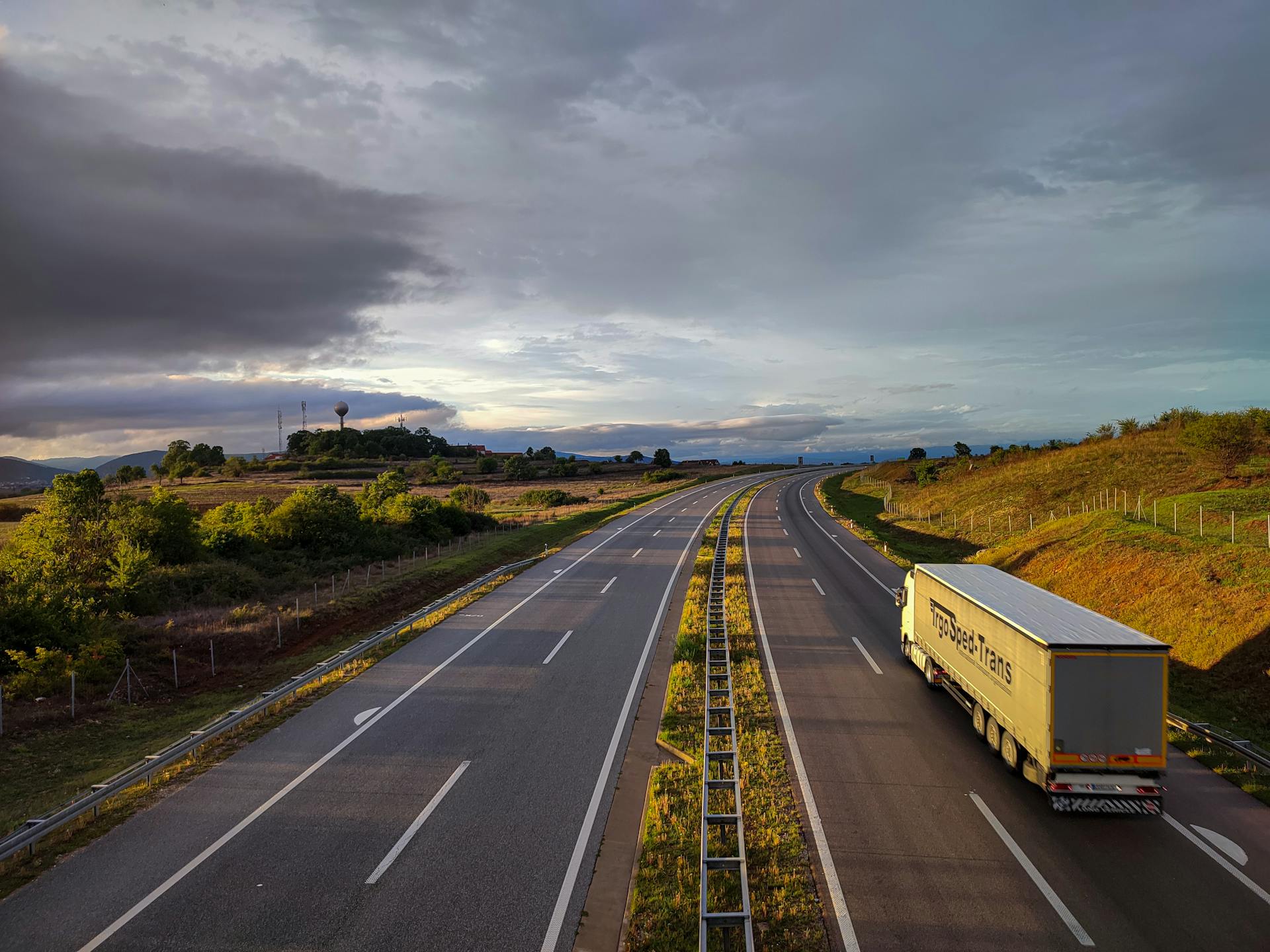
Vermont Truck Dispatch | Ben & Jerry's Reefer & Maple Syrup
We dispatch trucks for Vermont's Ben & Jerry's/Cabot Creamery dairy reefer freight and its #1-in-the-nation maple syrup. We also serve freight at the I-89/I-91 Canadian border crossings into Quebec.
How much do truck dispatch rates run in Vermont?
Vermont-origin freight currently pays about $2.35-$2.80/mi for dry van, more for reefer and flatbed. Demand is driven by Dairy & Specialty Food, Maple Syrup & Artisan Products and Semiconductor Manufacturing. Grow Trucking dispatches Vermont owner-operators and small fleets across 15 tracked lanes on a transparent percentage-of-gross fee, disclosed upfront.
- Tracked lanes
- 15
- Major freight hubs
- Burlington, South Burlington and Rutland
- Top industries
- Dairy & Specialty Food and Maple Syrup & Artisan Products
Vermont rate and market data reviewed September 2026. See our dispatch fee structure.
Vermont Truck Dispatch Services
Vermont's freight market is small, but it is different from most. The state has more dairy cows per person than any other. That means steady refrigerated milk and cheese freight. It comes from Cabot Creamery, Jasper Hill Farm, and 600+ dairy farms that need feed and supplies. Ben & Jerry's (Unilever) in Waterbury is the state's largest branded food maker. Its ice cream ships nationwide by reefer. Vermont makes over half of U.S. maple syrup. That was 3.1 million gallons in 2024, worth $95 million at the farm. Sugaring season (Feb-Apr) brings outbound reefer and dry van freight. Bulk barrels, bottled syrup, and maple candy all ship nationwide. The I-89 corridor runs from Burlington to the Canadian border at Highgate Springs. I-91 runs to Derby Line/Rock Island. These are the main routes between New England and Montreal. Montreal is the second-largest French-speaking city in the world. Burlington sits on Lake Champlain, 30 miles from the border. It is a natural place to stage cross-border loads and clear customs. GlobalFoundries runs a computer chip plant here, which adds high-value tech freight. Marble and granite quarries around Rutland add flatbed work.
Vermont is a small freight market with its own flavor. It is built on Ben & Jerry's/Cabot Creamery dairy reefer freight, #1-in-the-nation maple syrup, and Canadian cross-border trade through Burlington. Reefer and specialty tanker demand is strong.
Vermont's dairy freight (Ben & Jerry's, Cabot Creamery) is branded reefer freight that ships nationwide. Few states this small have that
Vermont's #1-in-the-nation maple syrup creates its own niche of high-value packaged goods
Burlington sits on Lake Champlain, 30 miles from Canada. It is a natural place to stage cross-border loads and clear customs
GlobalFoundries' computer chip plant adds high-value tech freight that most small rural states don't have
What is the Vermont freight market like?
As of early 2026, Vermont's unemployment rate is 2.6%. That is a tight job market. Vermont carriers keep reporting trouble filling driver jobs. The state has roughly 4,000 heavy and tractor-trailer drivers. They haul dairy, maple syrup, resort supplies, lumber, fuel, and interstate freight.
Average Rates
Vermont-origin rates (mid-2026): dry van roughly $2.35-$2.80/mile. Reefer $2.60-$3.05/mile (Ben & Jerry's ice cream, Cabot cheese, and dairy; almost all of Vermont's exports need temperature control). Tanker rates for raw milk and maple sap during sugaring season. Flatbed $2.50-$2.95/mile (Vermont granite/marble, lumber, ski resort building materials).
Market Trends
- •
Vermont made 3.1 million gallons of maple syrup in 2024 (53% of all U.S. syrup). Its farm value was $95 million. That creates a sharp freight spike each spring during sugaring season (Feb-Apr)
- •
Ben & Jerry's Waterbury plant is still Vermont's largest branded food maker. It creates year-round reefer ice cream freight that ships nationwide
- •
Logging and forest trucking in Vermont supported roughly 800 direct jobs in 2024. It also added $140 million in economic output. The industry has a workforce problem as older operators retire
- •
Montreal-to-Boston freight often runs through Vermont on I-89/I-91. That makes the Derby Line/Rock Island and Highgate Springs crossings real business gateways, not just tourist routes
- •
GlobalFoundries' Vermont computer chip plant adds high-value tech freight. Few small rural states have that
What are the busiest freight lanes out of Vermont?
Price these lanes with our free Trip Pre-Cost Calculator, Should I Take This Load? Calculator and Lane Profitability Analyzer.
Burlington to Boston
Freight route connecting Burlington, VT to Boston, MA (215 miles). Connects Burlington to the Northeast's largest consumer market via I-93/I-89.
Rate: $538 - $634
Distance: 215 miles
Burlington to Montreal
Freight route from Burlington, VT to Montreal, QC (105 miles). Cross-border freight runs on I-89 to Quebec's main distribution hub. Montreal is the second-largest French-speaking city in the world.
Rate: $252 - $299
Distance: 105 miles
Burlington to Albany
Freight route connecting Burlington, VT to Albany, NY (145 miles). Connects Burlington to Upstate New York via I-87/US-7.
Rate: $362 - $428
Distance: 145 miles
Burlington to Manchester
Freight route connecting Burlington, VT to Manchester, NH (145 miles). Connects Burlington to New Hampshire's tax-free retail corridor via I-89/I-93.
Rate: $362 - $428
Distance: 145 miles
Burlington to Portland
Freight route connecting Burlington, VT to Portland, ME (190 miles). Connects Burlington to Maine's seafood/manufacturing base via US-2.
Rate: $466 - $551
Distance: 190 miles
Burlington to Hartford
Freight route connecting Burlington, VT to Hartford, CT (235 miles). Connects Burlington to Connecticut's aerospace/insurance corridor via I-91.
Rate: $576 - $682
Distance: 235 miles
Burlington to New York
Freight route connecting Burlington, VT to New York, NY (320 miles). The Northeast's largest consumer market, reached via I-87/I-91.
Rate: $768 - $912
Distance: 320 miles
Burlington to Rutland
Freight route connecting Burlington, VT to Rutland, VT (65 miles). Connects Burlington to western Vermont's marble/granite quarry freight base via US-7.
Rate: $179 - $208
Distance: 65 miles
Burlington to Springfield
Freight route connecting Burlington, VT to Springfield, MA (205 miles). Connects Burlington to Western Massachusetts's distribution hub via I-91.
Rate: $502 - $594
Distance: 205 miles
Burlington to Sherbrooke
Freight route connecting Burlington, VT to Sherbrooke, QC (140 miles). Cross-border freight via I-91 to Derby Line/Rock Island into Quebec.
Rate: $329 - $392
Distance: 140 miles
Burlington to Concord
Freight route connecting Burlington, VT to Concord, NH (152 miles). Connects Burlington to New Hampshire's capital via I-89.
Rate: $380 - $448
Distance: 152 miles
Burlington to Waterbury
Freight route from Burlington, VT to Waterbury, VT (25 miles). It is a very short in-state corridor that serves the Ben & Jerry's Waterbury plant.
Rate: $71 - $82
Distance: 25 miles
Burlington to Philadelphia
Freight route connecting Burlington, VT to Philadelphia, PA (400 miles). Philadelphia's pharma corridor and port connect via I-87/I-95.
Rate: $920 - $1,100
Distance: 400 miles
Burlington to Providence
Freight route connecting Burlington, VT to Providence, RI (260 miles). Connects Burlington to Rhode Island via I-93/I-95.
Rate: $624 - $741
Distance: 260 miles
Burlington to Plattsburgh
Freight route connecting Burlington, VT to Plattsburgh, NY (25 miles). Very short cross-lake corridor connecting Burlington to New York's North Country via US-2/I-87.
Rate: $71 - $82
Distance: 25 miles
Search brokers & carriers in Vermont
Browse active freight brokers and for-hire carriers based in Vermont. The list comes live from FMCSA and updates weekly. Check bond, authority, and fleet size before you haul.
Freight Brokers
Active, FMCSA-bonded freight brokers based in Vermont.
Browse directoryDry Van Carriers
For-hire dry van carriers operating out of Vermont.
Browse directoryFlatbed Carriers
For-hire flatbed carriers operating out of Vermont.
Browse directoryReefer Carriers
For-hire reefer carriers operating out of Vermont.
Browse directoryTruck Parking
Official NHS rest stops and truck parking capacity across Vermont.
Browse directoryWhich industries drive freight demand in Vermont?
Dairy & Specialty Food (Cabot Creamery, Jasper Hill Farm, Ben & Jerry's/Unilever in Waterbury)
Maple Syrup & Artisan Products (53% of U.S. supply)
Semiconductor Manufacturing (GlobalFoundries)
Tourism (ski resorts at Stowe, Killington, Sugarbush, and Jay Peak; fall foliage)
Forest Products & Lumber
Marble & Granite Quarrying (Rutland)
How does Vermont freight change by season?
Rates and weather change with the seasons. Here is a quarter-by-quarter look at rates, weather, and what to do in Vermont.
Q1 (Jan-Mar)
Rate Movement
Rates hold steady, then jump as sugaring season (Feb-Mar) begins
Weather Impact
Severe winter weather is a serious statewide risk
Strategy
Get trucks ready for the coming maple sugaring season freight spike
Q2 (Apr-Jun)
Rate Movement
Rates stay high through the end of sugaring season into April
Weather Impact
Improving as spring arrives, though mud season can affect rural roads
Strategy
Put maple syrup freight first until sugaring season ends
Q3 (Jul-Sep)
Rate Movement
Rates hold steady on dairy freight while tourism-season demand builds
Weather Impact
Generally favorable statewide
Strategy
Focus on Ben & Jerry's/Cabot dairy freight and get ready for fall foliage season
Q4 (Oct-Dec)
Rate Movement
Rates rise with fall foliage tourism (Sep-Oct) and the start of ski season in December
Weather Impact
Winter weather starts hitting the state hard by November
Strategy
Book trucks early. Foliage season leads into ski season, so demand stays high through year-end
Additional Seasonal Considerations
- •
Maple sugaring season (Feb-Apr) brings a sharp freight spike as sap and finished syrup move to market
- •
Ski season (Dec-Mar) and fall foliage season (Sep-Oct) bring steady jumps in tourism freight
- •
Winter weather is a serious problem across the whole state from Nov-Apr
- •
Ben & Jerry's/Cabot dairy freight runs steady all year, mostly no matter the season
Where are the major freight hubs in Vermont?
The ports, inland ports, intermodal terminals, and distribution cities that move freight across Vermont. See where most of the freight is.
Distribution Cities
- Burlington
- South Burlington
- Rutland
- Montpelier
- Barre
Ports & Intermodal Terminals
Burlington International Airport Cargo
Serves Vermont's largest metro area, with air cargo room for time-sensitive freight.
Highgate Springs Border Crossing (I-89)
A main Vermont-Quebec crossing. It connects to Quebec Autoroute 15 toward Montreal.
Derby Line/Rock Island Border Crossing (I-91)
A main Vermont-Quebec crossing. It connects to Quebec Autoroute 55.
Where can trucks park and fuel in Vermont?
Truck parking and fuel info to help you plan your routes through Vermont.
Estimate fuel, tolls, and fuel tax with our free Fuel Cost Calculator, IFTA Tax Calculator and Toll Cost Estimator with Route Comparison.
Major Truck Stops
TA Travel Center - Brattleboro (I-91, Exit 1)
📍 967 Putney Rd, Brattleboro, VT 05301
110 truck parking spaces ($15/day with fuel), restaurant, showers, WiFi, CAT scale. Southern Vermont staging near Massachusetts border.
Petro Stopping Center - White River Junction (I-89/I-91)
📍 5 Bessey Dr, White River Junction, VT 05001
95 truck parking spaces ($12/day with fuel), Iron Skillet restaurant, showers, laundry. Key junction for north-south I-91 and east-west I-89 freight.
Irving - Waterbury (I-89, Exit 10)
📍 866 Waterbury-Stowe Rd, Waterbury, VT 05676
40 truck parking spaces (free overnight), diesel, convenience store, basic services. Central Vermont staging for Ben & Jerry's and Green Mountain Coffee freight.
Maplefields - Montpelier area
📍 2063 US-2, Montpelier, VT 05602
25 truck parking spaces (free, limited), diesel, convenience store. State capital area staging.
Shell - Rutland (US-7)
📍 303 N Main St, Rutland, VT 05701
30 truck parking spaces (free overnight), diesel, convenience store. Western Vermont route serving marble quarries and factories.
Irving - St. Johnsbury (I-91, Exit 21)
📍 650 Memorial Dr, St. Johnsbury, VT 05819
35 truck parking spaces (free), diesel, convenience store. Northeastern Vermont near New Hampshire border.
Mobil - Burlington area
📍 1214 Williston Rd, South Burlington, VT 05403
20 truck parking spaces (free, limited), diesel, convenience store. Burlington metro area, Vermont's largest city.
Sunoco - Bennington (US-7)
📍 194 Northside Dr, Bennington, VT 05201
18 truck parking spaces (free), diesel, convenience store. Southern Vermont near New York border.
Parking Difficulty
Low to Moderate. Vermont is rural and freight volume is low, so parking is usually open all year. The two big stops (TA Brattleboro and Petro White River Junction) handle most through-traffic. They fill by evening in peak foliage season (Sep-Oct), when tourism traffic rises. The Burlington area has limited truck parking. Winter weather (Nov-Apr) cuts parking when mountain passes close. Maple syrup season (Feb-Apr) adds local truck traffic but rarely hurts parking.
- •Plan ahead for parking in metro areas
- •Use rest areas as a backup
- •Use parking apps to find available spots
Strategic Positioning Advice
Park where you can find loads fast and cut deadhead miles:
- •
Major Distribution Centers: Position near major distribution hubs in Burlington for quick access to outbound loads.
- •
Busy Freight Routes: Stay near busy freight corridors to catch backhaul loads.
- •
Timing: Arrive when booking is busiest (usually early morning) to get the best rates.
Fuel price trend
How has the diesel price changed in Vermont?
EIA does not publish a separate diesel price for Vermont, so this is the weekly average for the New England region that Vermont is part of, over the last 12 months.
- Price this week
- $6.47/gal
- Since last week
- Up 3 cents
- Versus a year ago
- Up 64%
- Versus the U.S. average
- 19 cents above
Week of October 19, 2026
+$2.53 a gallon
U.S. average $6.28
Source: U.S. Energy Information Administration weekly retail on-highway diesel prices. Averages, not the price at one pump.
What are Vermont's truck weight limits and regulations?
Weight limits, permits, and emission rules. Know these rules to stay legal. Also see what to expect at a DOT roadside inspection, the federal size and weight limits, and the full federal trucking regulations reference.
Check weights and permits with our free Scale / Weigh Station Guide, Weight & Axle Load Calculator and Oversize / Overweight Permit Estimator.
Weight Limits
Federal limits on the Interstate System (23 CFR 658.17):
- Single Axle: 20,000 lbs
- Tandem Axle: 34,000 lbs
- Gross Vehicle Weight: 80,000 lbs, or less where the bridge formula sets a lower total
Other highways follow Vermont law, and some states allow more on non-Interstate roads. Check with the state's size and weight office before you load.
Size Limits
Width is a federal limit. Height and trailer length depend on the state:
- Width: 8.5 feet (102 inches) on the National Network (23 CFR 658.15)
- Height: Set by each state. There is no federal height limit, and FHWA says most states are between 13 ft 6 in and 14 ft. Check Vermont's limit for your route.
- Length: 53 ft semitrailers are common, but a state can apply its own kingpin-to-rear-axle rule
State-Specific Rules
- •
Vermont State Police and VTrans work together on truck safety rules. They check trucks at weigh stations and with roving patrols
- •
Federal weight limits on the Interstate System: 80,000 lbs gross vehicle weight, 20,000 lbs single axle, 34,000 lbs tandem axle. Other highways follow state law, so check the state's size and weight office
- •
Size limits: 8.5 ft (102 in) width. Legal height is set by each state, and FHWA says most are 13 ft 6 in to 14 ft, so check the state's size and weight office. A 53 ft semitrailer is common, but state kingpin-to-rear-axle rules apply
- •
Oversize/overweight permits issued through VTrans
- •
Cross-border freight through Derby Line/Rock Island, Highgate Springs, or Norton/Woburn needs standard customs papers. A FAST card speeds up processing for carriers who cross often
- •
Vermont's diesel fuel tax is about $0.32/gallon (check the current rate with the Vermont Department of Motor Vehicles)
Permits
Vermont may require special permits for:
- •Oversized/overweight loads
- •Hazardous materials
- •Special route rules
Vermont: freight facts a driver should know
Vermont won't issue big-load permits on weekends or holidays
Vermont won't issue a permit for any load over 108,000 pounds, wider than 12 feet, or longer than 100 feet to travel on a Saturday, Sunday, or legal holiday. Plan heavy or oversize Vermont runs for weekdays.
Source: Vermont Department of Motor Vehicles, oversize/overweight permits. Checked 30 Sep 2026.
Special permits can push divisible loads to 150,000 pounds
Vermont will consider special permits for loads up to 150,000 pounds gross, as long as the weight is spread at no more than 20,000 pounds per axle on dual wheels, or 12,000 pounds per axle on single wheels.
Source: Code of Vermont Rules 14-019 (14-050-019-X). Checked 30 Sep 2026.
Current truck wait times at Vermont's border crossings
| Crossing | Status | Commercial lane delay | Lanes open |
|---|---|---|---|
| Derby Line I-91 | Open | 0 min | 1 |
| Norton | Open | 0 min | 1 |
Source: U.S. Customs and Border Protection, Border Wait Times. CBP updates this roughly hourly; refreshes with this page.
How have Vermont freight rates moved, and what's next?
How Vermont freight rates have moved through recent market cycles, and what owner-operators and fleets should expect next. Use this to time lane commitments and rate negotiations. Before you accept a load, check it against our free rate benchmarker.
Recent Rate Cycles
Rate cycles that shaped the current Vermont freight market:
2018-2019
Strong market. Rates hit their peak because trucks were in short supply
2020
Rates swung at first because of the pandemic. Freight demand then bounced back hard
2021-2022
Record-high rates. E-commerce demand surged and trucks were in short supply
2023-2024
Rates fell sharply as truck supply passed demand. Smaller carriers left the market
2025-2026
The national market is recovering. Vermont's dairy and maple syrup freight, plus steady Montreal-Boston through-freight, have kept demand steady in this small state
Market Correction Periods
Knowing when corrections hit Vermont helps with strategic planning:
- •
Q1 2023: Rates fell hard as trucks were added faster than freight grew
- •
Mid-2024: The market is settling, with supply and demand more in balance
- •
Pattern: Rate drops usually last 6–12 months before rates recover
Vermont Market Outlook
As of mid-2026, Vermont's freight market is still small but distinct. It rests on dairy and maple syrup and on Montreal-Boston cross-border through-freight. Unemployment is a tight 2.6%, so Vermont-based carriers have real trouble hiring drivers.
What Drives Rates in Vermont
- •Freight volume and demand (dairy, maple syrup, tourism, computer chip plants)
- •Truck supply, which tightened a lot from last year across the nation and even more in Vermont's tight job market
- •Fuel costs and Vermont's diesel fuel tax (~$0.32/gallon)
- •When maple sugaring season starts, and how much Montreal-Boston cross-border freight is moving
How do I cut deadhead miles running freight in Vermont?
How to cut empty miles when you haul in and out of Vermont. See the outbound and inbound freight balance, the best return lanes, and where to park your truck. Run your own numbers with our free deadhead miles calculator.
Outbound Freight
55%
Roughly 55% of Vermont freight moves outbound. Outbound loads from Vermont's production and distribution centers typically book fastest early in the week.
Inbound Freight
45%
About 45% of the freight balance is inbound. Book your return load before you deliver. It is the biggest way to raise your rate-per-mile on these lanes.
Best Backhaul Lanes into Vermont
The strongest return lanes for repositioning back toward Vermont:
Montreal to Burlington
Cross-border route on I-89 to Quebec's main distribution hub
Rate: $2.30 - $2.75/mile
Boston to Burlington
I-93/I-89 corridor that links Vermont to the region's biggest consumer market
Rate: $2.45 - $2.90/mile
Albany to Burlington
I-87/I-89 corridor connecting Vermont to Upstate New York
Rate: $2.40 - $2.85/mile
Positioning Strategies for Vermont
Where and when to stage to keep your next load close and your deadhead low:
- •
Park near Burlington's I-89 corridor for the fastest access to Canadian cross-border freight and southern New England
- •
Watch the timing of maple sugaring season (Feb-Apr) if you haul syrup on reefer or dry van
- •
Use load boards to book backhaul before long cross-country hauls. Vermont's in-state freight volume is small
What do experienced dispatchers know about running Vermont?
Hands-on tips from years of dispatching in Vermont.
Vermont's dairy industry (Cabot Cheese, Ben & Jerry's) creates steady reefer freight to East Coast markets. Build relationships with these food processors for steady work.
Maple syrup season (Feb-Apr) creates seasonal bulk freight. Vermont makes 50% of U.S. maple syrup.
Green Mountain Coffee Roasters (Keurig) in Waterbury supplies large dry van freight all year.
Burlington's location and Montreal cross-border freight bring strong midweek rates. This happens when tourism (May-Oct) and Canadian trade line up with weekly shipper schedules.
Vermont is mountainous, so I-89 and I-91 often close in winter (Nov-Apr). Build in real time buffers and carry chains.
Tourism season (summer and fall foliage Sep-Oct) brings more consumer freight to ski resorts and hotels. It also clogs I-89/I-91.
Marble quarries in the Rutland area create flatbed freight for building materials. It is a niche that most carriers overlook.
Vermont's craft beer and spirits makers (Long Trail, Alchemist, WhistlePig) create small-volume specialty freight at premium rates.
Burlington is Vermont's largest metro and main distribution hub. Park here for the fastest access to Canadian border freight on I-89.
The White River Junction I-89/I-91 interchange is your strategic staging point. Equal access to Boston, Montreal, and Albany markets.
Remember: These tips come from real dispatching work in Vermont. Markets change, but these basics still help you earn more and cut deadhead miles.
How have drivers near Vermont grown with Grow Trucking?
Vermont Freight FAQs
Comprehensive answers to common questions about trucking and dispatch in Vermont. State-specific regulations, costs, and operating strategies.
Yes. You need a USDOT number, an MC number for interstate for-hire hauling, and Vermont IRP/IFTA registration through the Vermont DMV.
Federal minimum liability coverage usually runs $750,000-$1,000,000, based on cargo type. You also need cargo and physical damage coverage. Check current minimums with your insurance provider.
As of mid-2026, reefer freight from dairy plants (Cabot, Ben & Jerry's) pays $2.50-$2.90/mile. Dry van from Green Mountain Coffee pays $2.40-$2.80/mile. Flatbed from marble quarries pays $2.45-$2.85/mile.
Yes, if you specialize in food freight or can handle winter driving. Vermont has less freight, so there is less competition. New operators must be ready for severe winter weather (Nov-Apr). Plan multi-state routes into Massachusetts, New York, or New Hampshire.
Vermont diesel fuel tax is about $0.31 per gallon as of 2026. Add the federal tax ($0.244/gallon) and the total is about $0.554 per gallon. Retail diesel in the New England region, which includes Vermont, averages $6.47/gallon as of October 19, 2026 (EIA weekly average), about 19 cents above the national average of $6.28. That price is up 3 cents from last week and 64% above a year ago. Vermont is in the Northeast, and winter driving (November-March) is severe. Mountain routes and weight limits on some bridges and roads add to it. Freight volume is low because the population is small. The Burlington area is the regional hub. I-89 and I-91 are the main corridors. Seasonal tourism changes traffic patterns. Winter prep and mountain driving skills are key in Vermont. Source: IFTA matrix, Vermont Department of Taxes, AAA, verified September 2026.
Vermont's winter (Nov-Apr) is severe with mountain pass closures, ice storms, and heavy snow. Tire chains are mandatory in certain conditions. Always check Vermont 511 road conditions before departure. I-89 through the Green Mountains and I-91 along the Connecticut River both experience frequent closures. Build 4-6 hour schedule buffers for winter hauls. Many carriers avoid Vermont entirely Dec-Mar.
Maple syrup season (Feb-Apr) drives bulk freight of syrup and processing equipment. Summer tourism (Jun-Aug) brings more consumer goods to resorts. Fall foliage (Sep-Oct) is the peak for tourism freight. Dairy processing and Green Mountain Coffee run steady all year. Ski resort freight peaks Nov-Mar.
Winter driving in Vermont takes tire chains (required by law in some conditions), extra heaters, and winter emergency supplies. Mountain grades on I-89 call for good brake upkeep. Reefer units must be rated for extreme cold (below -20°F). Many loads have several pickup and delivery stops at small facilities. Be flexible and patient.
Boston to White River Junction (I-93/I-89, $2.55-$2.95/mile) connects Vermont to major Northeast market. Albany to Burlington (I-87/US-7, $2.50-$2.90/mile) serves western Vermont. Montreal to Burlington (I-89, $2.60-$3.00/mile) crosses Canadian border. Hartford to Brattleboro (I-91, $2.50-$2.90/mile) serves southern Vermont. Pre-book backhaul given low freight density.
Vermont has low freight volume, so parking is usually open without a reservation. The exception is peak foliage season (late Sep-early Oct), when TA Brattleboro and Petro White River Junction fill by evening. Winter storm closures sometimes pack trucks into the stops that are open. Weekend parking during ski season can be tight near Burlington. Check weather forecasts all year.
Keep exploring dispatch options
Tools, equipment guides and nearby states relevant to running freight in and out of Vermont.
By equipment
Free tools
- Trip Pre-Cost Calculator
- Toll Cost Estimator with Route Comparison
- Load Board Rate Benchmarker
- Deadhead Miles Calculator
- Fuel Cost Calculator
- IFTA Tax Calculator
- Scale / Weigh Station Guide
- Cost Per Mile Calculator
- Diesel prices today
- Diesel tax by state
- Truck idling laws by state
- Truck speed limits by state
- Truck chain laws by state
- Truck lane laws by state
- Truck height and length limits by state
- Rest area parking limits by state
- New England diesel prices
- Fuel Surcharge Calculator
- Revenue Per Mile Tracker
- All Free Tools
Nearby states
Services
More from Grow Trucking
Ready to Move Freight in Vermont?
Secure Your Strategy:
Apply for your FREE Custom 90-Day Growth Plan (a $1,500 value). It starts with a Business Audit that finds where you lose money and sets your profit goals.
Guarantee Your GROWTH:
Start your 90-day partnership to implement the plan. We back it with our "Growth or Your Money Back" Guarantee.