
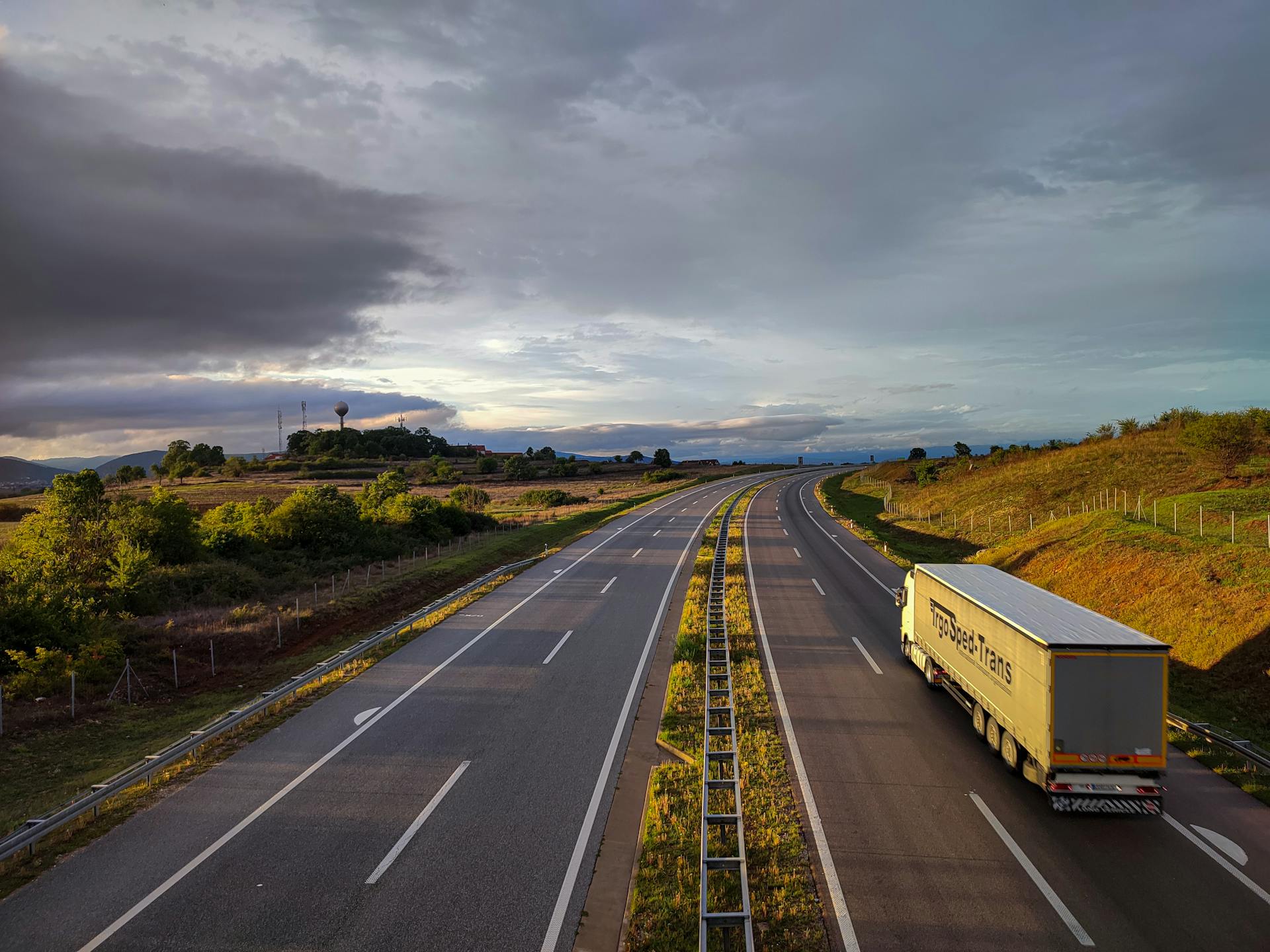
Washington Truck Dispatch | Puget Sound Ports & Boeing Aerospace
We dispatch trucks for the Ports of Seattle and Tacoma (the Northwest Seaport Alliance). We also serve Boeing's Everett aerospace plant and the Yakima Valley's huge apple and produce reefer base.
How much do truck dispatch rates run in Washington?
Washington-origin freight currently pays about $2.20-$2.65/mi for dry van, more for reefer and flatbed. Demand is driven by Port & Container Logistics, Aerospace Manufacturing and Agriculture. Grow Trucking dispatches Washington owner-operators and small fleets across 15 tracked lanes on a transparent percentage-of-gross fee, disclosed upfront.
- Tracked lanes
- 15
- Major freight hubs
- Seattle, Tacoma and Spokane
- Top industries
- Port & Container Logistics and Aerospace Manufacturing
Washington rate and market data reviewed September 2026. See our dispatch fee structure.
Washington Truck Dispatch Services
Washington State is the Pacific Northwest's freight powerhouse. The Ports of Seattle and Tacoma run jointly as the Northwest Seaport Alliance. Together they are a top container port complex in the U.S. by volume. They handle mostly Asia-Pacific trade for retailers across the Midwest and Northwest. Rail from the Northwest adds little time versus LA/Long Beach, and it avoids Southern California congestion. Boeing's Everett factory is the largest building in the world by volume. It builds 747, 767, 777, and 787 widebody aircraft. It needs a constant flow of fuselage sections, wings, and parts from suppliers nationwide. Eastern Washington is a very different freight market. The Yakima Valley grows roughly 75% of all U.S. apples, plus cherries, hops (75% of U.S. supply), and wine grapes. That creates huge reefer volumes moving to distribution centers nationwide. The Amazon (Bellevue) and Microsoft (Redmond) headquarters add large tech-sector logistics demand.
Washington offers freight chances in three areas. They are the Northwest Seaport Alliance's big container volume, Boeing's unique oversize aerospace freight, and the Yakima Valley's large produce reefer base. Demand is strong for drayage, oversize, and reefer loads.
The Northwest Seaport Alliance is one of the largest container port complexes in the U.S. It has a real rail-time edge over LA/Long Beach for Midwest-bound freight
Boeing's Everett factory creates steady, high-value oversize freight that few carriers can handle. That is a real edge for those who can
The Yakima Valley's farm output (75% of U.S. apples, 75% of U.S. hops) gives you huge, high-value reefer freight volume
A mixed economy (port, aerospace, tech, agriculture, timber) means less reliance on any one industry
What is the Washington freight market like?
As of early 2026, container volume through the Northwest Seaport Alliance was down 13.9% year-over-year in January. That is because 2025's tariff-driven frontloading faded. Exports held up, with farm products and breakbulk cargo surging. The Alliance recently finished a modern gate complex at Terminal 5. It doubled truck queuing capacity and grew refrigerated plug capacity to over 1,500. That supports Washington's booming farm exports.
Average Rates
Washington-origin rates (mid-2026): dry van runs roughly $2.20-$2.65/mile (Seattle/Tacoma port drayage, tech-sector distribution). Reefer runs $2.60-$3.10/mile (Yakima Valley apples, cherries, and hops, among the highest-value reefer freight in the country). Flatbed/specialized runs $2.70-$3.50/mile+ for Boeing oversize aerospace parts that need specialized equipment.
Market Trends
- •
The Northwest Seaport Alliance's Terminal 5 gate complex upgrade doubled truck queuing capacity. It uses RFID technology to move trucks faster
- •
Refrigerated plug capacity at Terminal 5 grew to over 1,500 to support Washington's booming farm export volume
- •
Container volume was down 13.9% year-over-year in January 2026 as 2025's tariff-driven frontloading faded. Farm exports and breakbulk cargo have held up and surged
- •
Seattle is now a global leader in maritime sustainability. All three cruise berths have plug-in shore power as of 2026
- •
Boeing's continued 737, 767, 777, and 787 production at Everett creates constant, specialized oversize freight demand from suppliers nationwide
What are the busiest freight lanes out of Washington?
Price these lanes with our free Trip Pre-Cost Calculator, Should I Take This Load? Calculator and Lane Profitability Analyzer.
Seattle to Portland
Freight route connecting Seattle, WA to Portland, OR (175 miles). A short, high-frequency I-5 corridor connecting two major Pacific Northwest port/freight markets.
Rate: $446 - $516
Distance: 175 miles
Seattle to Spokane
Freight route connecting Seattle, WA to Spokane, WA (280 miles). Connects Seattle's port complex to Eastern Washington via I-90, crossing Snoqualmie Pass.
Rate: $686 - $798
Distance: 280 miles
Seattle to Sacramento
Freight route connecting Seattle, WA to Sacramento, CA (715 miles). Connects Seattle to Northern California's growing distribution market via I-5.
Rate: $1,573 - $1,859
Distance: 715 miles
Seattle to Los Angeles
Freight route connecting Seattle, WA to Los Angeles, CA (1135 miles). Connects Seattle's port complex to Southern California's massive consumer market via I-5.
Rate: $2,384 - $2,838
Distance: 1135 miles
Seattle to Boise
Freight route connecting Seattle, WA to Boise, ID (495 miles). Connects Seattle to Idaho's agricultural/distribution base via I-84.
Rate: $1,163 - $1,361
Distance: 495 miles
Seattle to Denver
Freight route connecting Seattle, WA to Denver, CO (1315 miles). Denver's Mountain West distribution hub rounds out Seattle's eastbound reach via I-90.
Rate: $2,696 - $3,222
Distance: 1315 miles
Seattle to Chicago
Freight route connecting Seattle, WA to Chicago, IL (2050 miles). Chicago's intermodal hub status extends Seattle's Midwest reach via I-90.
Rate: $3,895 - $4,715
Distance: 2050 miles
Seattle to Salt Lake City
Freight route connecting Seattle, WA to Salt Lake City, UT (840 miles). Connects Seattle to Utah's distribution corridor via I-84/I-15.
Rate: $1,806 - $2,142
Distance: 840 miles
Seattle to Yakima
Freight route connecting Seattle, WA to Yakima, WA (145 miles). Connects Seattle's port complex to the Yakima Valley's massive apple/cherry/hops reefer freight base.
Rate: $399 - $464
Distance: 145 miles
Seattle to Vancouver
Freight route connecting Seattle, WA to Vancouver, BC (140 miles). Cross-border freight connecting Seattle's port complex to Canadian markets.
Rate: $343 - $399
Distance: 140 miles
Seattle to Everett
Freight route connecting Seattle, WA to Everett, WA (30 miles). Extremely short corridor serving Boeing's Everett factory. The largest building in the world by volume.
Rate: $87 - $105
Distance: 30 miles
Seattle to Bellevue
Freight route connecting Seattle, WA to Bellevue, WA (12 miles). Extremely short corridor connecting Seattle's port complex to Amazon's Bellevue tech campus.
Rate: $34 - $40
Distance: 12 miles
Seattle to Reno
Freight route connecting Seattle, WA to Reno, NV (705 miles). Connects Seattle to Northern Nevada's growing distribution hub via I-5/US-95.
Rate: $1,551 - $1,833
Distance: 705 miles
Seattle to Minneapolis
Freight route connecting Seattle, WA to Minneapolis, MN (1660 miles). Minneapolis's Fortune 500 and food-processing base rounds out Seattle's eastbound reach via I-90.
Rate: $3,237 - $3,901
Distance: 1660 miles
Seattle to San Francisco
Freight route connecting Seattle, WA to San Francisco, CA (810 miles). Connects Seattle's port complex and tech sector to the Bay Area's tech/consumer market via I-5.
Rate: $1,742 - $2,066
Distance: 810 miles
Search brokers & carriers in Washington
Browse active freight brokers and for-hire carriers based in Washington. The list comes live from FMCSA and updates weekly. Check bond, authority, and fleet size before you haul.
Freight Brokers
Active, FMCSA-bonded freight brokers based in Washington.
Browse directoryDry Van Carriers
For-hire dry van carriers operating out of Washington.
Browse directoryFlatbed Carriers
For-hire flatbed carriers operating out of Washington.
Browse directoryReefer Carriers
For-hire reefer carriers operating out of Washington.
Browse directoryTruck Parking
Official NHS rest stops and truck parking capacity across Washington.
Browse directoryWhich industries drive freight demand in Washington?
Port & Container Logistics (Ports of Seattle/Tacoma - Northwest Seaport Alliance)
Aerospace Manufacturing (Boeing - Everett, largest building in the world by volume)
Agriculture (Yakima Valley - apples #1 US at 75% of supply, cherries #1, hops #1 at 75% of US supply)
Technology (Amazon - Bellevue, Microsoft - Redmond)
Timber & Forest Products (#2 U.S. timber production behind Oregon)
Seafood (Pacific salmon and other Puget Sound/coastal seafood)
How does Washington freight change by season?
Rates and weather change with the seasons. Here is a quarter-by-quarter look at rates, weather, and what to do in Washington.
Q1 (Jan-Mar)
Rate Movement
Rates can swing with tariff-driven container volume
Weather Impact
Snoqualmie Pass and other mountain crossings can see winter weather delays
Strategy
Monitor WSDOT mountain pass conditions. Watch port container volume trends closely given recent tariff-driven swings
Q2 (Apr-Jun)
Rate Movement
Rates get stronger as spring farm activity ramps up ahead of summer harvest
Weather Impact
Generally improving as mountain passes clear
Strategy
Prepare for the coming apple/cherry harvest season reefer surge
Q3 (Jul-Sep)
Rate Movement
Rates climb sharply as apple/cherry harvest season starts in the Yakima Valley
Weather Impact
Generally favorable statewide
Strategy
Focus on Yakima Valley reefer freight during peak harvest (Aug-Oct)
Q4 (Oct-Dec)
Rate Movement
Rates stay high as harvest freight winds down and holiday retail/port volume builds
Weather Impact
Winter weather starts hitting mountain passes by late November
Strategy
Book capacity early. Late-harvest and holiday freight overlap, so space gets tight
Additional Seasonal Considerations
- •
Apple/cherry harvest season (Aug-Oct) drives huge Yakima Valley reefer freight volume
- •
Winter weather can close Snoqualmie Pass (I-90) and other mountain crossings Nov-Mar
- •
Boeing production and specialized oversize freight run steady year-round, in any season
- •
Port container volume follows global trade and tariff-policy cycles more than fixed seasons
Where are the major freight hubs in Washington?
The ports, inland ports, intermodal terminals, and distribution cities that move freight across Washington. See where most of the freight is.
Distribution Cities
- Seattle
- Tacoma
- Spokane
- Bellevue
- Yakima
Ports & Intermodal Terminals
Northwest Seaport Alliance (Ports of Seattle/Tacoma)
One of the largest U.S. container port complexes. It recently upgraded with a doubled-capacity Terminal 5 gate complex and more refrigerated plug capacity.
Boeing Everett Factory
The largest building in the world by volume. It needs a constant flow of fuselage sections, wings, and parts.
Seattle-Tacoma International Airport (Sea-Tac) Cargo
A growing air cargo logistics hub near Boeing Field that supports high-value, time-sensitive freight.
Where can trucks park and fuel in Washington?
Truck parking and fuel info to help you plan your routes through Washington.
Estimate fuel, tolls, and fuel tax with our free Fuel Cost Calculator, IFTA Tax Calculator and Toll Cost Estimator with Route Comparison.
Major Truck Stops
TA Travel Center - Fife (I-5, Exit 137)
📍 1602 Alexander Ave E, Fife, WA 98424
300 truck parking spaces ($15/day with fuel), restaurant, showers, laundry, WiFi, CAT scale. Primary Tacoma port drayage staging.
Pilot Flying J - North Bend (I-90, Exit 31)
📍 420 SE North Bend Way, North Bend, WA 98045
200 truck parking spaces ($12/day with fuel), restaurant, showers, WiFi. Western side of Snoqualmie Pass, critical staging for I-90 mountain crossing.
Loves - Yakima (I-82, Exit 33)
📍 1704 S 1st St, Yakima, WA 98901
180 truck parking spaces ($12/day with fuel), restaurant, showers, WiFi, CAT scale. Central Yakima Valley apple/produce freight hub.
TA - Spokane Valley (I-90, Exit 291)
📍 3808 N Sullivan Rd, Spokane Valley, WA 99216
220 truck parking spaces ($15/day with fuel), restaurant, showers, laundry, WiFi. Eastern Washington freight hub, gateway to Idaho.
Pilot - Mount Vernon (I-5, Exit 227)
📍 1101 Riverside Dr, Mount Vernon, WA 98273
150 truck parking spaces ($10/day with fuel), restaurant, showers, WiFi. On the northern I-5 corridor, a staging spot for Canadian border crossings.
Pacific Pride - Everett (US-2)
📍 8015 Evergreen Way, Everett, WA 98203
100 truck parking spaces (free with fuel), 24/7 diesel, convenience store. Boeing Everett factory area staging for aerospace freight.
Chevron - Ellensburg (I-90, Exit 106)
📍 2100 Canyon Rd, Ellensburg, WA 98926
90 truck parking spaces (free), diesel, convenience store. Central Washington I-90 corridor between Seattle and Spokane.
Shell - Pasco (I-182/US-395)
📍 2100 N 4th Ave, Pasco, WA 99301
70 truck parking spaces (free), diesel, convenience store. A staging spot for Tri-Cities farm freight and Columbia Basin produce.
Parking Difficulty
Moderate to High. The Seattle/Tacoma port area sees high demand because of container drayage volume. TA Fife (300 spaces, $15/day) and Pacific Pride Everett (100 spaces) fill by 7-8 PM Monday-Thursday. The SODO district has very limited parking and strict enforcement. Pilot North Bend (200 spaces) on the west side of Snoqualmie Pass fills early during winter weather events. Yakima Valley stops fill during harvest season (Aug-Oct). Spokane and Eastern Washington have better availability. Weekend parking is a bit easier except near ports.
- •Plan ahead for parking in metro areas
- •Use rest areas as a backup
- •Use parking apps to find available spots
Strategic Positioning Advice
Park where you can find loads fast and cut deadhead miles:
- •
Major Distribution Centers: Position near major distribution hubs in Seattle for quick access to outbound loads.
- •
Busy Freight Routes: Stay near busy freight corridors to catch backhaul loads.
- •
Timing: Arrive when booking is busiest (usually early morning) to get the best rates.
Fuel price trend
How has the diesel price changed in Washington?
EIA does not publish a separate diesel price for Washington, so this is the weekly average for the West Coast region that Washington is part of, over the last 12 months.
- Price this week
- $7.39/gal
- Since last week
- Up 15 cents
- Versus a year ago
- Up 67%
- Versus the U.S. average
- $1.12 above
Week of October 19, 2026
+$2.97 a gallon
U.S. average $6.28
Source: U.S. Energy Information Administration weekly retail on-highway diesel prices. Averages, not the price at one pump.
What are Washington's truck weight limits and regulations?
Weight limits, permits, and emission rules. Know these rules to stay legal. Also see what to expect at a DOT roadside inspection, the federal size and weight limits, and the full federal trucking regulations reference.
Check weights and permits with our free Scale / Weigh Station Guide, Weight & Axle Load Calculator and Oversize / Overweight Permit Estimator.
Weight Limits
Federal limits on the Interstate System (23 CFR 658.17):
- Single Axle: 20,000 lbs
- Tandem Axle: 34,000 lbs
- Gross Vehicle Weight: 80,000 lbs, or less where the bridge formula sets a lower total
Other highways follow Washington law, and some states allow more on non-Interstate roads. Check with the state's size and weight office before you load.
Size Limits
Width is a federal limit. Height and trailer length depend on the state:
- Width: 8.5 feet (102 inches) on the National Network (23 CFR 658.15)
- Height: Set by each state. There is no federal height limit, and FHWA says most states are between 13 ft 6 in and 14 ft. Check Washington's limit for your route.
- Length: 53 ft semitrailers are common, but a state can apply its own kingpin-to-rear-axle rule
State-Specific Rules
- •
Washington State Patrol and WSDOT jointly enforce commercial vehicle safety at weigh stations and with roving patrols
- •
Federal weight limits on the Interstate System: 80,000 lbs gross vehicle weight, 20,000 lbs single axle, 34,000 lbs tandem axle. Other highways follow state law, so check the state's size and weight office
- •
Size limits: 8.5 ft (102 in) width. Legal height is set by each state, and FHWA says most are 13 ft 6 in to 14 ft, so check the state's size and weight office. A 53 ft semitrailer is common, but state kingpin-to-rear-axle rules apply
- •
WSDOT issues oversize/overweight permits. Boeing aerospace freight often needs specialized oversize permits and route planning
- •
Cross-border freight with Canada needs standard customs paperwork. A FAST card speeds up processing for regular cross-border carriers
- •
Washington's diesel fuel tax is about $0.494/gallon, among the higher state rates (verify the current rate with Washington DOR)
Permits
Washington may require special permits for:
- •Oversized/overweight loads
- •Hazardous materials
- •Special route rules
Washington: freight facts a driver should know
Washington's bridge table can allow over 100,000 pounds on a wide axle group
Washington caps single axles at 20,000 pounds and tandem axles at 34,000 pounds. For wider-spaced axle groups, the state runs its own bridge-formula table rather than one flat number, and it's more generous than the standard federal formula, allowing up to 105,500 pounds on a group spaced 86 feet or more apart.
Source: Revised Code of Washington §46.44.041. Checked 30 Sep 2026.
Two tandem sets 36 feet apart can each carry the full legal weight
If a combination runs two separate tandem axle sets spaced 36 feet or more apart, Washington law allows each set to carry the full 34,000 pounds on its own, rather than splitting one combined limit between them.
Source: Revised Code of Washington §46.44.041. Checked 30 Sep 2026.
Current truck wait times at Washington's border crossings
| Crossing | Status | Commercial lane delay | Lanes open |
|---|---|---|---|
| Pacific Highway | Open | 5 min | 1 |
| Sumas | Open | 0 min | 1 |
Source: U.S. Customs and Border Protection, Border Wait Times. CBP updates this roughly hourly; refreshes with this page.
This week's produce truck rates out of Washington
USDA tracks refrigerated truck rates and driver availability for Washington's produce-growing areas every week. These are real reported rates, not an estimate.
| Commodity | To | Rate | Trucks available |
|---|---|---|---|
| Apples | Philadelphia | $10,500–$14,500 | Slight Shortage |
| Apples | Seattle | $1,100–$1,800 | Slight Shortage |
| Apples | Los Angeles | $3,400–$4,200 | Slight Shortage |
| Apples | Miami | $12,500–$15,000 | Slight Shortage |
| Apples | New York | $11,300–$14,000 | Slight Shortage |
| Apples | Boston | $11,000–$16,000 | Slight Shortage |
Source: USDA Agricultural Marketing Service, National Truck Rate Report. Week of Oct 19, 2026.
How have Washington freight rates moved, and what's next?
How Washington freight rates have moved through recent market cycles, and what owner-operators and fleets should expect next. Use this to time lane commitments and rate negotiations. Before you accept a load, check it against our free rate benchmarker.
Recent Rate Cycles
Rate cycles that shaped the current Washington freight market:
2018-2019
Strong market. Rates hit their peak because trucks were in short supply
2020
Rates swung at first because of the pandemic. Freight demand then bounced back hard
2021-2022
Record-high rates. E-commerce demand surged and trucks were in short supply
2023-2024
Rates fell sharply as truck supply passed demand. Smaller carriers left the market
2025-2026
The national market is recovering. Washington container volume has swung with tariff policy. But farm exports and Boeing's specialized freight demand stay strong
Market Correction Periods
Knowing when corrections hit Washington helps with strategic planning:
- •
Q1 2023: Rates fell hard as trucks were added faster than freight grew
- •
Mid-2024: The market is settling, with supply and demand more in balance
- •
Pattern: Rate drops usually last 6–12 months before rates recover
Washington Market Outlook
As of mid-2026, Washington's freight market shows a real split. Container volume has swung with tariff-policy cycles (down 13.9% YoY in Jan 2026). Meanwhile farm exports, Boeing's aerospace freight, and the Northwest Seaport Alliance's new infrastructure (Terminal 5 upgrade) point to strong underlying demand.
What Drives Rates in Washington
- •Freight volume and demand (port containers, aerospace, agriculture/produce, technology)
- •Truck supply, which tightened a lot from last year across the nation
- •Fuel costs and Washington's diesel fuel tax (~$0.494/gallon)
- •Tariff-driven container volume swings and Yakima Valley harvest timing
How do I cut deadhead miles running freight in Washington?
How to cut empty miles when you haul in and out of Washington. See the outbound and inbound freight balance, the best return lanes, and where to park your truck. Run your own numbers with our free deadhead miles calculator.
Outbound Freight
50%
Roughly 50% of Washington freight moves outbound. Outbound loads from Washington's production and distribution centers typically book fastest early in the week.
Inbound Freight
50%
About 50% of the freight balance is inbound. Book your return load before you deliver. It is the biggest way to raise your rate-per-mile on these lanes.
Best Backhaul Lanes into Washington
The strongest return lanes for repositioning back toward Washington:
Portland to Seattle
A short I-5 corridor connecting two major Pacific Northwest freight markets
Rate: $2.55 - $2.95/mile
Spokane to Seattle
I-90 corridor connecting Eastern and Western Washington
Rate: $2.40 - $2.80/mile
Vancouver (BC) to Seattle
A cross-border corridor connecting two major Pacific Northwest port markets
Rate: $2.30 - $2.70/mile
Positioning Strategies for Washington
Where and when to stage to keep your next load close and your deadhead low:
- •
Position near the Seattle/Tacoma port complex for the fastest access to container drayage freight
- •
Track Yakima Valley harvest timing (Aug-Oct) if running reefer freight
- •
Use load boards to pre-book backhaul before longer cross-country hauls
What do experienced dispatchers know about running Washington?
Hands-on tips from years of dispatching in Washington.
Boeing's Everett factory creates specialized oversize freight that few carriers can handle. It's a real edge if you have the right trailers and permits.
The Northwest Seaport Alliance's recent Terminal 5 upgrade (doubled truck queuing capacity, RFID gate technology) has made drayage much more efficient. It's worth learning if you haven't run this port lately.
Yakima Valley's apple/cherry/hops freight is massive and high-value. 75% of U.S. apples and hops move through this corridor.
Seattle-Tacoma port drayage and Spokane farm freight create Tuesday morning rate peaks 10-15% above Friday. That happens when vessel arrivals and eastern Washington harvest cycles line up.
Container volume has swung with tariff policy shifts. Don't assume last year's port volume patterns hold. Check current NWSA data before you commit heavily to port drayage capacity.
Snoqualmie Pass on I-90 needs real winter-weather planning. Build schedule buffer for Eastern Washington freight Nov-Mar.
Seattle's SODO district (South of Downtown) near the Port of Seattle sees severe congestion at rush hours (7-9 AM, 4-7 PM). Schedule port pickups and deliveries for mid-day or evening.
The Amazon (Bellevue) and Microsoft (Redmond) headquarters create large tech-sector distribution freight with tight delivery windows. Carriers who steadily hit appointment times get first pick of loads.
Washington's diesel fuel tax is about $0.494/gallon, among the highest in the nation. Always factor this into rate negotiations and fuel planning.
Cross-border freight to Vancouver, BC via the Peace Arch (I-5) or Pacific Highway crossings can see 1-3 hour delays at peak times. Get a FAST card if you run this lane often.
Remember: These tips come from real dispatching work in Washington. Markets change, but these basics still help you earn more and cut deadhead miles.
How have drivers near Washington grown with Grow Trucking?
+$2,550/week after moving to $2.80/mi on oversize machinery / wind energy freight. Oversize machinery loads optimized for maximum revenue.
Read the case study+$2,010/week after moving to $2.62/mi on general freight / consumer goods freight. Language barriers removed, unfair lease terms renegotiated.
Read the case study+$1,950/week after moving to $2.70/mi on chemical / industrial hazmat freight. Hazmat premium rates recovered and CSA violations cleared.
Read the case studyWashington Freight FAQs
Comprehensive answers to common questions about trucking and dispatch in Washington. State-specific regulations, costs, and operating strategies.
Yes. You need a USDOT number and an MC number for interstate for-hire hauling. You also need Washington-specific IRP/IFTA registration through the Washington DOL. Port drayage needs TWIC cards for terminal access.
Federal minimum liability coverage usually runs $750,000-$1,000,000 depending on cargo type. You also need cargo and physical damage coverage. Boeing oversize freight and cross-border freight may need more coverage. Confirm with your insurance provider. Port drayage needs marine cargo insurance.
As of mid-2026, Boeing-adjacent specialized oversize freight pays the highest premiums (often $2.70-$3.50/mile and up, depending on equipment). Yakima Valley reefer freight runs $2.60-$3.10/mile during harvest season (Aug-Oct). Standard dry van and port drayage run $2.20-$2.65/mile. Apple/cherry freight at peak harvest can spike even higher.
Yes, especially if you specialize. The Northwest Seaport Alliance's container drayage and the Yakima Valley's harvest-season reefer freight give steady volume. Boeing's specialized oversize freight is a real niche with less competition for well-equipped carriers. The Seattle metro has steady freight year-round.
Washington diesel fuel tax is about $0.595 per gallon as of 2026, among the highest state rates in the nation. Add the federal tax ($0.244/gallon), and total diesel fuel tax is about $0.839 per gallon. Retail diesel in the West Coast region, which includes Washington, averages $7.39/gallon as of October 19, 2026 (EIA weekly average), about $1.12 above the national average of $6.28. That price is up 15 cents from last week and 67% above a year ago. Washington's West Coast location has major freight hubs. They are the Seattle/Tacoma ports (big Pacific Rim volume) and the I-5 corridor. It also has mountain/winter challenges (chain laws, Cascade passes) and emissions/environmental rules. Factor high fuel costs into your rate talks. Source: IFTA matrix, Washington Department of Licensing, AAA, verified September 2026.
The Ports of Seattle and Tacoma run jointly as the Northwest Seaport Alliance, one of the largest U.S. container port complexes. You need a TWIC card, a chassis for container drayage, and an advance appointment through the eModal reservation system. The recent Terminal 5 upgrade (doubled gate capacity, RFID technology) has improved efficiency. Seattle's SODO district congestion means you should schedule outside rush hours.
Apple/cherry harvest season (Aug-Oct) is Washington's biggest freight event. The Yakima Valley grows 75% of U.S. apples. The hops harvest (Aug-Sep) adds more reefer demand. Boeing aerospace production runs year-round. Port container volume follows tariff-policy and global trade cycles more than fixed seasons. Holiday retail (Nov-Dec) increases tech-sector distribution freight from Amazon/Microsoft.
Standard dry van/reefer/flatbed works for most Washington freight. Port drayage needs a chassis for container freight and TWIC cards. Boeing's specialized aerospace parts need extendable flatbeds, heavy-haul permits, and often specialized rigging. That is not standard flatbed work. Reefer units are key for Yakima Valley produce freight. Chains are mandatory for mountain pass crossings (Snoqualmie Pass, Stevens Pass) Nov-Mar.
Washington has several crossings into British Columbia: Peace Arch (I-5), Pacific Highway (truck crossing), and Sumas (WA-9). You need standard customs paperwork (commercial invoice, packing list, PARS/PAPS). You also need proper Canadian carrier authority if you operate in Canada, plus insurance coverage. FAST card enrollment speeds up clearance a lot for regular cross-border carriers. Border wait times range from 30 minutes to 3+ hours at peak times. Build in schedule buffer.
Seattle/Tacoma metro stops (TA Fife - 300 spaces, Pilot North Bend - 200 spaces) fill by 7-8 PM Monday-Thursday during peak freight weeks. Arrive early or reserve parking. Yakima Valley stops fill during apple/cherry harvest season (Aug-Oct). Spokane and Eastern Washington have better year-round availability. The Snoqualmie Pass area (North Bend) fills early during winter weather events when I-90 is restricted. Weekend parking is a bit easier statewide.
Keep exploring dispatch options
Tools, equipment guides and nearby states relevant to running freight in and out of Washington.
By equipment
Free tools
- Trip Pre-Cost Calculator
- Toll Cost Estimator with Route Comparison
- Load Board Rate Benchmarker
- Deadhead Miles Calculator
- Fuel Cost Calculator
- IFTA Tax Calculator
- Scale / Weigh Station Guide
- Cost Per Mile Calculator
- Diesel prices today
- Diesel tax by state
- Truck idling laws by state
- Truck speed limits by state
- Truck chain laws by state
- Truck lane laws by state
- Truck height and length limits by state
- Rest area parking limits by state
- West Coast diesel prices
- Lease vs Buy Calculator
- Driver Pay Calculator
- All Free Tools
Services
More from Grow Trucking
Ready to Move Freight in Washington?
Secure Your Strategy:
Apply for your FREE Custom 90-Day Growth Plan (a $1,500 value). It starts with a Business Audit that finds where you lose money and sets your profit goals.
Guarantee Your GROWTH:
Start your 90-day partnership to implement the plan. We back it with our "Growth or Your Money Back" Guarantee.