
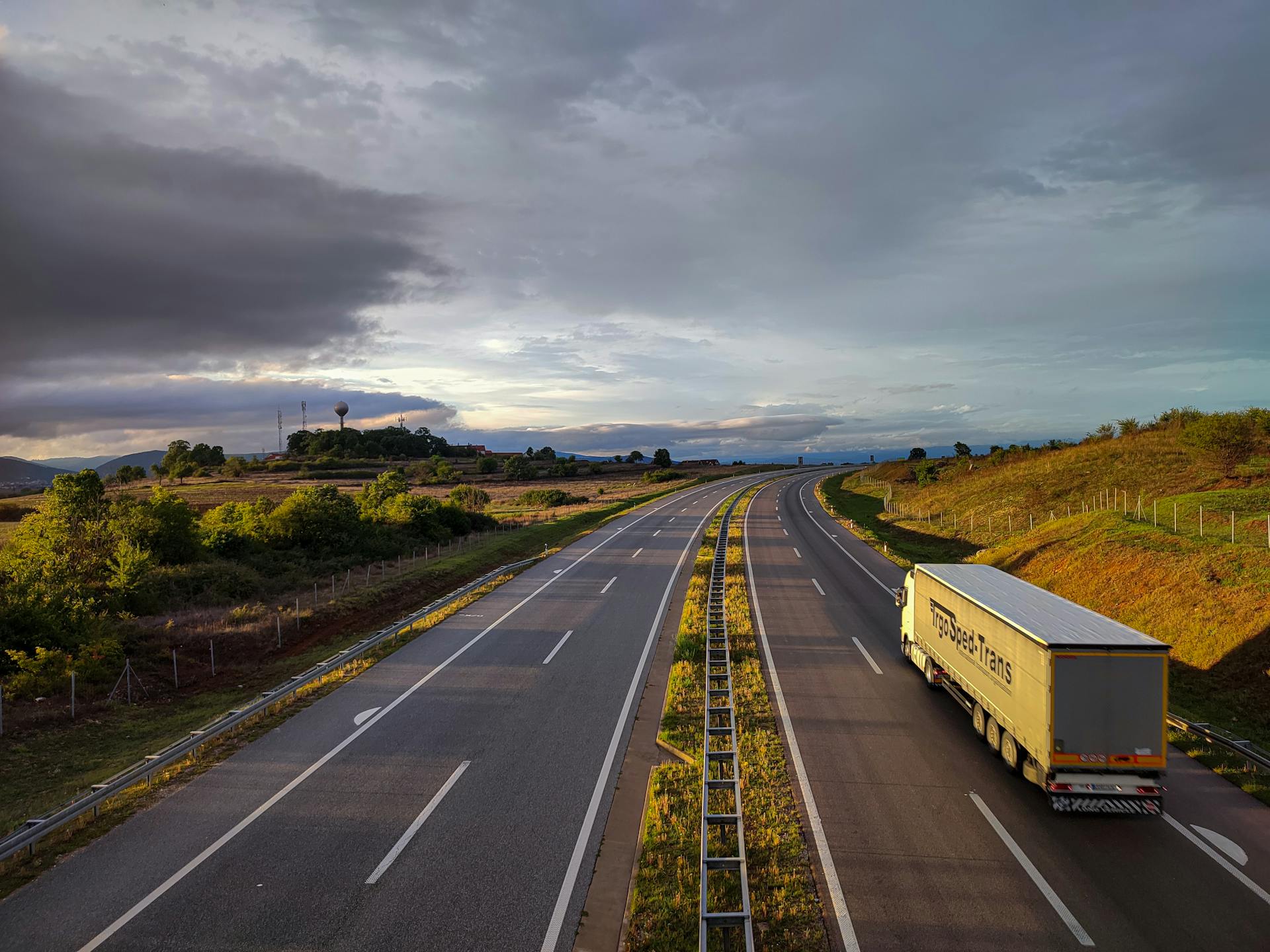
New York Truck Dispatch | Port NY/NJ & NYC Last-Mile Freight
We dispatch trucks for the Port of New York and New Jersey, the East Coast's busiest port. We also cover New York City's uniquely dense last-mile freight market and Upstate New York's Buffalo-Niagara Canadian border crossing.
How much do truck dispatch rates run in New York?
New York-origin freight currently pays about $2.20-$2.65/mi for dry van, more for reefer and flatbed. Demand is driven by Port & Container Logistics, Food Distribution and E. Grow Trucking dispatches New York owner-operators and small fleets across 15 tracked lanes on a transparent percentage-of-gross fee, disclosed upfront.
- Tracked lanes
- 15
- Major freight hubs
- New York City, Buffalo and Rochester
- Top industries
- Port & Container Logistics and Food Distribution
New York rate and market data reviewed September 2026. See our dispatch fee structure.
New York Truck Dispatch Services
New York's freight market is one of extremes. The Port of New York and New Jersey handled 8.9 million TEUs last year, up 2.3% year-over-year. It is mostly a truck port. 85% of its volume stays within roughly 250 miles of the port. NYC's density creates the most complex last-mile delivery setting in the country. Manhattan deliveries often need box trucks or straight trucks because of 53-foot trailer limits. Tolls at the George Washington Bridge, Lincoln Tunnel, and Holland Tunnel run $70+ per crossing. The city's off-hours delivery program encourages nighttime trucking. Hunts Point Market in the Bronx is the largest food distribution center in the world, feeding 22 million people. Upstate New York has an entirely different profile. Buffalo is the second-busiest US-Canada crossing (after Detroit's Ambassador Bridge), via the Peace Bridge and Rainbow Bridge. It handles roughly $60 billion in annual trade. Rochester (Corning optics), Buffalo (steel), Syracuse (medical devices), and Albany (biotech) anchor a real manufacturing base.
New York offers freight opportunities across two distinct markets. One is the ultra-dense, toll-heavy NYC metro/Port NY-NJ complex. The other is Upstate New York's manufacturing, agriculture, and Canadian cross-border freight via Buffalo.
The Port of NY/NJ is the largest port on the U.S. East Coast, creating massive, dependable drayage and distribution freight
NYC's 20+ million person metro is the largest consumer market in North America. That ensures constant inbound freight demand
Buffalo's cross-border position gives Upstate New York a distinct, dependable freight base tied to U.S.-Canada trade
A varied freight profile (port drayage, last-mile, manufacturing, and agriculture) lowers reliance on any single market
What is the New York freight market like?
As of 2026, New York's freight and logistics market is valued at roughly $71B, growing toward $81B by 2030. The Port of NY/NJ keeps growing (8.9M TEUs, up 2.3% year-over-year). But automobile volume through the port dropped roughly 12% recently, which is blamed on tariff-related impacts.
Average Rates
New York-origin rates (mid-2026): dry van roughly $2.20-$2.65/mile statewide. NYC metro deliveries carry big toll/accessorial premiums ($200-$400 in added charges is common). Reefer runs $2.50-$2.90/mile (Hunts Point Market, upstate dairy/produce). Flatbed runs $2.50-$2.95/mile (upstate manufacturing).
Market Trends
- •
The Port of NY/NJ handled 8.9 million TEUs last year, up 2.3% over 2025 and 4.3% over its own forecast. 85% of that volume stays within 250 miles of the port by truck
- •
Automobile volume through the Port of NY/NJ dropped roughly 12% year-over-year to 365,000 vehicles. The decline is blamed on tariff-related impacts
- •
NYC's off-hours delivery program keeps encouraging nighttime trucking to cut daytime congestion costs
- •
Buffalo's Peace Bridge and Rainbow Bridge crossings are still the second-busiest US-Canada trade gateway (after Detroit's Ambassador Bridge). They handle roughly $60 billion in annual trade
- •
Upstate manufacturing (Corning optics in Rochester, medical devices in Syracuse, biotech in Albany) keeps creating a distinct freight base apart from the NYC metro market
What are the busiest freight lanes out of New York?
Price these lanes with our free Trip Pre-Cost Calculator, Should I Take This Load? Calculator and Lane Profitability Analyzer.
New York to Philadelphia
Freight route connecting New York, NY to Philadelphia, PA (95 miles). Short, high-frequency Northeast corridor connecting NYC's port complex to Philadelphia's pharma/port freight.
Rate: $256 - $294
Distance: 95 miles
New York to Boston
Freight route connecting New York, NY to Boston, MA (215 miles). The Northeast's second-largest consumer market, connected via I-95.
Rate: $570 - $656
Distance: 215 miles
New York to Washington
Freight route connecting New York, NY to Washington, DC (230 miles). The DC metro's government and consumer freight base via I-95.
Rate: $598 - $690
Distance: 230 miles
New York to Buffalo
Freight route connecting New York, NY to Buffalo, NY (370 miles). Connects NYC's port complex to Buffalo's Canadian cross-border freight via the NY Thruway.
Rate: $907 - $1,054
Distance: 370 miles
New York to Chicago
Freight route connecting New York, NY to Chicago, IL (790 miles). Chicago's intermodal hub status extends NYC's Midwest reach via I-80/I-90.
Rate: $1,778 - $2,094
Distance: 790 miles
New York to Baltimore
Freight route connecting New York, NY to Baltimore, MD (190 miles). The Port of Baltimore and Mid-Atlantic distribution network via I-95.
Rate: $494 - $570
Distance: 190 miles
New York to Pittsburgh
Freight route connecting New York, NY to Pittsburgh, PA (370 miles). Connects NYC's port complex to Pittsburgh's industrial/tech freight base via I-80.
Rate: $907 - $1,054
Distance: 370 miles
New York to Charlotte
Freight route connecting New York, NY to Charlotte, NC (630 miles). Charlotte's banking and distribution sector connects well via I-95/I-85.
Rate: $1,480 - $1,732
Distance: 630 miles
New York to Atlanta
Freight route connecting New York, NY to Atlanta, GA (870 miles). Atlanta's distribution hub status rounds out NYC's Southeast reach via I-95/I-85.
Rate: $1,914 - $2,262
Distance: 870 miles
New York to Detroit
Freight route connecting New York, NY to Detroit, MI (630 miles). Detroit's auto-supplier base creates real two-way automotive-parts freight via I-80/I-90.
Rate: $1,449 - $1,701
Distance: 630 miles
New York to Cleveland
Freight route connecting New York, NY to Cleveland, OH (465 miles). Cleveland's steel manufacturing base connects via I-80.
Rate: $1,116 - $1,302
Distance: 465 miles
New York to Rochester
Freight route connecting New York, NY to Rochester, NY (335 miles). Rochester's Corning optics/manufacturing base via the NY Thruway.
Rate: $838 - $972
Distance: 335 miles
New York to Albany
Freight route connecting New York, NY to Albany, NY (155 miles). Albany's biotech cluster and Upstate distribution base via I-87.
Rate: $411 - $473
Distance: 155 miles
New York to Toronto
Freight route connecting New York, NY to Toronto, ON (495 miles). Cross-border freight via the Buffalo-Niagara crossings, one of the busiest US-Canada trade gateways.
Rate: $1,138 - $1,336
Distance: 495 miles
New York to Richmond
Freight route connecting New York, NY to Richmond, VA (350 miles). Richmond's distribution position connects NYC to the Mid-Atlantic via I-95.
Rate: $858 - $998
Distance: 350 miles
Search brokers & carriers in New York
Browse active freight brokers and for-hire carriers based in New York. The list comes live from FMCSA and updates weekly. Check bond, authority, and fleet size before you haul.
Freight Brokers
Active, FMCSA-bonded freight brokers based in New York.
Browse directoryDry Van Carriers
For-hire dry van carriers operating out of New York.
Browse directoryFlatbed Carriers
For-hire flatbed carriers operating out of New York.
Browse directoryReefer Carriers
For-hire reefer carriers operating out of New York.
Browse directoryTruck Parking
Official NHS rest stops and truck parking capacity across New York.
Browse directoryWhich industries drive freight demand in New York?
Port & Container Logistics (Port of New York and New Jersey)
Food Distribution (Hunts Point Market, Bronx, largest food distribution center in the world)
E-Commerce & Last-Mile Delivery (NYC metro, #1 U.S. e-commerce market)
Cross-Border Trade (Buffalo - Peace Bridge/Rainbow Bridge)
Manufacturing (Rochester optics/Corning, Buffalo steel, Syracuse medical devices, Albany biotech)
Agriculture (Upstate/Hudson Valley: dairy, apples, wine grapes)
How does New York freight change by season?
Rates and weather change with the seasons. Here is a quarter-by-quarter look at rates, weather, and what to do in New York.
Q1 (Jan-Mar)
Rate Movement
Rates ease 5-10% in January-February after the Q4 holiday surge
Weather Impact
Lake-effect snow can badly disrupt Buffalo/Rochester-area freight
Strategy
Position near NYC metro or Buffalo early in the week for the best rates, and build in a weather buffer upstate
Q2 (Apr-Jun)
Rate Movement
Rates get stronger as port import volume and Hudson Valley farm freight ramp up
Weather Impact
Generally favorable statewide. Spring severe weather can cause short-lived disruptions
Strategy
Prioritize Port NY/NJ drayage and Buffalo cross-border freight
Q3 (Jul-Sep)
Rate Movement
Rates hold near seasonal highs on retail restocking ahead of the Q4 e-commerce peak
Weather Impact
Minimal statewide risk in summer
Strategy
Focus on Hunts Point Market freight and Upstate produce-season reefer freight
Q4 (Oct-Dec)
Rate Movement
Highest rates of the year, peaking in November-December on NYC's massive e-commerce and holiday retail volume
Weather Impact
Lake-effect snow and winter storms start hitting Upstate New York by late November
Strategy
Book capacity early. NYC's e-commerce concentration makes this the tightest capacity window of the year
Additional Seasonal Considerations
- •
The Q4 holiday freight surge (Nov-Dec) is especially intense because NYC is the #1 U.S. e-commerce market
- •
Winter weather (lake-effect snow) can badly disrupt Buffalo/Rochester-area freight Dec-Feb
- •
Hudson Valley/Upstate produce season (apples, dairy) peaks late summer through fall
- •
Port of NY/NJ volume usually peaks ahead of the holiday season and after Chinese New Year import cycles
Where are the major freight hubs in New York?
The ports, inland ports, intermodal terminals, and distribution cities that move freight across New York. See where most of the freight is.
Distribution Cities
- New York City
- Buffalo
- Rochester
- Albany
- Syracuse
Ports & Intermodal Terminals
Port of New York and New Jersey
The busiest port on the U.S. East Coast, handling 8.9 million TEUs annually. Predominantly a truck port with 85% of volume staying within 250 miles.
Hunts Point Market (Bronx)
The largest food distribution center in the world. It supplies produce, meat, and fish to 22 million people.
Buffalo-Niagara Border Crossings (Peace Bridge, Rainbow Bridge)
The second-busiest U.S.-Canada trade gateway after Detroit's Ambassador Bridge. It handles roughly $60 billion in annual trade.
Where can trucks park and fuel in New York?
Truck parking and fuel info to help you plan your routes through New York.
Estimate fuel, tolls, and fuel tax with our free Fuel Cost Calculator, IFTA Tax Calculator and Toll Cost Estimator with Route Comparison.
Major Truck Stops
TA Travel Center - Syracuse (I-90, Exit 39)
📍 100 Farrell Rd, Syracuse, NY 13209
200 truck parking spaces ($15/day with fuel), restaurant, showers, WiFi, CAT scale, truck service. Central New York I-90 Thruway hub.
Pilot Flying J - Buffalo (I-90, Exit 49)
📍 4400 Genesee St, Buffalo, NY 14225
180 truck parking spaces ($12/day with fuel), restaurant, showers, laundry, WiFi. Western New York staging for Canadian border freight.
TA - Albany (I-87, Exit 5)
📍 1600 Central Ave, Albany, NY 12205
160 truck parking spaces ($15/day with fuel), restaurant, showers, WiFi, truck maintenance. Capital region I-87/I-90 crossroads.
Loves - Rochester (I-390, Exit 20)
📍 1000 Marketplace Dr, Rochester, NY 14623
140 truck parking spaces ($12/day with fuel), restaurant, showers, WiFi, CAT scale. Rochester metro area staging.
Petro - Pembroke (I-90, Exit 48)
📍 8493 Main Rd, Pembroke, NY 14036
170 truck parking spaces ($12/day with fuel), Iron Skillet restaurant, showers, laundry. Between Rochester and Buffalo on Thruway.
TA - Utica (I-90, Exit 31)
📍 200 N Genesee St, Utica, NY 13502
130 truck parking spaces ($15/day with fuel), restaurant, showers, WiFi. Central I-90 corridor between Syracuse and Albany.
Pilot - Binghamton (I-81, Exit 4)
📍 735 Old Front St, Binghamton, NY 13905
110 truck parking spaces ($10/day with fuel), restaurant, showers, WiFi. Southern Tier I-81 corridor to Pennsylvania.
Sunoco - Newburgh (I-84, Exit 10)
📍 40 Route 17K, Newburgh, NY 12550
50 truck parking spaces (free, 2-hour limit), diesel, convenience store. Hudson Valley I-84 corridor near NYC metro.
Parking Difficulty
Moderate to High. New York has limited truck parking statewide except at major Thruway stops. The NYC metro area (5 boroughs, Long Island, lower Hudson Valley) has extremely limited truck parking with strict enforcement. Brooklyn/Queens port drayage needs advance parking planning. Upstate New York (Buffalo, Rochester, Syracuse, Albany) has better availability at TA/Pilot locations but fills by evening Monday-Thursday. I-87 northbound to the Canadian border has limited stops. Weekend parking is easier except near NYC. Thruway rest areas prohibit overnight truck parking. Use commercial stops only.
- •Plan ahead for parking in metro areas
- •Use rest areas as a backup
- •Use parking apps to find available spots
Strategic Positioning Advice
Park where you can find loads fast and cut deadhead miles:
- •
Major Distribution Centers: Position near major distribution hubs in New York City for quick access to outbound loads.
- •
Busy Freight Routes: Stay near busy freight corridors to catch backhaul loads.
- •
Timing: Arrive when booking is busiest (usually early morning) to get the best rates.
Fuel price trend
How has the diesel price changed in New York?
EIA does not publish a separate diesel price for New York, so this is the weekly average for the Central Atlantic region that New York is part of, over the last 12 months.
- Price this week
- $6.51/gal
- Since last week
- Up 4 cents
- Versus a year ago
- Up 68%
- Versus the U.S. average
- 23 cents above
Week of October 19, 2026
+$2.63 a gallon
U.S. average $6.28
Source: U.S. Energy Information Administration weekly retail on-highway diesel prices. Averages, not the price at one pump.
What are New York's truck weight limits and regulations?
Weight limits, permits, and emission rules. Know these rules to stay legal. Also see what to expect at a DOT roadside inspection, the federal size and weight limits, and the full federal trucking regulations reference.
Check weights and permits with our free Scale / Weigh Station Guide, Weight & Axle Load Calculator and Oversize / Overweight Permit Estimator.
Weight Limits
Federal limits on the Interstate System (23 CFR 658.17):
- Single Axle: 20,000 lbs
- Tandem Axle: 34,000 lbs
- Gross Vehicle Weight: 80,000 lbs, or less where the bridge formula sets a lower total
Other highways follow New York law, and some states allow more on non-Interstate roads. Check with the state's size and weight office before you load.
Size Limits
Width is a federal limit. Height and trailer length depend on the state:
- Width: 8.5 feet (102 inches) on the National Network (23 CFR 658.15)
- Height: Set by each state. There is no federal height limit, and FHWA says most states are between 13 ft 6 in and 14 ft. Check New York's limit for your route.
- Length: 53 ft semitrailers are common, but a state can apply its own kingpin-to-rear-axle rule
State-Specific Rules
- •
New York State Police and NYSDOT jointly enforce commercial vehicle safety. They check trucks at weigh stations and with roving patrols
- •
Federal weight limits on the Interstate System: 80,000 lbs gross vehicle weight, 20,000 lbs single axle, 34,000 lbs tandem axle. Other highways follow state law, so check the state's size and weight office
- •
Size limits: 8.5 ft (102 in) width. Legal height is set by each state, and FHWA says most are 13 ft 6 in to 14 ft, so check the state's size and weight office. A 53 ft semitrailer is common, but state kingpin-to-rear-axle rules apply (Manhattan and other boroughs add more truck-route and size limits)
- •
Oversize/overweight permits come from NYSDOT
- •
NYC's off-hours delivery program offers incentives for nighttime deliveries (usually 7 PM-6 AM) to cut daytime congestion
- •
New York's diesel fuel tax runs about $0.45-0.50/gallon including state excise and petroleum business tax parts. It adjusts by a set formula, so verify the current rate with NY DOT
Permits
New York may require special permits for:
- •Oversized/overweight loads
- •Hazardous materials
- •Special route rules
New York: freight facts a driver should know
New York's legal axle limits follow the federal baseline
New York's legal axle limits follow the federal bridge formula: 22,400 pounds max on a single axle, 36,000 pounds on two consecutive axles less than 8 feet apart, and an 80,000-pound gross vehicle weight cap, without the state-specific exceptions some neighboring states allow.
Source: New York State Department of Transportation. Checked 30 Sep 2026.
New York bans oversize loads around every major holiday
NYSDOT bans all oversize-load travel around major holidays. For 2026, that includes no oversize travel from noon Friday, September 4 through early Tuesday, September 8 for Labor Day, and similar blackout windows around Thanksgiving and Christmas.
Source: New York State Department of Transportation, 2026 Oversize Travel Holiday Restrictions. Checked 30 Sep 2026.
Current truck wait times at New York's border crossings
| Crossing | Status | Commercial lane delay | Lanes open |
|---|---|---|---|
| Thousand Islands Bridge | Open | 0 min | 1 |
| Lewiston Bridge | Open | 0 min | 2 |
| Peace Bridge | Open | 2 min | 4 |
| Champlain | Open | 0 min | 1 |
| Massena | Open | 0 min | 1 |
| Ogdensburg | Open | 0 min | 1 |
Source: U.S. Customs and Border Protection, Border Wait Times. CBP updates this roughly hourly; refreshes with this page.
How have New York freight rates moved, and what's next?
How New York freight rates have moved through recent market cycles, and what owner-operators and fleets should expect next. Use this to time lane commitments and rate negotiations. Before you accept a load, check it against our free rate benchmarker.
Recent Rate Cycles
Rate cycles that shaped the current New York freight market:
2018-2019
Strong market. Rates hit their peak because trucks were in short supply
2020
Rates swung at first because of the pandemic. Freight demand then bounced back hard
2021-2022
Record-high rates. E-commerce demand surged and trucks were in short supply
2023-2024
Rates fell sharply as truck supply passed demand. Smaller carriers left the market
2025-2026
The national market is recovering. Port of NY/NJ keeps growing even as automobile import volume softened on tariff-related impacts
Market Correction Periods
Knowing when corrections hit New York helps with strategic planning:
- •
Q1 2023: Rates fell hard as trucks were added faster than freight grew
- •
Mid-2024: The market is settling, with supply and demand more in balance
- •
Pattern: Rate drops usually last 6–12 months before rates recover
New York Market Outlook
As of mid-2026, New York's freight market (valued at ~$71B) is forecast to grow toward $81B by 2030. Port of NY/NJ container growth is still strong even as automotive import volume has softened on tariff impacts. NYC's e-commerce lead keeps driving last-mile freight demand.
What Drives Rates in New York
- •Freight volume and demand (port containers, NYC e-commerce/last-mile, cross-border trade, manufacturing)
- •Truck supply, which tightened a lot from last year across the nation
- •Fuel costs, New York's diesel fuel tax (~$0.45-0.50/gallon), and NYC metro toll costs
- •Port of NY/NJ container growth trends and tariff-related automotive import volume shifts
How do I cut deadhead miles running freight in New York?
How to cut empty miles when you haul in and out of New York. See the outbound and inbound freight balance, the best return lanes, and where to park your truck. Run your own numbers with our free deadhead miles calculator.
Outbound Freight
55%
Roughly 55% of New York freight moves outbound. Outbound loads from New York's production and distribution centers typically book fastest early in the week.
Inbound Freight
45%
About 45% of the freight balance is inbound. Book your return load before you deliver. It is the biggest way to raise your rate-per-mile on these lanes.
Best Backhaul Lanes into New York
The strongest return lanes for repositioning back toward New York:
Philadelphia to NYC
A short, high-frequency Northeast corridor with steady port-adjacent freight
Rate: $2.60 - $3.00/mile
Boston to NYC
I-95 corridor connecting two major Northeast consumer markets
Rate: $2.55 - $2.95/mile
Toronto to Buffalo
Cross-border corridor via the Peace Bridge/Rainbow Bridge
Rate: $2.50 - $2.90/mile
Positioning Strategies for New York
Where and when to stage to keep your next load close and your deadhead low:
- •
Stage in New Jersey or outer suburbs rather than trying NYC metro parking
- •
Track Port of NY/NJ vessel schedules if running drayage freight
- •
Use load boards to pre-book backhaul before longer cross-country hauls
What do experienced dispatchers know about running New York?
Hands-on tips from years of dispatching in New York.
NYC metro (5 boroughs, Long Island) creates massive freight volume but has extreme congestion, limited truck access, and strict parking enforcement. You need specialized knowledge.
Port of NY/NJ is the largest East Coast port. Brooklyn/Newark drayage provides steady high-volume work but requires TWIC cards and patience for port congestion.
The Buffalo-Toronto corridor on I-90/QEW is a major cross-border freight lane. Canadian customs clearance and border wait times affect scheduling.
Port of NY/NJ drayage and NYC metro delivery windows create Tuesday-Wednesday rate premiums 12-18% above Friday. Vessel arrivals and urban delivery limits bunch up midweek freight.
NYC congestion pricing and truck limits (Manhattan commercial zones, overnight-only deliveries in many areas) need detailed route planning and local knowledge.
Albany is New York's distribution hub for upstate. Position here for fastest access to Syracuse, Rochester, Buffalo, and Vermont/Montreal markets.
Finger Lakes wine region and Hudson Valley farm freight create seasonal reefer chances May-Oct.
JFK and Newark airports create air cargo drayage freight. Time-sensitive, premium rates, but requires TSA clearance for certain cargo.
Long Island has extremely limited truck access with many low-clearance bridges and parkway limits. Verify routes carefully before you accept Long Island deliveries.
NYC produce market (Hunts Point in Bronx) operates 24/7 and needs overnight deliveries. Overnight/early morning delivery windows are mandatory for many loads.
Remember: These tips come from real dispatching work in New York. Markets change, but these basics still help you earn more and cut deadhead miles.
How have drivers near New York grown with Grow Trucking?
+$2,100/week after moving to $2.75/mi on produce / pharmaceutical / seafood freight. Pharma and seafood loads consistently matched.
Read the case study+$1,740/week after moving to $2.58/mi on general freight / cross-country relay freight. Team drivers redesigned to relay model with consistent home time.
Read the case studyNew York Freight FAQs
Comprehensive answers to common questions about trucking and dispatch in New York. State-specific regulations, costs, and operating strategies.
Yes. You need a USDOT number, an MC number for interstate for-hire carriage, and New York-specific IRP/IFTA registration through the NY DMV. NYC also has specific commercial vehicle rules and a Heavy Vehicle Use Tax. Consult NY DOT and NYC DOT for complete rules.
Federal minimum liability coverage usually runs $750,000-$1,000,000 depending on cargo type. You also need cargo and physical damage coverage. NYC operations and port drayage may need more coverage. TWIC cards are required for Port of NY/NJ access. Confirm with a New York-experienced insurance provider.
As of mid-2026, Port of NY/NJ drayage runs $2.80-$3.50/mile (short haul, high frequency). NYC last-mile delivery earns premiums because of congestion and parking challenges. Standard dry van on the I-90 Thruway corridor runs $2.50-$2.95/mile. Reefer freight from Finger Lakes and Hudson Valley farms runs $2.60-$3.10/mile. Tolls on NY Thruway and NYC bridges are large. Always include them in rate calculations.
Yes, but geography matters. Upstate New York (Buffalo, Rochester, Syracuse, Albany) offers manageable freight with good rates and less congestion. It suits new operators. NYC metro needs specialized knowledge of truck routes, parking, and delivery limits. It is not recommended for new operators without experienced guidance. Port drayage provides steady work but needs TWIC cards and patience for port/traffic delays.
New York diesel fuel tax combines state excise, petroleum business tax, and sales tax parts. It totals about $0.38-$0.44 per gallon (varying by specific calculation; IFTA rate referenced at ~$0.442/gallon). Add the federal tax ($0.244/gallon), and total diesel fuel tax is about $0.62-$0.68 per gallon. Retail diesel in the Central Atlantic region, which includes New York, averages $6.51/gallon as of October 19, 2026 (EIA weekly average), about 23 cents above the national average of $6.28. That price is up 4 cents from last week and 68% above a year ago. The NYC metro area often has higher retail prices because of local factors. NY Thruway tolls for commercial trucks are large. Factor both fuel tax and tolls into rates for NY routes. Source: New York State Department of Taxation and Finance, verified September 2026.
NYC needs specialized knowledge. A truck route map is mandatory. Many streets prohibit trucks. Parkways ban commercial vehicles (low clearances). Manhattan has overnight delivery limits (many areas 7 PM-6 AM only). Parking is extremely limited with aggressive enforcement. Brooklyn/Queens port drayage has designated truck routes. Long Island has many low bridges. Verify clearances. Many operators specialize in NYC exclusively. Consider partnering with an NYC-experienced carrier for your first loads. Your GPS must have commercial truck routing. Passenger GPS will route you illegally.
NYC metro runs high volume year-round, with the Q4 holiday peak (Nov-Dec) highest. Port of NY/NJ peaks before Chinese New Year (imports arrive early) and in the summer retail season. Finger Lakes wine harvest (Sep-Oct) drives reefer freight. Hudson Valley apple/produce harvest (Aug-Oct) peaks farm freight. Upstate tourism (summer and fall foliage) raises consumer goods. Buffalo-Toronto cross-border freight is steady year-round.
NY Thruway (I-90) tolls for commercial trucks vary by distance and axle count. Full length Buffalo to NYC can cost $50-80+ for typical 5-axle tractor-trailer. Tappan Zee Bridge (I-87/I-287), George Washington Bridge, other NYC crossings add $70-100+ each direction. E-ZPass commercial accounts provide discounts. Always factor tolls into rate negotiations. They greatly impact profitability on NY loads. Verify current toll rates at thruway.ny.gov.
Buffalo-Toronto (I-90 to QEW via Peace Bridge or Lewiston-Queenston Bridge) is a major trade corridor. It needs four things. (1) FAST card/ACE enrollment for expedited clearance. (2) Proper customs papers (commercial invoice, packing list, PAPS/PARS). (3) Canadian carrier authority if you operate in Canada. (4) Proper insurance. Border wait times vary from 30 minutes to 3+ hours. Build a schedule buffer. Preclearance via ACE cuts delays. Prohibited/restricted goods need special permits. Consult a customs broker for complex shipments.
Upstate NY major stops (TA Syracuse, Pilot Buffalo, TA Albany) fill by 7-8 PM Monday-Thursday. Arrive early or reserve via Reserve-It. NYC metro has almost no truck parking. Most drivers return to the company yard or park in New Jersey (Secaucus, Newark area) and shuttle in. Port drayage parking is extremely limited. Plan container pickup/delivery timing carefully. Thruway rest areas prohibit overnight parking. Weekend parking is easier but still limited near NYC. I-87 to the Canadian border has sparse services north of Albany.
Keep exploring dispatch options
Tools, equipment guides and nearby states relevant to running freight in and out of New York.
By equipment
Free tools
- Trip Pre-Cost Calculator
- Toll Cost Estimator with Route Comparison
- Load Board Rate Benchmarker
- Deadhead Miles Calculator
- Fuel Cost Calculator
- IFTA Tax Calculator
- Scale / Weigh Station Guide
- Cost Per Mile Calculator
- Diesel prices today
- Diesel tax by state
- Truck idling laws by state
- Truck speed limits by state
- Truck chain laws by state
- Truck lane laws by state
- Truck height and length limits by state
- Rest area parking limits by state
- Central Atlantic diesel prices
- Accessorial Charges Calculator
- Repair vs Replace Calculator
- All Free Tools
Nearby states
Services
More from Grow Trucking
Ready to Move Freight in New York?
Secure Your Strategy:
Apply for your FREE Custom 90-Day Growth Plan (a $1,500 value). It starts with a Business Audit that finds where you lose money and sets your profit goals.
Guarantee Your GROWTH:
Start your 90-day partnership to implement the plan. We back it with our "Growth or Your Money Back" Guarantee.