
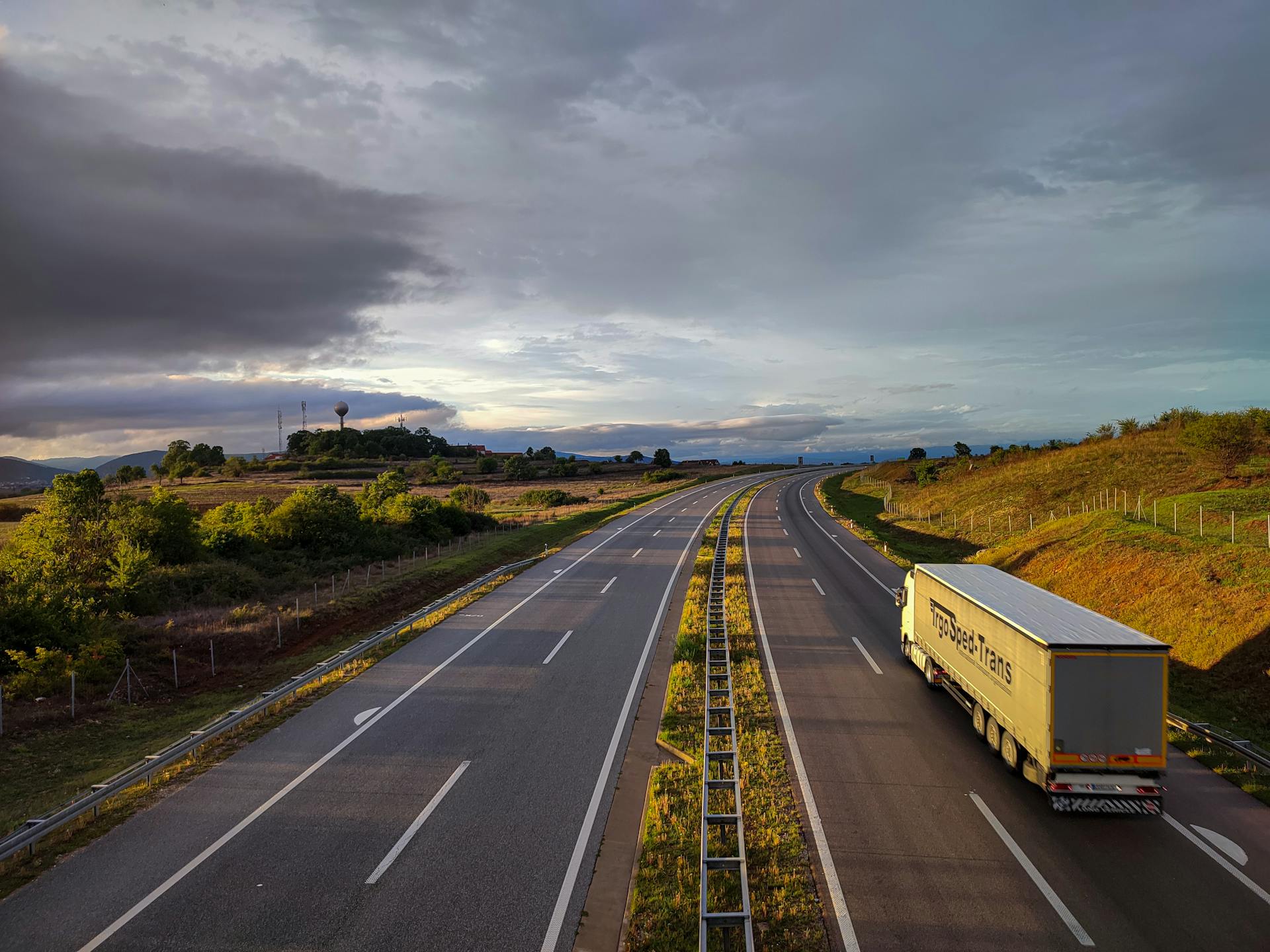
Maine Truck Dispatch | Lobster Reefer & Bath Iron Works
We dispatch trucks for Maine's lobster/seafood cold-chain industry, which supplies 80%+ of all U.S. lobster. We also cover Bath Iron Works Navy destroyer construction and the state's spot as the endpoint of I-95, the longest interstate on the East Coast.
How much do truck dispatch rates run in Maine?
Maine-origin freight currently pays about $2.30-$2.75/mi for dry van, more for reefer and flatbed. Demand is driven by Lobster & Seafood, Shipbuilding & Defense and Forest Products & Paper. Grow Trucking dispatches Maine owner-operators and small fleets across 15 tracked lanes on a transparent percentage-of-gross fee, disclosed upfront.
- Tracked lanes
- 15
- Major freight hubs
- Portland, Bangor and Lewiston
- Top industries
- Lobster & Seafood and Shipbuilding & Defense
Maine rate and market data reviewed September 2026. See our dispatch fee structure.
Maine Truck Dispatch Services
Maine's freight identity rests on three pillars: lobster, forest products, and seasonal tourism. Maine harvests over 80% of all U.S. lobster. Coastal processing plants from Portland to Jonesport ship temperature-critical loads nationwide. Live lobster needs specialized tank trucks and air freight. Processed/frozen lobster moves by standard reefer, with peak season August through November. The state's paper and timber industry was once dominant. It has shrunk but is still important. Paper mills in Rumford, Westbrook, and Sappi's Somerset mill in Skowhegan create pulp and paper freight. About 90% of Maine's 17 million acres of forestland is privately owned. More of it is shifting toward mass timber engineered wood products. Bath Iron Works (General Dynamics) builds Navy destroyers. That creates specialized heavy-haul demand and anchors Maine's largest industrial employment. Maine is the northeasternmost state and the endpoint of I-95 (310 miles from the New Hampshire border to Houlton at the Canadian border). So it faces real long-distance and backhaul challenges. Portland to New York is 320 miles, and to Boston just 110. That pushes deadhead rates among the highest in the nation. Aroostook County, the 'County,' is closer to Quebec City than Boston. It anchors the state's potato freight and cross-border trade with New Brunswick.
Maine offers freight opportunities anchored by its dominant lobster/seafood cold-chain industry, Bath Iron Works Navy shipbuilding, and forest products. Reefer demand is strong, but backhaul is truly scarce because the state is a continental endpoint.
Maine's dominant, branded lobster/seafood industry creates unique, high-value reefer and specialized tank-truck freight
Bath Iron Works provides dependable, mostly non-cyclical heavy-haul defense freight
The state's forest products sector is reinventing itself around mass timber, a growing flatbed freight category
Aroostook County's cross-border trade with New Brunswick gives you a distinct freight base apart from coastal Maine
What is the Maine freight market like?
As of 2026, Maine's economy is valued at roughly $68B GDP (43rd nationally), with 3.3% unemployment. Maine's lobster industry exports heavily to Canada and the EU. Retaliatory tariffs in recent trade disputes have cut Canadian market access. That hurts the export side of the state's signature industry.
Average Rates
Maine-origin rates (mid-2026): dry van roughly $2.30-$2.75/mile (general consumer goods, tourism supply). Reefer runs $2.60-$3.10/mile (lobster/seafood, Maine's signature freight, with real premiums during peak Aug-Nov season). Flatbed runs $2.50-$2.95/mile (paper/pulp, Bath Iron Works heavy-haul). Deadhead rates are among the highest in the nation because Maine is a continental endpoint.
Market Trends
- •
Maine's lobster industry, the largest in the U.S., still faces export headwinds from retaliatory tariffs that affect Canadian and EU market access
- •
Bath Iron Works (General Dynamics) is still Maine's largest industrial employer. It builds Navy destroyers and creates specialized heavy-haul freight demand
- •
The state's traditional paper/lumber markets have shrunk. But the forest products sector is reinventing itself around mass timber engineered wood products like cross-laminated timber
- •
Maine is the endpoint of I-95 (the longest interstate on the East Coast). So carrier availability is thinner than in mid-corridor states, which pushes deadhead rates among the highest in the nation
- •
Remote workers moving to coastal Maine (Portland, Bar Harbor, Rockland) since 2020 have driven up local costs and modestly raised consumer freight demand
What are the busiest freight lanes out of Maine?
Price these lanes with our free Trip Pre-Cost Calculator, Should I Take This Load? Calculator and Lane Profitability Analyzer.
Portland to Boston
Freight route connecting Portland, ME to Boston, MA (110 miles). Short, dependable corridor with the most reliable two-way freight in the state via I-95.
Rate: $292 - $341
Distance: 110 miles
Portland to Manchester
Freight route connecting Portland, ME to Manchester, NH (94 miles). A short, high-frequency corridor connecting Portland to New Hampshire's distribution corridor via I-95.
Rate: $259 - $301
Distance: 94 miles
Portland to New York
Freight route connecting Portland, ME to New York, NY (320 miles). The Northeast's largest consumer market, reached via I-95. One of the longest hauls on this list.
Rate: $784 - $928
Distance: 320 miles
Portland to Providence
Freight route connecting Portland, ME to Providence, RI (155 miles). Connects Portland to Rhode Island via I-95.
Rate: $395 - $465
Distance: 155 miles
Portland to Hartford
Freight route connecting Portland, ME to Hartford, CT (220 miles). Connects Portland to Connecticut's aerospace/insurance corridor via I-95.
Rate: $550 - $649
Distance: 220 miles
Portland to Bangor
Freight route connecting Portland, ME to Bangor, ME (130 miles). Connects Portland to Maine's second-largest freight hub and gateway to Aroostook County via I-95.
Rate: $344 - $403
Distance: 130 miles
Portland to Montreal
Freight route connecting Portland, ME to Montreal, QC (265 miles). Cross-border freight via Route 2/I-95 into Quebec.
Rate: $623 - $742
Distance: 265 miles
Portland to Philadelphia
Freight route connecting Portland, ME to Philadelphia, PA (400 miles). Philadelphia's pharma corridor and port connect via I-95.
Rate: $940 - $1,120
Distance: 400 miles
Portland to Burlington
Freight route connecting Portland, ME to Burlington, VT (190 miles). Connects Portland to Vermont's dairy/cross-border freight base via US-2.
Rate: $475 - $560
Distance: 190 miles
Portland to Baltimore
Freight route connecting Portland, ME to Baltimore, MD (480 miles). The Port of Baltimore and Mid-Atlantic distribution network via I-95.
Rate: $1,104 - $1,320
Distance: 480 miles
Portland to Bath
Freight route connecting Portland, ME to Bath, ME (35 miles). A very short corridor serving Bath Iron Works' Navy destroyer construction facility.
Rate: $98 - $116
Distance: 35 miles
Portland to Augusta
Freight route connecting Portland, ME to Augusta, ME (60 miles). Connects Portland to Maine's state capital via I-95.
Rate: $165 - $192
Distance: 60 miles
Portland to Concord
Freight route connecting Portland, ME to Concord, NH (90 miles). Connects Portland to New Hampshire's capital via I-95/I-93.
Rate: $243 - $284
Distance: 90 miles
Portland to Fredericton
Freight route connecting Portland, ME to Fredericton, NB (322 miles). Cross-border freight connecting Maine to New Brunswick via US-1/I-95.
Rate: $757 - $902
Distance: 322 miles
Portland to Washington
Freight route connecting Portland, ME to Washington, DC (555 miles). The DC metro's government and consumer freight base rounds out Maine's southbound reach via I-95.
Rate: $1,249 - $1,498
Distance: 555 miles
Search brokers & carriers in Maine
Browse active freight brokers and for-hire carriers based in Maine. The list comes live from FMCSA and updates weekly. Check bond, authority, and fleet size before you haul.
Freight Brokers
Active, FMCSA-bonded freight brokers based in Maine.
Browse directoryDry Van Carriers
For-hire dry van carriers operating out of Maine.
Browse directoryFlatbed Carriers
For-hire flatbed carriers operating out of Maine.
Browse directoryReefer Carriers
For-hire reefer carriers operating out of Maine.
Browse directoryTruck Parking
Official NHS rest stops and truck parking capacity across Maine.
Browse directoryWhich industries drive freight demand in Maine?
Lobster & Seafood (Cold Chain) - 80%+ of all U.S. lobster
Shipbuilding & Defense (Bath Iron Works, General Dynamics, Navy destroyers)
Forest Products & Paper (Sappi in Skowhegan, mills in Rumford, Westbrook, mass timber emerging)
Agriculture (wild blueberries, the largest global producer; Aroostook County potatoes; maple syrup, #2 US)
Petroleum Distribution (Port of Portland: heating oil, propane for New England)
Tourism (Acadia National Park, coastal communities, ski resorts)
How does Maine freight change by season?
Rates and weather change with the seasons. Here is a quarter-by-quarter look at rates, weather, and what to do in Maine.
Q1 (Jan-Mar)
Rate Movement
Rates hold steady on Bath Iron Works and paper freight through winter
Weather Impact
Severe winter weather affects the whole state, especially the Bangor-Houlton I-95 stretch
Strategy
Build a big schedule buffer for northern Maine freight. Watch MaineDOT conditions closely
Q2 (Apr-Jun)
Rate Movement
Rates strengthen as spring construction and tourism-prep freight ramp up
Weather Impact
Spring weight limits (Mar-Apr) can affect heavy-haul freight planning on rural roads
Strategy
Verify current spring weight limits before you plan heavy loads
Q3 (Jul-Sep)
Rate Movement
Rates climb sharply as lobster season and peak summer tourism overlap
Weather Impact
Generally favorable statewide
Strategy
Focus on lobster/seafood reefer freight and coastal tourism-adjacent freight
Q4 (Oct-Dec)
Rate Movement
Rates stay high through the tail of lobster season (through November) before easing
Weather Impact
Winter weather starts hitting the state hard by November
Strategy
Book capacity early. The lobster season tail overlaps with early winter, which makes this a tight window
Additional Seasonal Considerations
- •
Lobster season peaks August through November, which creates strong reefer/tank-truck demand from coastal ports
- •
Summer tourism (Jun-Sep) triples the population of coastal towns and drives big hospitality/consumer freight
- •
Winter weather (50-100+ inches of snow a year) makes the I-95 Bangor-Houlton corridor treacherous Nov-Apr
- •
Spring weight limits (Mar-Apr) cap truck loads on rural roads during frost-heave season
Where are the major freight hubs in Maine?
The ports, inland ports, intermodal terminals, and distribution cities that move freight across Maine. See where most of the freight is.
Distribution Cities
- Portland
- Bangor
- Lewiston
- Augusta
- Auburn
Ports & Intermodal Terminals
Port of Portland
Handles petroleum products (heating oil, propane) for New England distribution. It is Maine's main maritime gateway.
Bath Iron Works (General Dynamics)
Maine's largest industrial employer. It builds Navy destroyers and creates specialized heavy-haul freight demand.
Portland Fish Exchange
A central hub for Maine's lobster and seafood industry. It needs cold-chain-critical logistics.
Where can trucks park and fuel in Maine?
Truck parking and fuel info to help you plan your routes through Maine.
Estimate fuel, tolls, and fuel tax with our free Fuel Cost Calculator, IFTA Tax Calculator and Toll Cost Estimator with Route Comparison.
Major Truck Stops
Irving Big Stop — Kittery (I-95, Exit 3)
📍 21 Chauncey Way, Kittery, ME 03904
140 truck parking spaces ($14/day fee), restaurant, CAT scale, diesel, and convenience store. It sits at Maine's southern gateway on I-95, where you enter from New Hampshire
Irving Big Stop — Gray (I-95/ME Turnpike, Exit 63)
📍 140 Shawmut Drive, Gray, ME 04039
180 truck parking spaces ($15/day fee), restaurant, CAT scale, diesel, and driver amenities. Serves Greater Portland area and the midpoint of Maine's turnpike
Dysart's Truck Stop — Bangor (I-95, Exit 180)
📍 530 Coldbrook Road, Hermon, ME 04401
200 truck parking spaces ($12/day fee), 24-hour restaurant, CAT scale, tire shop, diesel, and truck wash. Legendary Maine truck stop serving Bangor and Central Maine
Irving Big Stop — Hampden (I-95, Exit 180)
📍 24 Springer Drive, Hampden, ME 04444
150 truck parking spaces ($12/day fee), restaurant, CAT scale, diesel, and convenience store. Serves Bangor area and northern Maine corridor
Irving Big Stop — Houlton (I-95, Exit 302)
📍 5 Ludlow Road, Houlton, ME 04730
100 truck parking spaces ($10/day fee), restaurant, CAT scale, diesel, and convenience store. It serves the northern end of I-95 and the Canadian border crossing at Woodstock, New Brunswick
TA Travel Center — Scarborough (I-95/ME Turnpike, Exit 42)
📍 303 Gorham Road, Scarborough, ME 04074
160 truck parking spaces ($14/day fee), Country Pride Restaurant, CAT scale, tire shop, diesel, and truck amenities. It sits near Portland and serves coastal Maine lobster/seafood freight
Irving Big Stop — Augusta (I-95, Exit 112)
📍 5 Industrial Drive, Augusta, ME 04330
120 truck parking spaces ($12/day fee), restaurant, CAT scale, diesel, and convenience store. Serves Maine's capital city and Central Maine freight corridor
Irving Big Stop — Newport (I-95, Exit 157)
📍 562 Moosehead Trail, Newport, ME 04953
110 truck parking spaces ($10/day fee), restaurant, CAT scale, diesel, and convenience store. Serves Central/Northern Maine between Augusta and Bangor
Parking Difficulty
Low to Moderate outside Portland. Maine's low overall freight density generally means parking is available. But northern/rural areas (Houlton, Aroostook County) have limited services, with 80-100 mile gaps between major truck stops. The Portland area sees moderate demand because of lobster/seafood and Bath Iron Works freight. Peak congestion comes during lobster season (Aug-Nov), when reefer carriers flood coastal areas. Best availability: Sunday evenings and early Monday mornings statewide. Weekday afternoons in northern Maine.
- •Plan ahead for parking in metro areas
- •Use rest areas as a backup
- •Use parking apps to find available spots
Strategic Positioning Advice
Park where you can find loads fast and cut deadhead miles:
- •
Major Distribution Centers: Position near major distribution hubs in Portland for quick access to outbound loads.
- •
Busy Freight Routes: Stay near busy freight corridors to catch backhaul loads.
- •
Timing: Arrive when booking is busiest (usually early morning) to get the best rates.
Fuel price trend
How has the diesel price changed in Maine?
EIA does not publish a separate diesel price for Maine, so this is the weekly average for the New England region that Maine is part of, over the last 12 months.
- Price this week
- $6.47/gal
- Since last week
- Up 3 cents
- Versus a year ago
- Up 64%
- Versus the U.S. average
- 19 cents above
Week of October 19, 2026
+$2.53 a gallon
U.S. average $6.28
Source: U.S. Energy Information Administration weekly retail on-highway diesel prices. Averages, not the price at one pump.
What are Maine's truck weight limits and regulations?
Weight limits, permits, and emission rules. Know these rules to stay legal. Also see what to expect at a DOT roadside inspection, the federal size and weight limits, and the full federal trucking regulations reference.
Check weights and permits with our free Scale / Weigh Station Guide, Weight & Axle Load Calculator and Oversize / Overweight Permit Estimator.
Weight Limits
Federal limits on the Interstate System (23 CFR 658.17):
- Single Axle: 20,000 lbs
- Tandem Axle: 34,000 lbs
- Gross Vehicle Weight: 80,000 lbs, or less where the bridge formula sets a lower total
Other highways follow Maine law, and some states allow more on non-Interstate roads. Check with the state's size and weight office before you load.
Size Limits
Width is a federal limit. Height and trailer length depend on the state:
- Width: 8.5 feet (102 inches) on the National Network (23 CFR 658.15)
- Height: Set by each state. There is no federal height limit, and FHWA says most states are between 13 ft 6 in and 14 ft. Check Maine's limit for your route.
- Length: 53 ft semitrailers are common, but a state can apply its own kingpin-to-rear-axle rule
State-Specific Rules
- •
Maine State Police and MaineDOT jointly enforce commercial vehicle safety. They check trucks at weigh stations and with roving patrols
- •
Federal weight limits on the Interstate System: 80,000 lbs gross vehicle weight, 20,000 lbs single axle, 34,000 lbs tandem axle. Other highways follow state law, so check the state's size and weight office
- •
Size limits: 8.5 ft (102 in) width. Legal height is set by each state, and FHWA says most are 13 ft 6 in to 14 ft, so check the state's size and weight office. A 53 ft semitrailer is common, but state kingpin-to-rear-axle rules apply
- •
Oversize/overweight permits come from MaineDOT
- •
Spring weight limits (Mar-Apr) apply on many rural roads during frost-heave season. Verify current limits before you plan heavy loads
- •
Cross-border freight through Calais or Houlton needs standard customs paperwork for New Brunswick/Quebec trade
- •
Maine's diesel fuel tax is about $0.31/gallon (verify the current rate with Maine Revenue Services)
Permits
Maine may require special permits for:
- •Oversized/overweight loads
- •Hazardous materials
- •Special route rules
Maine: freight facts a driver should know
Maine's legal weight scales with how many axles you run
Maine sets gross weight by axle count rather than one flat number: 34,000 pounds on 2 axles, 54,000 on 3 axles, 69,000 on 4 axles, and the full 80,000 pounds on 5 or more axles. A specific combination — a 3-axle truck tractor pulling a tri-axle semitrailer — can gross up to 100,000 pounds.
Source: Maine Revised Statutes, Title 29-A §2353. Checked 30 Sep 2026.
No overlimit hauls on summer weekend nights
Maine bans overlimit moves from 30 minutes after sunset to 30 minutes before sunrise year-round, and blocks weekend and holiday overlimit travel specifically during July and August, when tourist traffic peaks. Permit holders, not the state, are responsible for arranging any required State Police escort directly with the local Field Troop office.
Source: Maine Bureau of Motor Vehicles, overlimit permits. Checked 30 Sep 2026.
Current truck wait times at Maine's border crossings
| Crossing | Status | Commercial lane delay | Lanes open |
|---|---|---|---|
| International Avenue | Open | 0 min | 1 |
| Houlton | Open | 0 min | 1 |
| Jackman | Open | 0 min | 1 |
| Madawaska | Open | 0 min | 1 |
Source: U.S. Customs and Border Protection, Border Wait Times. CBP updates this roughly hourly; refreshes with this page.
How have Maine freight rates moved, and what's next?
How Maine freight rates have moved through recent market cycles, and what owner-operators and fleets should expect next. Use this to time lane commitments and rate negotiations. Before you accept a load, check it against our free rate benchmarker.
Recent Rate Cycles
Rate cycles that shaped the current Maine freight market:
2018-2019
Strong market. Rates hit their peak because trucks were in short supply
2020
Rates swung at first because of the pandemic. Freight demand then bounced back hard
2021-2022
Record-high rates. E-commerce demand surged and trucks were in short supply
2023-2024
Rates fell sharply as truck supply passed demand. Smaller carriers left the market
2025-2026
The national market is recovering. Maine's lobster industry has faced real export headwinds from retaliatory tariffs, even as Bath Iron Works defense freight stays dependable
Market Correction Periods
Knowing when corrections hit Maine helps with strategic planning:
- •
Q1 2023: Rates fell hard as trucks were added faster than freight grew
- •
Mid-2024: The market is settling, with supply and demand more in balance
- •
Pattern: Rate drops usually last 6–12 months before rates recover
Maine Market Outlook
As of mid-2026, Maine's freight market gains from Bath Iron Works' dependable shipbuilding freight and continued lobster/seafood volume. Real trade-policy headwinds hurt Canadian and EU lobster export access. The state's thin backhaul availability as a continental endpoint also weighs on it.
What Drives Rates in Maine
- •Freight volume and demand (lobster/seafood, shipbuilding, forest products, tourism)
- •Available truck capacity, which tightened sharply year-over-year nationally and is further limited by Maine's endpoint location
- •Fuel costs and Maine's diesel fuel tax (~$0.31/gallon)
- •Lobster season timing, export trade-policy news, and Bath Iron Works contract cycles
How do I cut deadhead miles running freight in Maine?
How to cut empty miles when you haul in and out of Maine. See the outbound and inbound freight balance, the best return lanes, and where to park your truck. Run your own numbers with our free deadhead miles calculator.
Outbound Freight
60%
Roughly 60% of Maine freight moves outbound. Outbound loads from Maine's production and distribution centers typically book fastest early in the week.
Inbound Freight
40%
About 40% of the freight balance is inbound. Book your return load before you deliver. It is the biggest way to raise your rate-per-mile on these lanes.
Best Backhaul Lanes into Maine
The strongest return lanes for repositioning back toward Maine:
Boston to Portland
A short, dependable I-95 corridor with the most reliable backhaul in the state
Rate: $2.65 - $3.10/mile
Manchester (NH) to Portland
A short regional corridor connecting Northern New England markets
Rate: $2.60 - $3.05/mile
Montreal to Bangor
A cross-border corridor via Route 2, connecting to Quebec's distribution network
Rate: $2.30 - $2.75/mile
Positioning Strategies for Maine
Where and when to stage to keep your next load close and your deadhead low:
- •
Pre-book backhaul before you enter the state because return freight is thin
- •
Position near Portland for the most dependable two-way freight in the state
- •
Track lobster season timing (Aug-Nov) for the strongest reefer freight volume
What do experienced dispatchers know about running Maine?
Hands-on tips from years of dispatching in Maine.
Maine's backhaul scarcity is real and built into the map. Maine is the endpoint of I-95 (310 miles from the New Hampshire border to Houlton at the Canadian border). So carrier availability is thinner than in mid-corridor states. That pushes deadhead rates among the highest in the nation (60% outbound / 40% inbound). Plan your return load before you arrive, or budget 20-30% empty miles.
Lobster/seafood freight is unique. Live lobster needs specialized tank trucks that keep seawater circulating and aerated. That differs from the standard reefer used for processed/frozen lobster tails and meat. Maine harvests over 80% of all U.S. lobster. Peak season is August through November, when rates spike 25-35% above baseline ($2.85-$3.40/mile reefer).
Bath Iron Works freight is dependable and mostly shielded from the broader freight cycle. Navy destroyer construction contracts don't soften with consumer freight. General Dynamics employs 6,800+ workers at the Bath facility. That creates steady inbound steel, electronics, and equipment freight. It also creates specialized heavy-haul for hull sections and propulsion systems.
Portland lobster and seasonal tourism freight (May-Oct) create Tuesday-Thursday premiums. Seafood processors and resort suppliers rush weekly deliveries to Boston and NYC markets.
Aroostook County ('the County') freight needs real distance planning. It's closer to Quebec City (220 miles) than Boston (320 miles). Rural roads test carrier patience with 55 mph speeds and logging truck traffic. Potato freight from Presque Isle, Caribou, and Fort Fairfield moves mostly to processing plants in-state or to Northeast consumer markets.
Watch lobster export trade-policy news if you depend on that freight. Recent retaliatory tariffs have already cut Canadian market access (historically 35-40% of Maine lobster exports). That shifts more volume to domestic U.S. markets and affects pricing.
Winter weather on I-95 from Bangor to Houlton (130 miles) is extreme. Expect 80-100+ inches of snow a year, with nor'easters that create whiteout conditions and multi-hour delays. MaineDOT plows aggressively, but this corridor regularly closes during major storms. Budget 50-75% extra transit time Nov-Mar for northern Maine freight.
Portland Fish Exchange is the central hub for Maine's lobster and seafood industry. It needs cold-chain-critical logistics and relationships with seafood brokers who specialize in Northeast distribution (C.H. Robinson Fresh, Total Quality Logistics Fresh).
Spring weight limits (Mar-Apr frost heave season) apply on many rural Maine roads. They limit trucks to 23,000 lbs per axle (versus the standard 20,000 lbs) during peak thaw periods. Verify current limits with MaineDOT before you plan heavy loads through rural areas. Violations bring big fines and possible equipment impoundment.
Maine's forest products sector is reinventing itself around mass timber engineered wood products (cross-laminated timber, glulam beams) for modern construction. That differs from traditional lumber. It is a growing flatbed freight category with higher value and tighter handling rules than dimensional lumber.
Remember: These tips come from real dispatching work in Maine. Markets change, but these basics still help you earn more and cut deadhead miles.
How have drivers near Maine grown with Grow Trucking?
Maine Freight FAQs
Comprehensive answers to common questions about trucking and dispatch in Maine. State-specific regulations, costs, and operating strategies.
Yes. You need a USDOT number and an MC number for interstate for-hire carriage. You also need Maine-specific IRP (International Registration Plan) and IFTA (International Fuel Tax Agreement) registration through the Maine Bureau of Motor Vehicles. Maine does not require a separate intrastate motor carrier permit for interstate-authorized carriers. IRP/IFTA registration usually takes 7-10 business days once your federal authority is active. Cross-border freight through Houlton or Calais needs standard customs paperwork for New Brunswick/Quebec trade.
Federal minimum liability coverage is $750,000 for general freight and $1,000,000 for hazardous materials. You also need cargo insurance (usually $100,000 minimum) and physical damage coverage for financed equipment. Live lobster/specialized tank freight may need more marine cargo coverage and temperature-control equipment breakdown insurance. Bath Iron Works defense freight may need higher liability limits and security-related coverage for classified materials. Confirm current rules with your insurance provider. Check broker-specific rules before you accept loads.
As of mid-2026, reefer/tank freight tied to lobster and seafood runs $2.60-$3.10/mile. It earns real premiums in peak Aug-Nov season ($2.85-$3.40/mile, with 25-35% rate spikes in the September-October peak). Flatbed tied to Bath Iron Works heavy-haul and paper/mass timber runs $2.50-$2.95/mile. Wild blueberry reefer freight (August harvest) runs $2.65-$3.05/mile. Standard dry van runs $2.30-$2.75/mile. Backhaul is truly scarce. So outbound Maine freight usually earns 15-25% premiums over inbound freight because of carrier positioning costs.
Yes, if you understand the backhaul reality. Maine's lobster industry (80%+ of U.S. production) and Bath Iron Works give you dependable freight. But new operators should plan their return load before they enter the state, because backhaul is thin at a continental endpoint. Portland to New York is 320 miles, and to Boston just 110 miles. The short Boston run gives you the most reliable backhaul in the state. New operators should prepare for extreme winter weather on northern I-95 (Bangor-Houlton: 80-100+ inches of snow a year). They should budget 50-75% extra transit time Nov-Mar. They should also verify spring weight limits (Mar-Apr) before they plan heavy loads through rural areas.
Maine diesel fuel tax is about $0.312 per gallon as of 2026. Add the federal tax ($0.244/gallon), and total diesel fuel tax is about $0.556 per gallon. Retail diesel in the New England region, which includes Maine, averages $6.47/gallon as of October 19, 2026 (EIA weekly average), about 19 cents above the national average of $6.28. That price is up 3 cents from last week and 64% above a year ago. Remote northern areas (Aroostook County, Houlton corridor) can have fuel prices $0.30-$0.50/gallon higher than Portland. Transport costs and limited competition cause that. Winter driving conditions (November-March) are severe. Plan fuel stops at major truck stops in Bangor or Portland before you enter remote corridors. Seasonal tourism peaks affect I-95 corridor freight. Source: IFTA matrix, Maine Revenue Services, AAA, verified September 2026.
Maine's lobster/seafood freight needs specialized equipment and relationships. For live lobster, you must have specialized tank trucks that keep seawater circulating, aerated, and at 38-42°F. Standard reefers cannot haul live lobster. For processed/frozen lobster (tails, picked meat), standard reefer equipment at 28-32°F is enough. Build relationships with seafood logistics providers: C.H. Robinson Fresh, Total Quality Logistics Fresh, and regional New England seafood brokers who specialize in Portland Fish Exchange volume. Peak season runs August through November. September-October pay the highest rates ($2.85-$3.40/mile, 25-35% above baseline). Lobster moves mostly to Northeast markets (Boston, New York, Philadelphia), the Midwest (Chicago), and the West Coast (Los Angeles, San Francisco). Some live lobster also moves by air freight from Portland International Jetport for same-day delivery to high-end restaurants nationwide.
Bath Iron Works (General Dynamics) is Maine's largest industrial employer, with 6,800+ workers building Navy destroyers (DDG-51 Arleigh Burke-class). That creates steady freight apart from consumer retail cycles. Inbound freight includes steel plate and structural steel (flatbed, $2.50-$2.95/mile). It also includes electronics and radar systems (specialized van with security protocols, $2.80-$3.20/mile), propulsion equipment, and shipbuilding supplies. Outbound freight is minimal (mostly scrap and waste removal). Some freight needs security clearances and background checks for classified materials. Start with basic inbound steel/supplies freight before you pursue classified loads. Build relationships with defense logistics providers: BAE Systems Supply Chain, Oshkosh Defense, and regional New England industrial freight brokers. Bath is on the Kennebec River 30 miles north of Portland via US-1. You can reach it without toll roads.
Maine sets seasonal spring weight limits (usually March-April, sometimes into May) on many rural roads during frost-heave season, when pavement is most easily damaged. Standard limits cut allowable axle weights to 23,000 lbs per axle (versus normal 20,000 lbs single / 34,000 lbs tandem). Some roads are limited to 80% or even 50% of normal legal limits during severe thaw periods. MaineDOT posts current limits at maine.gov/mdot/traffic. Check before you plan heavy loads through rural areas. Violations bring big fines ($100-$500 per ton over limit) and possible equipment impoundment. Spring limits mostly affect rural roads serving logging operations, potato farms in Aroostook County, and remote communities. Major interstate highways (I-95, I-295) usually stay unrestricted.
Maine is the northern end of I-95 (the longest interstate on the East Coast, ending at Houlton after 310 miles through Maine). That creates built-in backhaul scarcity. Carrier availability is thinner than in mid-corridor states, because most carriers avoid sending trucks to Maine without a confirmed backhaul. This pushes deadhead rates among the highest in the nation (estimated 60% outbound / 40% inbound freight split). Here is what that means in practice. (1) Outbound Maine freight usually earns 15-25% premiums over similar lanes to make up for backhaul difficulty. (2) Pre-booking backhaul before you enter the state is key. Don't expect to find return loads easily on the spot market. (3) The Portland-Boston corridor (110 miles) is the most reliable backhaul lane. Northern Maine (Bangor-Houlton) has minimal return freight options. (4) Cross-border freight to New Brunswick (Houlton or Calais crossings) gives some backhaul relief to carriers willing to handle Canadian customs.
Winter weather on I-95 from Bangor to Houlton (130 miles, Maine's longest unbroken rural interstate stretch) is extreme. Do not underestimate it. Annual snowfall runs 80-100+ inches. Nor'easters create whiteout conditions, multi-hour delays, and periodic full closures. MaineDOT plows aggressively, but this corridor regularly closes during major storms. 12-24 hour closures are not uncommon in severe nor'easters. Here is how to prepare. (1) Budget 50-75% extra transit time Nov-Mar for northern Maine freight. A 2-hour summer drive can become 4-5 hours in winter. (2) Carry chains and be ready to use them. Maine State Police ticket drivers who are not prepared. (3) Check 511.maine.gov for real-time conditions before you enter the Bangor-Houlton corridor. (4) Stage at Dysart's or Irving Big Stop in the Bangor area rather than trying to push through during active storms. (5) Reefer freight needs extra diesel fuel planning for auxiliary power units that hold temperature control during weather delays. This is not optional winter planning. It is a must for one of the most weather-challenged interstate corridors in the eastern U.S.
Keep exploring dispatch options
Tools, equipment guides and nearby states relevant to running freight in and out of Maine.
By equipment
Free tools
- Trip Pre-Cost Calculator
- Toll Cost Estimator with Route Comparison
- Load Board Rate Benchmarker
- Deadhead Miles Calculator
- Fuel Cost Calculator
- IFTA Tax Calculator
- Scale / Weigh Station Guide
- Cost Per Mile Calculator
- Diesel prices today
- Diesel tax by state
- Truck idling laws by state
- Truck speed limits by state
- Truck chain laws by state
- Truck lane laws by state
- Truck height and length limits by state
- Rest area parking limits by state
- New England diesel prices
- DEF Cost Calculator
- Annual DOT Inspection Checklist
- All Free Tools
Nearby states
Services
More from Grow Trucking
Ready to Move Freight in Maine?
Secure Your Strategy:
Apply for your FREE Custom 90-Day Growth Plan (a $1,500 value). It starts with a Business Audit that finds where you lose money and sets your profit goals.
Guarantee Your GROWTH:
Start your 90-day partnership to implement the plan. We back it with our "Growth or Your Money Back" Guarantee.