
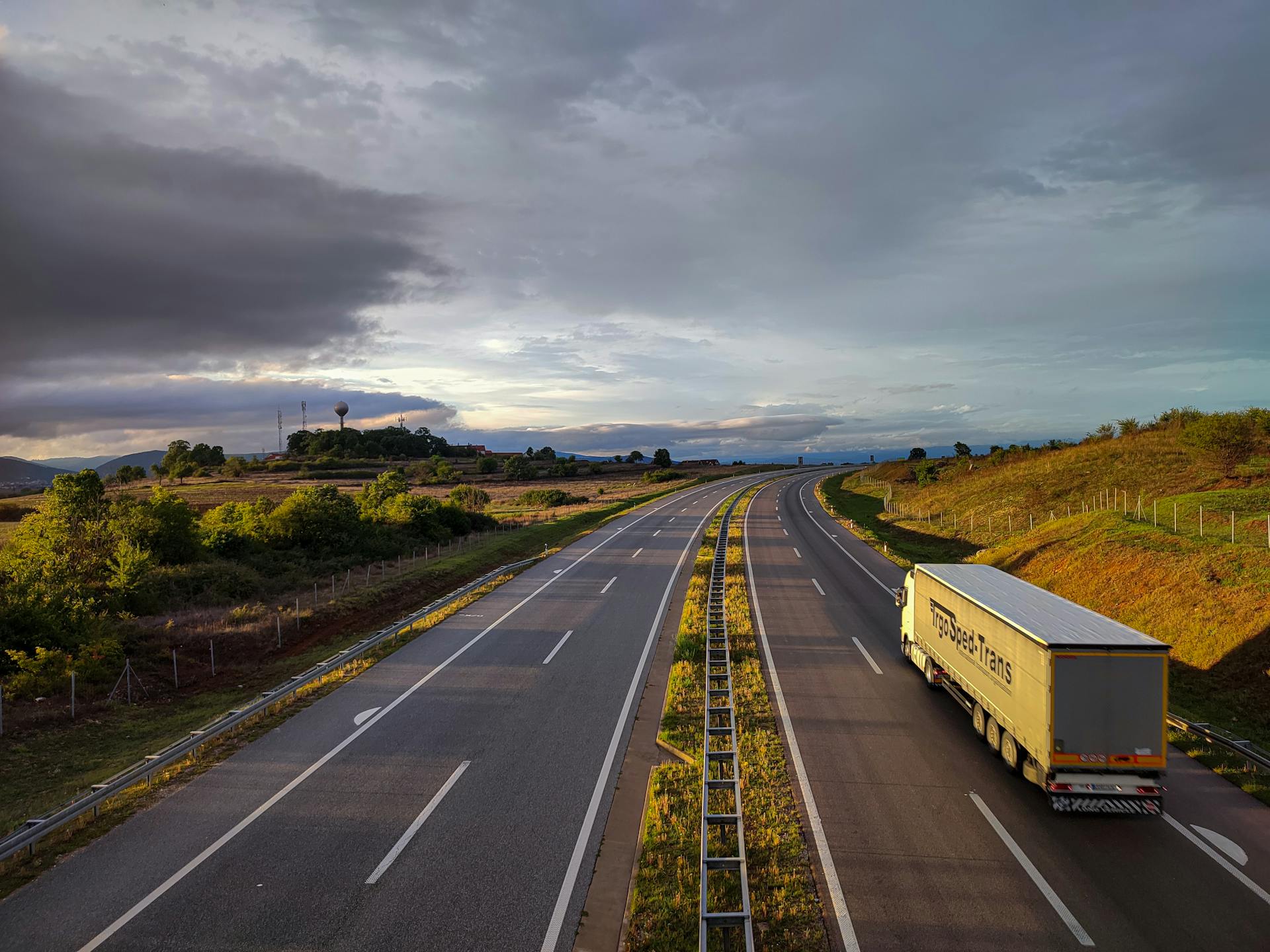
Maryland Truck Dispatch | Port of Baltimore & I-95 Corridor
Dispatch services for the Port of Baltimore. The #1 U.S. port for auto and light truck imports. The densest stretch of I-95 on the East Coast, and Maryland's federal government/military and biotech freight base.
How much do truck dispatch rates run in Maryland?
Maryland-origin freight currently pays about $2.35-$2.75/mi for dry van, more for reefer and flatbed. Demand is driven by Port & Auto Import Logistics, Federal Government & Defense and Pharmaceuticals & Biomedical. Grow Trucking dispatches Maryland owner-operators and small fleets across 15 tracked lanes on a transparent percentage-of-gross fee, disclosed upfront.
- Tracked lanes
- 15
- Major freight hubs
- Baltimore, Annapolis and Frederick
- Top industries
- Port & Auto Import Logistics and Federal Government & Defense
Maryland rate and market data reviewed September 2026. See our dispatch fee structure.
Maryland Truck Dispatch Services
Maryland sits at the crossroads of the Northeast Corridor. The Port of Baltimore ranks #1 nationally in automobile imports, farm machinery imports, and sugar imports. In 2025, Baltimore handled 728,225 autos and light trucks, second in the U.S. overall. It also finished second for exported coal and imported aluminum, gypsum, salt, and sugar. It ranks 10th among all U.S. ports in foreign cargo value ($65.6 billion). The port's container business gets a major boost in 2026 with the $518 million CSX Howard Street Tunnel Project. It will allow double-stacked container trains between Baltimore and Philadelphia. It is expected to add roughly 160,000 containers a year and nearly 14,000 jobs. Washington DC is close, which creates massive federal government and military freight demand (Aberdeen Proving Ground, Fort Meade/NSA, Andrews AFB, NIH Bethesda). The I-270 corridor in Montgomery County hosts the FDA, NIH, and a large biomedical/pharmaceutical cluster. I-95 through Maryland carries the densest truck traffic on the East Coast, with 30,000+ trucks a day between Baltimore and DC.
Maryland offers freight opportunities built on three things. They are the Port of Baltimore's #1 auto-import ranking, a massive federal government/military freight base, and a growing biotech/pharma corridor. Demand is strong for car-hauler, dry van, and specialized freight.
The Port of Baltimore is the #1 U.S. port for auto/light truck imports. That creates dependable, high-volume car-hauler and ro-ro freight
Washington DC is close, which creates a massive, stable federal government and military freight base. It is mostly shielded from the broader freight cycle
The CSX Howard Street Tunnel Project's 2026 completion adds real new container capacity and double-stack rail links to Philadelphia
The I-270 biotech/pharma corridor creates specialized, high-value freight that differs from standard distribution
What is the Maryland freight market like?
As of 2026, the Port of Baltimore keeps a banner run. It handled 728,225 autos and light trucks in 2025 (second in the U.S.). Its container business gets a lift this year from the CSX Howard Street Tunnel Project. It allows double-stacked container trains between Baltimore and Philadelphia and adds an estimated 160,000 containers of yearly capacity.
Average Rates
Maryland-origin rates (mid-2026): dry van roughly $2.35-$2.75/mile (I-95 corridor, retail distribution). Car-hauler/ro-ro rates earn a premium because of Baltimore's #1 U.S. auto-import ranking. Flatbed runs $2.55-$3.00/mile (farm machinery, project cargo). Reefer runs $2.50-$2.90/mile (Eastern Shore poultry/grain, Chesapeake Bay seafood).
Market Trends
- •
The Port of Baltimore led the nation in 2024 for roll-on/roll-off farm and construction equipment handling (848,628 tons). It stayed a top-2 U.S. port for vehicle imports through 2025 (728,225 autos/light trucks)
- •
The $518 million CSX Howard Street Tunnel Project finishes in 2026. It allows double-stacked container trains between Baltimore and Philadelphia. It adds an estimated 160,000 containers of yearly capacity plus nearly 14,000 jobs
- •
International manufacturers increasingly use the Port of Baltimore's foreign trade zones (FTZs) to store farm machinery and vehicles. They do it to manage tariff exposure amid trade policy swings
- •
Maryland's I-270 corridor (Montgomery County) keeps creating specialized pharma, laboratory, and medical device freight tied to the FDA and NIH
- •
I-95 through Maryland is still the densest truck-traffic corridor on the East Coast. It carries 30,000+ trucks a day between Baltimore and DC
What are the busiest freight lanes out of Maryland?
Price these lanes with our free Trip Pre-Cost Calculator, Should I Take This Load? Calculator and Lane Profitability Analyzer.
Baltimore to Washington
Freight route connecting Baltimore, MD to Washington, DC (40 miles). An extremely short, high-frequency corridor connecting Baltimore's port to the DC metro's government freight base.
Rate: $114 - $132
Distance: 40 miles
Baltimore to Philadelphia
Freight route connecting Baltimore, MD to Philadelphia, PA (100 miles). Benefits from the new CSX Howard Street Tunnel double-stack capacity connecting Baltimore's port to Philadelphia.
Rate: $270 - $310
Distance: 100 miles
Baltimore to New York
Freight route connecting Baltimore, MD to New York, NY (190 miles). The Northeast's largest consumer market, reached via I-95.
Rate: $494 - $570
Distance: 190 miles
Baltimore to Pittsburgh
Freight route connecting Baltimore, MD to Pittsburgh, PA (250 miles). Connects Baltimore's port to Western Pennsylvania's industrial base via I-70.
Rate: $638 - $738
Distance: 250 miles
Baltimore to Richmond
Freight route connecting Baltimore, MD to Richmond, VA (155 miles). Richmond's distribution position connects Maryland to the Mid-Atlantic via I-95.
Rate: $411 - $473
Distance: 155 miles
Baltimore to Norfolk
Freight route connecting Baltimore, MD to Norfolk, VA (220 miles). Connects Baltimore's port to the Port of Virginia and Naval Station Norfolk via I-95/I-64.
Rate: $561 - $649
Distance: 220 miles
Baltimore to Charlotte
Freight route connecting Baltimore, MD to Charlotte, NC (400 miles). Charlotte's banking and distribution sector connects well via I-95/I-85.
Rate: $980 - $1,140
Distance: 400 miles
Baltimore to Chicago
Freight route connecting Baltimore, MD to Chicago, IL (700 miles). Chicago's intermodal hub status extends Baltimore's Midwest reach via I-70/I-76.
Rate: $1,575 - $1,855
Distance: 700 miles
Baltimore to Atlanta
Freight route connecting Baltimore, MD to Atlanta, GA (640 miles). Atlanta's distribution hub status extends Baltimore's Southeast reach via I-95/I-85.
Rate: $1,472 - $1,728
Distance: 640 miles
Baltimore to Boston
Freight route connecting Baltimore, MD to Boston, MA (400 miles). The Northeast's second-largest consumer market, reached via I-95.
Rate: $980 - $1,140
Distance: 400 miles
Baltimore to Columbus
Freight route connecting Baltimore, MD to Columbus, OH (400 miles). Rickenbacker Inland Port and e-commerce DC growth make Columbus a strong reload market via I-70.
Rate: $980 - $1,140
Distance: 400 miles
Baltimore to Hagerstown
Freight route connecting Baltimore, MD to Hagerstown, MD (75 miles). Connects Baltimore's port to western Maryland's distribution cluster and the I-81 corridor via I-70.
Rate: $206 - $236
Distance: 75 miles
Baltimore to Charleston
Freight route connecting Baltimore, MD to Charleston, SC (590 miles). Connects Baltimore's port to South Carolina's automotive/port complex via I-95.
Rate: $1,386 - $1,622
Distance: 590 miles
Baltimore to Detroit
Freight route connecting Baltimore, MD to Detroit, MI (500 miles). Detroit's auto-supplier base creates two-way freight with Baltimore's own auto-import volume via I-70/I-76.
Rate: $1,175 - $1,375
Distance: 500 miles
Baltimore to Charlottesville
Freight route connecting Baltimore, MD to Charlottesville, VA (150 miles). Connects Maryland's freight base to central Virginia via I-95/US-29.
Rate: $398 - $458
Distance: 150 miles
Search brokers & carriers in Maryland
Browse active freight brokers and for-hire carriers based in Maryland. The list comes live from FMCSA and updates weekly. Check bond, authority, and fleet size before you haul.
Freight Brokers
Active, FMCSA-bonded freight brokers based in Maryland.
Browse directoryDry Van Carriers
For-hire dry van carriers operating out of Maryland.
Browse directoryFlatbed Carriers
For-hire flatbed carriers operating out of Maryland.
Browse directoryReefer Carriers
For-hire reefer carriers operating out of Maryland.
Browse directoryTruck Parking
Official NHS rest stops and truck parking capacity across Maryland.
Browse directoryWhich industries drive freight demand in Maryland?
Port & Auto Import Logistics (Port of Baltimore - #1 U.S. auto/light truck import port)
Federal Government & Defense (Aberdeen Proving Ground, Fort Meade/NSA, Andrews AFB, NIH Bethesda)
Pharmaceuticals & Biomedical (I-270 corridor in Montgomery County, FDA/NIH cluster)
Agriculture (Eastern Shore poultry, grain)
Food & Spice (McCormick & Company HQ in Hunt Valley, world's largest spice company)
Chesapeake Bay Seafood (crab, oysters)
How does Maryland freight change by season?
Rates and weather change with the seasons. Here is a quarter-by-quarter look at rates, weather, and what to do in Maryland.
Q1 (Jan-Mar)
Rate Movement
Rates ease 5-10% in January-February after the Q4 holiday/auto import surge
Weather Impact
Winter weather can sometimes affect I-95/I-70 corridors
Strategy
Position near Baltimore's port and I-95 corridor early in the week for the best rates
Q2 (Apr-Jun)
Rate Movement
Rates hold steady as government/defense freight and biotech/pharma freight continue year-round
Weather Impact
Generally favorable. Spring severe weather can cause short-lived disruptions
Strategy
Focus on I-270 biotech/pharma freight, which runs apart from the broader seasonal cycle
Q3 (Jul-Sep)
Rate Movement
Rates start climbing as auto-import and inbound port volume builds ahead of Q4
Weather Impact
Chesapeake Bay Bridge summer beach traffic can add congestion to Eastern Shore routes
Strategy
Watch Bay Bridge traffic patterns if you run Eastern Shore farm/seafood freight
Q4 (Oct-Dec)
Rate Movement
Highest rates of the year, peaking around Black Friday on auto-import and consumer goods volume
Weather Impact
Winter weather begins affecting I-95/I-70 by late November
Strategy
Book capacity early. The Port of Baltimore's Q3-Q4 auto-import surge makes this the tightest window of the year
Additional Seasonal Considerations
- •
The Q3-Q4 port-driven inbound consumer/auto goods surge peaks around Black Friday
- •
Federal government/defense freight runs steady year-round, mostly apart from the broader seasonal freight cycle
- •
Eastern Shore poultry/grain harvest freight peaks late summer through fall
- •
Chesapeake Bay Bridge summer beach traffic (Ocean City-bound) can add real congestion to Eastern Shore freight routes
Where are the major freight hubs in Maryland?
The ports, inland ports, intermodal terminals, and distribution cities that move freight across Maryland. See where most of the freight is.
Distribution Cities
- Baltimore
- Annapolis
- Frederick
- Hagerstown
- Rockville
Ports & Intermodal Terminals
Port of Baltimore (Dundalk & Fairfield Terminals)
The #1 U.S. port for auto and light truck imports (728,225 vehicles in 2025). Also #1 for roll-on/roll-off farm machinery.
CSX Howard Street Tunnel
A $518 million modernization project finishing in 2026. It allows double-stacked container trains between Baltimore and Philadelphia and adds ~160,000 containers of yearly capacity.
BWI Airport Cargo Facility
Supports time-sensitive freight for the DC-Baltimore metro's government, biotech, and consumer sectors.
Where can trucks park and fuel in Maryland?
Truck parking and fuel info to help you plan your routes through Maryland.
Estimate fuel, tolls, and fuel tax with our free Fuel Cost Calculator, IFTA Tax Calculator and Toll Cost Estimator with Route Comparison.
Major Truck Stops
TA Travel Center — Baltimore/White Marsh (I-95, Exit 67)
📍 8801 Pulaski Highway, Baltimore, MD 21237
210 truck parking spaces ($16/day fee), Country Pride restaurant, full truck maintenance, WiFi. A prime I-95 corridor spot serving Port of Baltimore drayage and auto-import freight.
Petro Stopping Center — Perryville (I-95, Exit 93)
📍 270 Bicentennial Circle, Perryville, MD 21903
240 truck parking spaces ($16/day fee), Iron Skillet restaurant, truck service center, CAT scales. A northeast Maryland gateway serving the Philadelphia-Baltimore I-95 corridor.
Love's Travel Stop — Hagerstown (I-70, Exit 32)
📍 17801 York Road, Hagerstown, MD 21740
185 truck parking spaces ($15/day fee), Arby's restaurant, 24/7 fuel, WiFi, showers. Western Maryland position connecting I-70/I-81 corridors and Pennsylvania freight routes.
Flying J Travel Plaza — Jessup (I-95, Exit 38)
📍 8285 Patuxent Range Road, Jessup, MD 20794
200 truck parking spaces ($16/day fee), Denny's restaurant, full fuel services. Critical positioning between Baltimore and Washington DC on I-95.
Pilot Travel Center — Aberdeen (I-95, Exit 85)
📍 635 South Philadelphia Boulevard, Aberdeen, MD 21001
170 truck parking spaces ($15/day fee), Subway restaurant, full services. Adjacent to Aberdeen Proving Ground - serves military/defense freight.
TA Express — Frederick (I-70, Exit 54)
📍 5001 Buckeystown Pike, Frederick, MD 21704
155 truck parking spaces ($14/day fee), Popeyes restaurant, repair services. On the central I-70 corridor, serving Frederick distribution and the I-270 biotech link.
Love's Travel Stop — La Plata (US-301, Exit 7)
📍 6700 Crain Highway, La Plata, MD 20646
145 truck parking spaces ($14/day fee), McDonald's, 24/7 fuel. Southern Maryland position serving US-301 alternative route to I-95 congestion.
Petro Stopping Center — Elkton (I-95, Exit 100)
📍 223 Belle Hill Road, Elkton, MD 21921
190 truck parking spaces ($16/day fee), Iron Skillet restaurant, full truck services. On the Maryland-Delaware border, serving Northeast Corridor freight.
Parking Difficulty
High. The I-95 corridor between Baltimore and DC sees severe parking demand and congestion, with 30,000+ trucks a day. Peak demand is weekday evenings 5-9 PM, when drivers park after fighting the Baltimore Harbor Tunnel and I-695/I-95 interchange bottlenecks. The Jessup area (I-95, Exit 38) between Baltimore-DC fills earliest because of its central spot. Perryville and Elkton (northern Maryland) run moderate to high because of Philadelphia-Baltimore traffic. Arrive before 5 PM or use reservation apps during the Q4 auto-import surge (Oct-Dec). Eastern Shore (US-50) and western Maryland (I-70/I-81) are less crowded but have fewer services.
- •Plan ahead for parking in metro areas
- •Use rest areas as a backup
- •Use parking apps to find available spots
Strategic Positioning Advice
Park where you can find loads fast and cut deadhead miles:
- •
Major Distribution Centers: Position near major distribution hubs in Baltimore for quick access to outbound loads.
- •
Busy Freight Routes: Stay near busy freight corridors to catch backhaul loads.
- •
Timing: Arrive when booking is busiest (usually early morning) to get the best rates.
Fuel price trend
How has the diesel price changed in Maryland?
EIA does not publish a separate diesel price for Maryland, so this is the weekly average for the Central Atlantic region that Maryland is part of, over the last 12 months.
- Price this week
- $6.51/gal
- Since last week
- Up 4 cents
- Versus a year ago
- Up 68%
- Versus the U.S. average
- 23 cents above
Week of October 19, 2026
+$2.63 a gallon
U.S. average $6.28
Source: U.S. Energy Information Administration weekly retail on-highway diesel prices. Averages, not the price at one pump.
What are Maryland's truck weight limits and regulations?
Weight limits, permits, and emission rules. Know these rules to stay legal. Also see what to expect at a DOT roadside inspection, the federal size and weight limits, and the full federal trucking regulations reference.
Check weights and permits with our free Scale / Weigh Station Guide, Weight & Axle Load Calculator and Oversize / Overweight Permit Estimator.
Weight Limits
Federal limits on the Interstate System (23 CFR 658.17):
- Single Axle: 20,000 lbs
- Tandem Axle: 34,000 lbs
- Gross Vehicle Weight: 80,000 lbs, or less where the bridge formula sets a lower total
Other highways follow Maryland law, and some states allow more on non-Interstate roads. Check with the state's size and weight office before you load.
Size Limits
Width is a federal limit. Height and trailer length depend on the state:
- Width: 8.5 feet (102 inches) on the National Network (23 CFR 658.15)
- Height: Set by each state. There is no federal height limit, and FHWA says most states are between 13 ft 6 in and 14 ft. Check Maryland's limit for your route.
- Length: 53 ft semitrailers are common, but a state can apply its own kingpin-to-rear-axle rule
State-Specific Rules
- •
Maryland State Police and MDOT jointly enforce commercial vehicle safety. They check trucks at weigh stations and with roving patrols
- •
Federal weight limits on the Interstate System: 80,000 lbs gross vehicle weight, 20,000 lbs single axle, 34,000 lbs tandem axle. Other highways follow state law, so check the state's size and weight office
- •
Size limits: 8.5 ft (102 in) width. Legal height is set by each state, and FHWA says most are 13 ft 6 in to 14 ft, so check the state's size and weight office. A 53 ft semitrailer is common, but state kingpin-to-rear-axle rules apply
- •
Oversize/overweight permits issued through the Maryland DOT
- •
Freight moving directly to or from military installations (Aberdeen Proving Ground, Fort Meade, Andrews AFB) may need more security clearance and paperwork
- •
Maryland's diesel fuel tax is about $0.37-0.40/gallon. It adjusts each year by a Consumer Price Index formula (verify the current rate with Maryland DOT)
Permits
Maryland may require special permits for:
- •Oversized/overweight loads
- •Hazardous materials
- •Special route rules
Maryland: freight facts a driver should know
Maryland's legal weight limits and permit-covered maximums
Without a permit, Maryland caps trucks at 80,000 pounds gross, 20,000 pounds on a single axle, 34,000 pounds on a tandem axle, and 42,500 pounds on a tridem axle. With a proper oversize/overweight permit from Maryland DOT, you can legally haul up to 120,000 pounds, and in exceptional cases, following an engineering review, permits can authorize loads over 150,000 pounds.
Source: Maryland Department of Transportation, oversize/overweight permit regulations. Checked 29 Sep 2026.
5,000 pounds over the limit means you don't move until you unload
A vehicle found to exceed any allowable weight limit by 5,000 pounds or more cannot be moved until the excess weight is unloaded. Maryland State Police and MDOT jointly enforce this at weigh stations and with roving patrols.
Source: Maryland commercial trucking rules overview. Checked 29 Sep 2026.
Active weather alerts for Maryland freight routes
Freeze Warning
Frederick; Carroll; Northern Baltimore; Northwest Harford; Culpeper; Northern Fauquier; Southern Fauquier; Western Loudoun
Active until Oct 25, 2:00 PM UTC
Source: National Weather Service. Refreshes with this page.
How have Maryland freight rates moved, and what's next?
How Maryland freight rates have moved through recent market cycles, and what owner-operators and fleets should expect next. Use this to time lane commitments and rate negotiations. Before you accept a load, check it against our free rate benchmarker.
Recent Rate Cycles
Rate cycles that shaped the current Maryland freight market:
2018-2019
Strong market. Rates hit their peak because trucks were in short supply
2020
Rates swung at first because of the pandemic. Freight demand then bounced back hard
2021-2022
Record-high rates. E-commerce demand surged and trucks were in short supply
2023-2024
Rates fell sharply as truck supply passed demand. Smaller carriers left the market
2025-2026
The national market is recovering. The Port of Baltimore's banner 2025 auto-import year and the CSX Howard Street Tunnel's 2026 completion have kept Maryland's freight demand strong
Market Correction Periods
Knowing when corrections hit Maryland helps with strategic planning:
- •
Q1 2023: Rates fell hard as trucks were added faster than freight grew
- •
Mid-2024: The market is settling, with supply and demand more in balance
- •
Pattern: Rate drops usually last 6–12 months before rates recover
Maryland Market Outlook
As of mid-2026, Maryland's freight market gains from the Port of Baltimore's banner auto-import performance. The CSX Howard Street Tunnel's near completion will greatly expand container capacity between Baltimore and Philadelphia.
What Drives Rates in Maryland
- •Freight volume and demand (auto imports, federal government/defense, biotech/pharma, agriculture)
- •Truck supply, which tightened a lot from last year across the nation
- •Fuel costs and Maryland's diesel fuel tax (~$0.37-0.40/gallon)
- •Port of Baltimore auto-import volume trends and CSX Howard Street Tunnel capacity expansion
How do I cut deadhead miles running freight in Maryland?
How to cut empty miles when you haul in and out of Maryland. See the outbound and inbound freight balance, the best return lanes, and where to park your truck. Run your own numbers with our free deadhead miles calculator.
Outbound Freight
50%
Roughly 50% of Maryland freight moves outbound. Outbound loads from Maryland's production and distribution centers typically book fastest early in the week.
Inbound Freight
50%
About 50% of the freight balance is inbound. Book your return load before you deliver. It is the biggest way to raise your rate-per-mile on these lanes.
Best Backhaul Lanes into Maryland
The strongest return lanes for repositioning back toward Maryland:
Washington DC to Baltimore
An extremely short, high-frequency corridor with government and consumer freight
Rate: $2.60 - $3.00/mile
Philadelphia to Baltimore
A short corridor that benefits from the new Howard Street Tunnel double-stack capacity
Rate: $2.55 - $2.95/mile
Pittsburgh to Baltimore
I-70 corridor connecting Maryland to Western Pennsylvania's industrial base
Rate: $2.45 - $2.85/mile
Positioning Strategies for Maryland
Where and when to stage to keep your next load close and your deadhead low:
- •
Position near Baltimore's port terminals for the fastest access to auto-import drayage freight
- •
Track vessel schedules at the port if you run ro-ro or container drayage freight
- •
Use load boards to pre-book backhaul before longer cross-country hauls
What do experienced dispatchers know about running Maryland?
Hands-on tips from years of dispatching in Maryland.
The Port of Baltimore's #1 U.S. ranking in auto imports (728,225 vehicles in 2025) is a durable, dependable freight base. Car-hauler carriers who build relationships here get steady, high-volume work. Vehicle processing moves through Dundalk and Fairfield terminals six days a week.
The CSX Howard Street Tunnel's 2026 completion is a real capacity unlock. Watch for growing Baltimore-Philadelphia container freight chances as double-stack service comes online. It adds an estimated 160,000 containers of yearly capacity.
Federal government and defense freight is mostly shielded from the broader freight cycle. It is worth building relationships if you can handle the security clearance rules. Aberdeen Proving Ground, Fort Meade/NSA, and Andrews AFB create constant freight demand.
Port of Baltimore container drayage and I-95 corridor positioning create Monday-Tuesday rate surges 10-15% above Friday. Import vessel arrivals bunch up weekly chassis demand.
I-95 tolls (Harbor Tunnel, Fort McHenry Tunnel) and Bay Bridge tolls are real costs. Add them to any lane crossing these points before you accept a rate. Commercial vehicle tolls can total $20-35 for a Baltimore-to-Delaware run.
The I-270 biotech/pharma corridor (Montgomery County, FDA and NIH cluster) is a distinct, higher-value freight niche apart from standard I-95 distribution. It is worth specializing in if you have temperature-controlled or hazmat equipment. Laboratory equipment and pharmaceutical samples need specialized handling.
Baltimore Harbor Tunnel (I-895) and Fort McHenry Tunnel (I-95) carry extreme congestion 6-9 AM and 3-7 PM on weekdays. Timing your route around these bottlenecks improves on-time performance by 30-60 minutes on Baltimore-DC runs.
Eastern Shore freight (poultry, grain, Chesapeake seafood) runs through Chesapeake Bay Bridge (US-50). Summer beach traffic (May-Sep weekends) adds 1-2 hours to crossing times. Plan Eastern Shore pickups/deliveries for weekdays when you can.
Port of Baltimore's foreign trade zones (FTZs) increasingly store farm machinery and vehicles awaiting tariff resolution. Knowing FTZ drayage rules opens a less-competitive freight niche paying $400-700 per terminal-to-warehouse move.
McCormick & Company (Hunt Valley, world's largest spice company) creates unique food-grade freight. It needs kosher/halal certification and strict contamination-prevention steps. This niche pays $2.60-$3.10/mile to specialized food-grade haulers.
Remember: These tips come from real dispatching work in Maryland. Markets change, but these basics still help you earn more and cut deadhead miles.
How have drivers near Maryland grown with Grow Trucking?
+$2,100/week after moving to $2.75/mi on produce / pharmaceutical / seafood freight. Pharma and seafood loads consistently matched.
Read the case study+$2,460/week after moving to $2.72/mi on e-commerce / general freight freight. New driver mentorship program broke broker access barriers.
Read the case studyMaryland Freight FAQs
Comprehensive answers to common questions about trucking and dispatch in Maryland. State-specific regulations, costs, and operating strategies.
Yes. You need a USDOT number, an MC number for interstate for-hire carriage, and Maryland-specific IRP/IFTA registration through the Maryland MVA (Motor Vehicle Administration). Maryland does not require separate intrastate authority for carriers that already hold federal interstate authority. Port of Baltimore drayage needs TWIC cards (Transportation Worker Identification Credential) for terminal access. It also needs SCAC code registration with port terminal operators. Military/defense freight (Aberdeen Proving Ground, Fort Meade, Andrews AFB) may need more security clearances. Contact facility transportation offices for specific rules before you accept defense freight.
Federal minimum liability coverage usually runs $750,000 for general freight and $1,000,000 for hazmat cargo. You also need cargo insurance ($100,000+ depending on commodity) and physical damage coverage. Port of Baltimore auto-import (ro-ro) freight needs $500,000-$1,000,000 cargo coverage because of high vehicle values. I-270 biotech/pharma freight often needs $250,000-$500,000 cargo coverage with temperature-control liability endorsements and chain-of-custody records for pharmaceutical samples. Defense freight may need higher liability limits and named insured status for DOD/military facilities. Confirm current minimums with your insurance provider. Verify coverage meets port terminal, pharmaceutical, and defense freight rules.
As of mid-2026, car-hauler/ro-ro freight tied to the Port of Baltimore's #1 U.S. auto-import ranking earns premium, dependable rates ($2.60-$3.20/mile for finished vehicles). Biotech/pharma freight out of the I-270 corridor pays $2.70-$3.10/mile (needs temperature-control and pharmaceutical handling certifications). Port container drayage averages $350-$650 per terminal-to-warehouse move, depending on distance. Flatbed tied to farm machinery imports and project cargo runs $2.55-$3.00/mile. General dry van runs $2.35-$2.75/mile. Eastern Shore reefer freight (poultry, seafood) runs $2.50-$2.90/mile. Defense freight pays time-sensitive premiums of $0.20-$0.40/mile above standard rates when delivery windows are tight.
Yes. Maryland's Port of Baltimore auto-import volume (728,225 vehicles in 2025) and stable federal government/defense freight base give new operators real stability. But new carriers should do five things. (1) Factor I-95 congestion into delivery time commitments. The Baltimore Harbor Tunnel and I-695/I-95 interchange add 30-60 minutes at peak hours (6-9 AM, 3-7 PM). (2) Add toll costs to every lane crossing I-95 tunnels ($8-12 per crossing) and Bay Bridge ($8-16 depending on axles). (3) Know that biotech/pharma freight needs specialized temperature-control equipment and pharmaceutical handling certification. (4) Get TWIC cards before you accept port drayage freight ($125+ per driver, valid 5 years). (5) Build relationships with Port of Baltimore auto-import and government/defense freight brokers for dependable repeat business.
Maryland diesel fuel tax is about $0.474 per gallon as of 2026, among the higher state rates on the East Coast. Add the federal tax ($0.244/gallon), and total diesel fuel tax is about $0.718 per gallon. The rate adjusts each year on July 1 by a CPI formula. Retail diesel in the Central Atlantic region, which includes Maryland, averages $6.51/gallon as of October 19, 2026 (EIA weekly average), about 23 cents above the national average of $6.28. That price is up 4 cents from last week and 68% above a year ago. Maryland's Mid-Atlantic corridor location (Baltimore port, I-95, DC nearby) creates high-traffic city challenges, with delivery limits and enforcement. Fuel stops in lower-tax Delaware ($0.22/gal) may help IFTA planning. But weigh Baltimore tolls and routing efficiency too. Source: IFTA matrix, Maryland Department of Transportation, AAA, verified September 2026.
To haul Port of Baltimore container drayage (terminal-to-warehouse moves), you need six things. (1) A TWIC card for all drivers ($125+ application fee, TSA background check, valid 5 years). (2) A SCAC code registered with port terminal operators (Dundalk, Fairfield, Seagirt terminals). (3) Proof of insurance on file with terminal operators before you get gate access. (4) Pre-registration in the terminal's truck appointment system (varies by terminal: Navis N4, eModal, or similar). (5) A chassis provider agreement (TRAC Intermodal, Direct ChassisLink, or Flexi-Van). (6) Knowledge of port terminal hours and appointment windows. CSX Howard Street Tunnel completion (2026) will raise double-stack rail container volume. Position for growing Baltimore-Philadelphia intermodal drayage chances. Contact Port of Baltimore Trucking Operations office to verify current terminal access rules before your first pickup. Gate delays average 30-45 minutes in peak periods (8-11 AM, 2-5 PM). Build buffer time into delivery commitments.
Maryland runs tolled facilities on I-95 (Harbor Tunnel, Fort McHenry Tunnel) and the Chesapeake Bay Bridge (US-50). Here are the commercial truck tolls. (1) Baltimore Harbor Tunnel (I-895): $8-12 per crossing, depending on axle count. (2) Fort McHenry Tunnel (I-95 through Baltimore): $8-12 per crossing. (3) John F. Kennedy Memorial Highway (I-95 northern Maryland near the Delaware border): $10-15. (4) Chesapeake Bay Bridge (US-50 to Eastern Shore): $8-16, depending on axles. (5) Intercounty Connector (ICC/MD-200): $10-20, depending on distance. E-ZPass gives 10-15% discounted toll rates versus cash. It also gets you through toll plazas faster. Total toll costs for a Baltimore-to-Delaware run via I-95 can reach $20-35, depending on route. Factor toll costs into every rate before you accept Maryland freight. Rates that look competitive may become unprofitable after tolls.
Book outbound loads Monday-Wednesday, when Maryland spot rates usually run 10-15% higher than Friday/weekend postings. Port of Baltimore drayage pays the most Tuesday-Thursday (15-20% premium over Friday rates), as shippers clear containers before weekend terminal closures. Defense freight (Aberdeen Proving Ground, Fort Meade, Andrews AFB) runs Monday-Friday with minimal weekend volume. Avoid Friday afternoon loads unless the rate covers weekend deadhead risk. The Q4 auto-import surge (October-December, peaking around Black Friday) creates extreme capacity tightness on Port of Baltimore car-hauler and container freight. Book 5-7 days ahead in this period, as rates spike 20-30% above baseline. Eastern Shore farm freight (poultry, grain) peaks late summer through fall harvest. Position early to catch the most.
I-95 through Baltimore (especially Baltimore Harbor Tunnel, Fort McHenry Tunnel, and I-695/I-95 interchange) carries 30,000+ trucks a day and sees severe congestion. Here are six strategies. (1) Avoid peak hours (6-9 AM southbound, 3-7 PM northbound) when you can. Off-peak travel saves 30-60 minutes on Baltimore-DC runs. (2) Consider I-895 (Baltimore Harbor Tunnel bypass) as an option to I-95 Fort McHenry Tunnel. Travel time varies by time of day. (3) Use real-time traffic apps (Waze, Google Maps, Maryland 511) to check current conditions before you pick a route. (4) Build 1-2 hours of buffer into delivery commitments for Baltimore-area freight at peak hours. (5) Tell dispatchers and shippers about likely delays early. Most DC-Baltimore shippers understand I-95 congestion. (6) Plan fuel stops outside the Baltimore urban core. Truck stops north (Perryville, Aberdeen) or south (Jessup) have better parking than Baltimore proper. Winter weather and accidents can shut down I-95 tunnels entirely. Watch Maryland DOT 511 for real-time closure updates.
Maryland truck parking is hard on the I-95 corridor between Baltimore and DC, which carries 30,000+ trucks a day. Peak demand is 5-9 PM, when drivers park after fighting Baltimore congestion. The Jessup area (I-95, Exit 38) between Baltimore-DC fills earliest (by 6 PM) because of its central spot. White Marsh (I-95, Exit 67, TA Travel Center) and Perryville (I-95, Exit 93) fill by 7-8 PM on weeknights. To secure parking, do five things. (1) Arrive before 5 PM on the I-95 corridor, especially the Jessup/Baltimore-DC stretch. (2) Use truck stop reservation apps (TruckSmart, Trucker Path Pro) during the Q4 auto-import surge and defense contract delivery periods. (3) Consider western Maryland (Hagerstown I-70/I-81 corridor) or US-301 (La Plata) as lower-cost staging with good I-95 access. (4) Have backup parking spots picked out. Maryland rest areas have truck parking (free, 8-hour max stay) but fill fast in peak periods. (5) Plan fuel stops with care. I-95 Maryland has truck stops every 15-30 miles, but parking availability varies widely by time of day. Eastern Shore (US-50) and western Maryland (I-70/I-81) are moderately hard, with fewer services but lower demand. This is among the hardest East Coast parking markets. Advance planning is key year-round.
Keep exploring dispatch options
Tools, equipment guides and nearby states relevant to running freight in and out of Maryland.
By equipment
Free tools
- Trip Pre-Cost Calculator
- Toll Cost Estimator with Route Comparison
- Load Board Rate Benchmarker
- Deadhead Miles Calculator
- Fuel Cost Calculator
- IFTA Tax Calculator
- Scale / Weigh Station Guide
- Cost Per Mile Calculator
- Diesel prices today
- Diesel tax by state
- Truck idling laws by state
- Truck speed limits by state
- Truck chain laws by state
- Truck lane laws by state
- Truck height and length limits by state
- Rest area parking limits by state
- Central Atlantic diesel prices
- Home Time Planner
- Drug & Alcohol Testing Tracker
- All Free Tools
Nearby states
Services
More from Grow Trucking
Ready to Move Freight in Maryland?
Secure Your Strategy:
Apply for your FREE Custom 90-Day Growth Plan (a $1,500 value). It starts with a Business Audit that finds where you lose money and sets your profit goals.
Guarantee Your GROWTH:
Start your 90-day partnership to implement the plan. We back it with our "Growth or Your Money Back" Guarantee.