
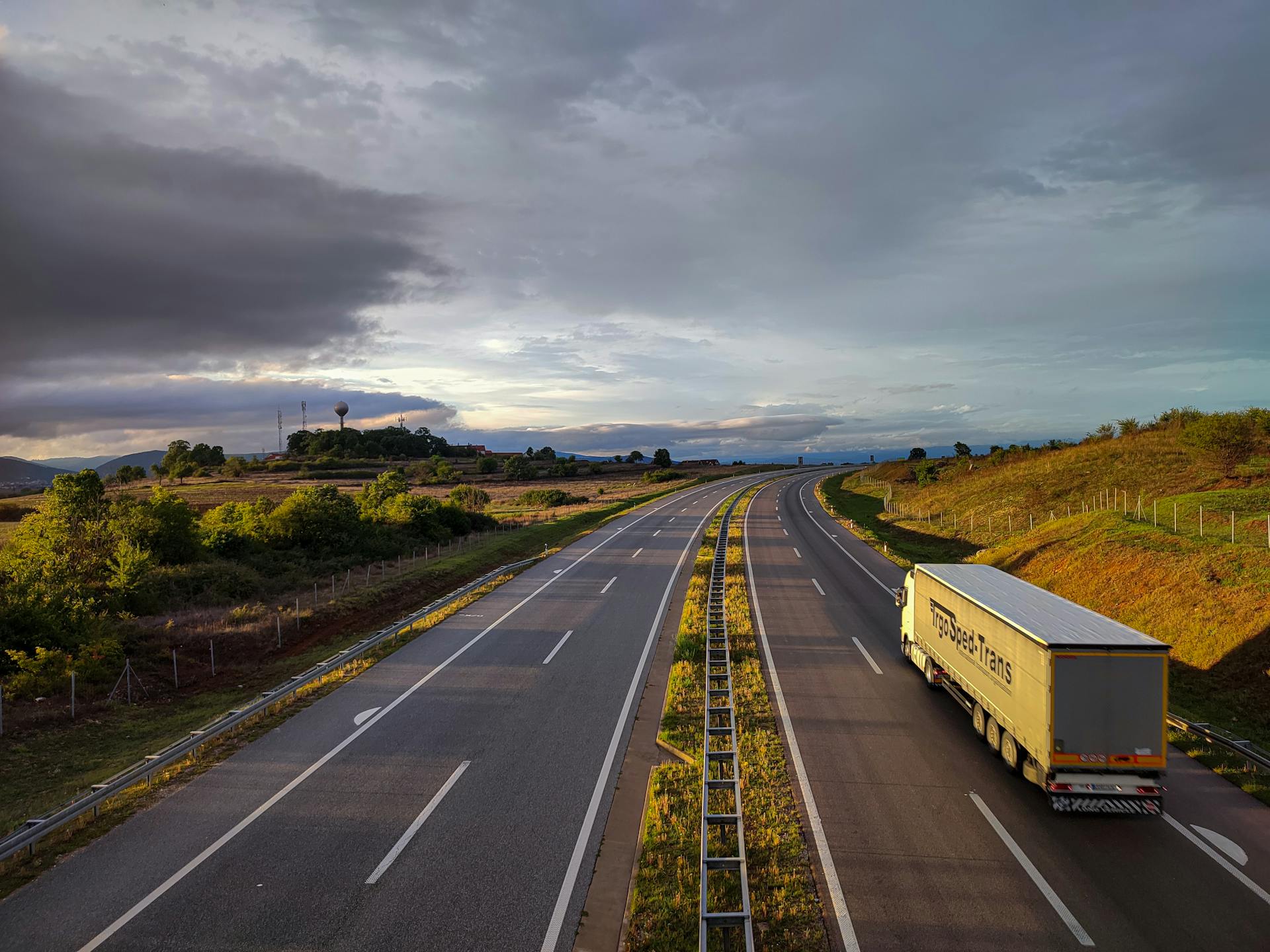
Oregon Truck Dispatch | Port of Portland & Silicon Forest
Dispatch services for Oregon's Port of Portland. The #1 U.S. wheat export gateway. The Silicon Forest tech corridor around Intel's Hillsboro campus, and the state's #1-in-the-nation timber industry.
How much do truck dispatch rates run in Oregon?
Oregon-origin freight currently pays about $2.25-$2.70/mi for dry van, more for reefer and flatbed. Demand is driven by Technology Manufacturing, Port & Bulk Agricultural Export and Timber & Forest Products. Grow Trucking dispatches Oregon owner-operators and small fleets across 14 tracked lanes on a transparent percentage-of-gross fee, disclosed upfront.
- Tracked lanes
- 14
- Major freight hubs
- Portland, Eugene and Salem
- Top industries
- Technology Manufacturing and Port & Bulk Agricultural Export
Oregon rate and market data reviewed September 2026. See our dispatch fee structure.
Oregon Truck Dispatch Services
Oregon sits at the crossroads of Pacific Northwest commerce. Portland's deep-water port on the Columbia River is the #1 U.S. wheat export gateway. It also handles container, auto, and bulk cargo. The 'Silicon Forest' corridor along US-26 west of Portland creates specialized year-round tech and consumer freight. It is centered on Intel's Hillsboro campus (the company's largest global manufacturing site, employing 22,000+ people) and Nike's Beaverton headquarters. Inbound freight includes chemicals, specialty gases, ultra-pure water systems, and precision equipment. Outbound freight includes finished wafers and Nike/Columbia Sportswear/adidas NA apparel distribution. Oregon ranks in the top 3 nationally for lumber production. The Willamette Valley produces roughly 75% of U.S. grass seed. Harvest in July-August creates a concentrated flatbed and van freight spike as seed moves from farms to cleaning plants and export terminals. The Columbia-Snake River barge system connects Portland to Lewiston, ID (470 miles). It carries grain and fertilizer at a fraction of truck cost per ton-mile.
Oregon offers freight opportunities anchored by the Port of Portland's #1 U.S. wheat export status and the Silicon Forest's Intel/Nike tech and consumer corridor. The state's leading timber industry adds more. Demand is strong for flatbed, reefer, and specialized freight.
The #1 U.S. wheat export gateway gives you a dependable, massive bulk farm freight base
Intel's Hillsboro expansion creates constant, high-value flatbed/heavy-haul demand for construction and precision equipment
Oregon's #1-in-the-nation grass seed production and top-3 lumber production give you varied flatbed freight beyond a single commodity
Nike, Columbia Sportswear, and adidas NA headquarters create year-round apparel distribution freight, apart from farm seasonality
What is the Oregon freight market like?
As of 2026, Oregon's freight market gains from Intel's continued Hillsboro expansion projects. They create massive flatbed and heavy-haul demand for construction materials and precision equipment. The Willamette Valley's July-August grass seed harvest creates a concentrated, predictable freight spike. It stands apart from the broader farm calendar.
Average Rates
Oregon-origin rates (mid-2026): dry van roughly $2.25-$2.70/mile (Portland distribution, Nike/Columbia Sportswear/adidas apparel). Flatbed runs $2.60-$3.20/mile (timber/lumber, Oregon's largest industry, and Intel construction/heavy-haul freight). Reefer runs $2.50-$2.90/mile (berries, nursery stock).
Market Trends
- •
Intel keeps expanding at its Hillsboro campus, the company's largest manufacturing site globally. That creates massive flatbed and heavy-haul demand for construction materials and precision semiconductor equipment
- •
Oregon produces roughly 75% of U.S. grass seed. The Willamette Valley's July-August harvest creates a concentrated flatbed and van freight spike as seed moves from farms to cleaning plants and export terminals
- •
The ongoing environmental debate over removing the four lower Snake River dams could end Lewiston, ID's port access. It could shift big grain freight from barge to rail or truck
- •
Portland is still the #1 U.S. wheat export gateway. It anchors a steady bulk farm export freight base
- •
Nike (Beaverton), Columbia Sportswear (Portland), and adidas NA (Portland) headquarters create year-round apparel/footwear distribution freight
What are the busiest freight lanes out of Oregon?
Price these lanes with our free Trip Pre-Cost Calculator, Should I Take This Load? Calculator and Lane Profitability Analyzer.
Portland to Seattle
Freight route connecting Portland, OR to Seattle, WA (175 miles). A short, high-frequency I-5 corridor connecting two major Pacific Northwest port/freight markets.
Rate: $446 - $516
Distance: 175 miles
Portland to Sacramento
Freight route connecting Portland, OR to Sacramento, CA (580 miles). Connects Portland to Northern California's growing distribution market via I-5.
Rate: $1,334 - $1,566
Distance: 580 miles
Portland to San Francisco
Freight route connecting Portland, OR to San Francisco, CA (635 miles). Connects Portland's tech/apparel sector to the Bay Area's tech/consumer market via I-5.
Rate: $1,429 - $1,683
Distance: 635 miles
Portland to Boise
Freight route connecting Portland, OR to Boise, ID (435 miles). Connects Portland to Idaho's agricultural/distribution base via I-84.
Rate: $1,000 - $1,174
Distance: 435 miles
Portland to Los Angeles
Freight route connecting Portland, OR to Los Angeles, CA (965 miles). Connects Portland's port/apparel sector to Southern California's massive consumer market via I-5.
Rate: $2,026 - $2,412
Distance: 965 miles
Portland to Spokane
Freight route connecting Portland, OR to Spokane, WA (350 miles). Connects Portland to Eastern Washington's agricultural base via I-84/US-395.
Rate: $822 - $962
Distance: 350 miles
Portland to Eugene
Freight route connecting Portland, OR to Eugene, OR (110 miles). Connects Portland to the Willamette Valley's grass seed and timber freight base via I-5.
Rate: $297 - $341
Distance: 110 miles
Portland to Salt Lake City
Freight route connecting Portland, OR to Salt Lake City, UT (765 miles). Connects Portland to Utah's distribution corridor via I-84.
Rate: $1,645 - $1,951
Distance: 765 miles
Portland to Denver
Freight route connecting Portland, OR to Denver, CO (1245 miles). Denver's Mountain West distribution hub rounds out Portland's eastbound reach via I-84.
Rate: $2,490 - $2,988
Distance: 1245 miles
Portland to Hillsboro
Freight route connecting Portland, OR to Hillsboro, OR (20 miles). An extremely short corridor serving Intel's largest global manufacturing campus.
Rate: $57 - $66
Distance: 20 miles
Portland to Vancouver
Freight route connecting Portland, OR to Vancouver, WA (10 miles). An extremely short cross-river corridor connecting Portland to its Washington-side sister city.
Rate: $29 - $34
Distance: 10 miles
Portland to Medford
Freight route connecting Portland, OR to Medford, OR (275 miles). Connects Portland to Southern Oregon's timber and agricultural freight base via I-5.
Rate: $701 - $811
Distance: 275 miles
Portland to Reno
Freight route connecting Portland, OR to Reno, NV (555 miles). Connects Portland to Northern Nevada's growing distribution hub via I-5/US-395.
Rate: $1,276 - $1,498
Distance: 555 miles
Portland to Chicago
Freight route connecting Portland, OR to Chicago, IL (2100 miles). Chicago's intermodal hub status extends Portland's Midwest reach via I-84/I-80.
Rate: $3,885 - $4,725
Distance: 2100 miles
Search brokers & carriers in Oregon
Browse active freight brokers and for-hire carriers based in Oregon. The list comes live from FMCSA and updates weekly. Check bond, authority, and fleet size before you haul.
Freight Brokers
Active, FMCSA-bonded freight brokers based in Oregon.
Browse directoryDry Van Carriers
For-hire dry van carriers operating out of Oregon.
Browse directoryFlatbed Carriers
For-hire flatbed carriers operating out of Oregon.
Browse directoryReefer Carriers
For-hire reefer carriers operating out of Oregon.
Browse directoryTruck Parking
Official NHS rest stops and truck parking capacity across Oregon.
Browse directoryWhich industries drive freight demand in Oregon?
Technology Manufacturing (Intel in Hillsboro, largest global manufacturing site)
Port & Bulk Agricultural Export (Port of Portland, #1 U.S. wheat export gateway)
Timber & Forest Products (Oregon ranks top 3 nationally in lumber production)
Sportswear/Retail (Nike HQ in Beaverton, Columbia Sportswear HQ, adidas NA HQ in Portland)
Agriculture (Willamette Valley: grass seed #1 US at 75% of supply, hazelnuts, berries, nursery stock)
Seafood & Coastal Fisheries
How does Oregon freight change by season?
Rates and weather change with the seasons. Here is a quarter-by-quarter look at rates, weather, and what to do in Oregon.
Q1 (Jan-Mar)
Rate Movement
Rates hold fairly steady because of Intel's year-round freight base
Weather Impact
Occasional winter weather can affect I-84 Columbia Gorge and mountain routes
Strategy
Position near Portland's I-5/I-84 interchange early in the week for the best rates
Q2 (Apr-Jun)
Rate Movement
Rates get stronger as construction/flatbed freight ramps up ahead of summer harvest season
Weather Impact
Generally favorable statewide
Strategy
Prepare for the coming grass seed harvest freight spike in July
Q3 (Jul-Sep)
Rate Movement
Rates spike sharply during the July-August grass seed harvest, Oregon's most concentrated seasonal freight event
Weather Impact
Generally favorable, though wildfire smoke can sometimes affect visibility/air quality
Strategy
Focus on Willamette Valley grass seed and berry harvest freight during this narrow window
Q4 (Oct-Dec)
Rate Movement
Rates stay high as wheat export season and holiday retail freight overlap
Weather Impact
Winter weather starts hitting I-84 Columbia Gorge and mountain routes by late November
Strategy
Book capacity early. Overlapping wheat export and holiday freight make this a tight window
Additional Seasonal Considerations
- •
Willamette Valley grass seed harvest (Jul-Aug) creates a concentrated flatbed/van freight spike
- •
Wheat export season ties to Eastern Oregon harvest timing, feeding Portland's export terminals
- •
Intel construction/equipment freight runs steady year-round, apart from season
- •
Berry harvest season (summer) drives Willamette Valley reefer freight demand
Where are the major freight hubs in Oregon?
The ports, inland ports, intermodal terminals, and distribution cities that move freight across Oregon. See where most of the freight is.
Distribution Cities
- Portland
- Eugene
- Salem
- Hillsboro
- Bend
Ports & Intermodal Terminals
Port of Portland
The #1 U.S. wheat export gateway. It also handles container, auto import, and bulk cargo on the Columbia River.
Intel Hillsboro Campus (Silicon Forest)
Intel's largest global manufacturing site. It employs 22,000+ and creates constant specialized freight demand.
Columbia-Snake River Barge System
Connects Portland to Lewiston, ID (470 miles). It carries grain and fertilizer by barge through locks at Bonneville, The Dalles, and other dams.
Where can trucks park and fuel in Oregon?
Truck parking and fuel info to help you plan your routes through Oregon.
Estimate fuel, tolls, and fuel tax with our free Fuel Cost Calculator, IFTA Tax Calculator and Toll Cost Estimator with Route Comparison.
Major Truck Stops
TA Travel Center - Troutdale (I-84, Exit 17)
📍 1000 NW Frontage Rd, Troutdale, OR 97060
240 truck parking spaces ($12/day with fuel), restaurant, showers, laundry, WiFi, CAT scale. Primary Portland metro staging for eastbound I-84 freight.
Pilot Flying J - Woodburn (I-5, Exit 271)
📍 1235 N Arney Rd, Woodburn, OR 97071
180 truck parking spaces ($10/day with fuel), restaurant, showers, WiFi. Major I-5 corridor stop south of Portland metro.
Loves - Albany (I-5, Exit 233)
📍 2950 Three Lakes Rd SE, Albany, OR 97322
160 truck parking spaces ($12/day with fuel), restaurant, showers, WiFi, CAT scale. Willamette Valley central staging.
Pacific Pride - Eugene (I-5, Exit 195)
📍 2795 Pierce Pkwy, Eugene, OR 97402
120 truck parking spaces (free with fuel), 24/7 diesel, convenience store. Southern Willamette Valley freight hub.
Jubitz Truck Stop - Portland (I-5, Exit 307)
📍 10310 N Vancouver Way, Portland, OR 97217
350 truck parking spaces ($15/day), full service restaurant, showers, truck wash, movie theater. Legendary Portland truck stop near port.
Chevron - Pendleton (I-84, Exit 209)
📍 505 SE 5th St, Pendleton, OR 97801
80 truck parking spaces (free), diesel, convenience store. Eastern Oregon wheat country staging for Portland-bound freight.
Shell - Bend (US-97)
📍 63455 N Hwy 97, Bend, OR 97703
60 truck parking spaces (free), diesel, convenience store. Central Oregon freight staging for north-south US-97 corridor.
Pilot - Ontario (I-84, Exit 376)
📍 1249 Tapadera Ave, Ontario, OR 97914
100 truck parking spaces ($10/day with fuel), restaurant, showers, WiFi. Oregon-Idaho border staging, gateway to the Boise market.
Parking Difficulty
Moderate to High. Portland metro sees high demand because of port/distribution volume. Jubitz (350 spaces, $15/day) and TA Troutdale (240 spaces, $12/day) fill by 7-8 PM Monday-Thursday. I-5 corridor stops at Woodburn, Albany, and Eugene have better availability but still fill evenings in peak freight weeks. Grass seed harvest season (July-August) sharply tightens Willamette Valley parking. Eastern Oregon has easier parking year-round. Weekend parking is moderately easier statewide.
- •Plan ahead for parking in metro areas
- •Use rest areas as a backup
- •Use parking apps to find available spots
Strategic Positioning Advice
Park where you can find loads fast and cut deadhead miles:
- •
Major Distribution Centers: Position near major distribution hubs in Portland for quick access to outbound loads.
- •
Busy Freight Routes: Stay near busy freight corridors to catch backhaul loads.
- •
Timing: Arrive when booking is busiest (usually early morning) to get the best rates.
Fuel price trend
How has the diesel price changed in Oregon?
EIA does not publish a separate diesel price for Oregon, so this is the weekly average for the West Coast region that Oregon is part of, over the last 12 months.
- Price this week
- $7.39/gal
- Since last week
- Up 15 cents
- Versus a year ago
- Up 67%
- Versus the U.S. average
- $1.12 above
Week of October 19, 2026
+$2.97 a gallon
U.S. average $6.28
Source: U.S. Energy Information Administration weekly retail on-highway diesel prices. Averages, not the price at one pump.
What are Oregon's truck weight limits and regulations?
Weight limits, permits, and emission rules. Know these rules to stay legal. Also see what to expect at a DOT roadside inspection, the federal size and weight limits, and the full federal trucking regulations reference.
Check weights and permits with our free Scale / Weigh Station Guide, Weight & Axle Load Calculator and Oversize / Overweight Permit Estimator.
Weight Limits
Federal limits on the Interstate System (23 CFR 658.17):
- Single Axle: 20,000 lbs
- Tandem Axle: 34,000 lbs
- Gross Vehicle Weight: 80,000 lbs, or less where the bridge formula sets a lower total
Other highways follow Oregon law, and some states allow more on non-Interstate roads. Check with the state's size and weight office before you load.
Size Limits
Width is a federal limit. Height and trailer length depend on the state:
- Width: 8.5 feet (102 inches) on the National Network (23 CFR 658.15)
- Height: 14 ft legal height in Oregon. There is no federal height limit.
- Length: 53 ft semitrailers are common, but a state can apply its own kingpin-to-rear-axle rule
State-Specific Rules
- •
Oregon State Police and ODOT jointly enforce commercial vehicle safety. They check trucks at weigh stations and with roving patrols
- •
Federal weight limits on the Interstate System: 80,000 lbs gross vehicle weight, 20,000 lbs single axle, 34,000 lbs tandem axle. Other highways follow state law, so check the state's size and weight office
- •
Size limits: 8.5 ft (102 in) width, 14 ft legal height, and a 53 ft semitrailer (state kingpin-to-rear-axle rules apply)
- •
Oversize/overweight permits come from ODOT
- •
Oregon uses a weight-mile tax in place of a traditional diesel fuel tax for most heavy commercial vehicles. Carriers must register for and report this separately from IFTA
- •
Oregon has no state sales tax. That can affect certain freight-related cost math differently than in sales-tax states
Permits
Oregon may require special permits for:
- •Oversized/overweight loads
- •Hazardous materials
- •Special route rules
Oregon: freight facts a driver should know
Oregon's legal height limit is taller than most states'
Oregon allows trucks up to 14 feet tall — six inches above the 13-foot-6-inch limit most states use. Gross weight still caps at 80,000 pounds, with single and tandem axle limits set by the lesser of a tire-width formula, the tire manufacturer's rating, or 20,000/34,000 pounds.
Source: Oregon Department of Transportation, legal vehicle dimensions. Checked 30 Sep 2026.
Oregon charges a separate weight-mile tax on top of permits
Oregon runs a mileage-based Weight-Mile Tax that heavy trucks pay in addition to fuel tax and any OS/OW permit, with the rate set by weight bracket. Ports of entry actively check for unpaid weight-mile tax, so it's worth squaring away before you run the state. Oregon's own Weight Table 2 annual permit separately lets divisible loads with legal individual axle weights run up to 105,500 pounds gross.
Source: Oregon Department of Transportation, permittable vehicle dimensions and weight tables. Checked 30 Sep 2026.
How have Oregon freight rates moved, and what's next?
How Oregon freight rates have moved through recent market cycles, and what owner-operators and fleets should expect next. Use this to time lane commitments and rate negotiations. Before you accept a load, check it against our free rate benchmarker.
Recent Rate Cycles
Rate cycles that shaped the current Oregon freight market:
2018-2019
Strong market. Rates hit their peak because trucks were in short supply
2020
Rates swung at first because of the pandemic. Freight demand then bounced back hard
2021-2022
Record-high rates. E-commerce demand surged and trucks were in short supply
2023-2024
Rates fell sharply as truck supply passed demand. Smaller carriers left the market
2025-2026
The national market is recovering. Intel's continued Hillsboro investment and Oregon's varied farm export base have kept freight demand strong
Market Correction Periods
Knowing when corrections hit Oregon helps with strategic planning:
- •
Q1 2023: Rates fell hard as trucks were added faster than freight grew
- •
Mid-2024: The market is settling, with supply and demand more in balance
- •
Pattern: Rate drops usually last 6–12 months before rates recover
Oregon Market Outlook
As of mid-2026, Oregon's freight market gains from Intel's continued Hillsboro expansion and the state's varied farm export base (wheat, grass seed, berries). Real uncertainty around the Snake River dam-removal debate's impact on grain barge access tempers this.
What Drives Rates in Oregon
- •Freight volume and demand (semiconductor manufacturing, bulk farm export, timber, apparel distribution)
- •Truck supply, which tightened a lot from last year across the nation
- •Oregon's weight-mile tax structure (in place of a traditional per-gallon fuel tax) for heavy vehicles
- •Intel construction/equipment cycles and Willamette Valley harvest timing
How do I cut deadhead miles running freight in Oregon?
How to cut empty miles when you haul in and out of Oregon. See the outbound and inbound freight balance, the best return lanes, and where to park your truck. Run your own numbers with our free deadhead miles calculator.
Outbound Freight
50%
Roughly 50% of Oregon freight moves outbound. Outbound loads from Oregon's production and distribution centers typically book fastest early in the week.
Inbound Freight
50%
About 50% of the freight balance is inbound. Book your return load before you deliver. It is the biggest way to raise your rate-per-mile on these lanes.
Best Backhaul Lanes into Oregon
The strongest return lanes for repositioning back toward Oregon:
Seattle to Portland
A short I-5 corridor connecting two major Pacific Northwest freight markets
Rate: $2.55 - $2.95/mile
Boise to Portland
I-84 corridor connecting Idaho's farm base to Portland's export terminals
Rate: $2.40 - $2.80/mile
Sacramento to Eugene
I-5 corridor connecting Northern California to Oregon's Willamette Valley
Rate: $2.35 - $2.75/mile
Positioning Strategies for Oregon
Where and when to stage to keep your next load close and your deadhead low:
- •
Position near Portland's I-5/I-84 interchange for the fastest access to outbound loads
- •
Track Intel construction schedules if you run specialized flatbed/heavy-haul freight
- •
Plan around the narrow but intense July-August grass seed harvest window
What do experienced dispatchers know about running Oregon?
Hands-on tips from years of dispatching in Oregon.
The July-August grass seed harvest is Oregon's most concentrated freight event. Oregon produces 75% of the country's grass seed, and the window is narrow. So plan capacity in advance.
Intel's Hillsboro expansion creates dependable, high-value flatbed/heavy-haul freight. It is worth building direct relationships because of the specialized handling required.
Register for Oregon's weight-mile tax separately from IFTA if you run heavy vehicles in the state. It's a distinct reporting requirement that most out-of-state carriers aren't used to.
Portland port drayage and Willamette Valley farm freight create Tuesday morning rate peaks 10-15% above Friday. Container vessel arrivals and produce harvest cycles bunch up midweek.
The Snake River dam-removal debate is worth watching if you depend on grain freight tied to Lewiston, ID barge access. A resolution could shift meaningful volume to truck or rail.
US-101 along the coast is slow and winding. Don't route time-sensitive coastal freight through it without building in real schedule buffer.
Portland's I-5 corridor carries 30,000+ trucks daily through the metro section. Schedule port/warehouse deliveries for 10 AM-2 PM or after 7 PM to avoid severe rush-hour congestion (7-9 AM, 4-7 PM).
Nike, Columbia Sportswear, and adidas NA headquarters in the Portland metro create year-round apparel distribution freight with tight delivery windows. Reliability matters more than rate on these accounts.
The Port of Portland is the #1 U.S. wheat export gateway. Eastern Oregon wheat harvest (July-September) creates predictable bulk freight moving west to export terminals at Portland.
Oregon's timber industry ranks top 3 nationally. Flatbed rates for lumber/plywood run $2.60-$3.20/mile, well above dry van, and the freight base is massive and year-round.
Remember: These tips come from real dispatching work in Oregon. Markets change, but these basics still help you earn more and cut deadhead miles.
How have drivers near Oregon grown with Grow Trucking?
+$2,550/week after moving to $2.80/mi on oversize machinery / wind energy freight. Oversize machinery loads optimized for maximum revenue.
Read the case study+$2,010/week after moving to $2.62/mi on general freight / consumer goods freight. Language barriers removed, unfair lease terms renegotiated.
Read the case study+$1,950/week after moving to $2.70/mi on chemical / industrial hazmat freight. Hazmat premium rates recovered and CSA violations cleared.
Read the case studyOregon Freight FAQs
Comprehensive answers to common questions about trucking and dispatch in Oregon. State-specific regulations, costs, and operating strategies.
Yes. You need a USDOT number, an MC number for interstate for-hire carriage, and Oregon-specific registration through ODOT. That includes weight-mile tax registration for most heavy commercial vehicles.
Federal minimum liability coverage usually runs $750,000-$1,000,000 depending on cargo type. You also need cargo and physical damage coverage. Intel's semiconductor freight may need higher limits and specialized coverage. Confirm current minimums with your insurance provider.
As of mid-2026, flatbed tied to timber/lumber and Intel construction/heavy-haul freight runs $2.60-$3.20/mile. The July-August grass seed harvest creates a sharp, short-lived rate spike for flatbed and van capacity in the Willamette Valley. Reefer freight (berries, nursery stock) runs $2.50-$2.90/mile.
Yes. Oregon's varied freight base (semiconductor, timber, farm export, apparel distribution) gives real stability. New operators do need to register for the state's weight-mile tax separately from IFTA. Many out-of-state carriers miss this step at first. Portland metro offers steady port drayage work.
Oregon uses a unique weight-mile tax system instead of a traditional per-gallon diesel fuel tax for most interstate commercial carriers. Under this system, diesel fuel tax is $0.00 for IFTA purposes. Carriers pay a weight-mile tax based on vehicle weight class and miles traveled in Oregon. Retail diesel in the West Coast region, which includes Oregon, averages $7.39/gallon as of October 19, 2026 (EIA weekly average), about $1.12 above the national average of $6.28. That price is up 15 cents from last week and 67% above a year ago. The weight-mile tax system needs separate registration and reporting with Oregon Department of Transportation. West Coast fuel prices stay high because of logistics, refining costs, and emissions rules. Verify current weight-mile tax rates and registration rules with ODOT before you operate in Oregon. Source: IFTA matrix, Oregon DOT, AAA, verified September 2026.
Port of Portland is the #1 U.S. wheat export gateway and handles container/auto imports. It needs standard port drayage equipment (chassis for containers) and advance appointment scheduling. You also need to know the terminal locations. Terminal 6 handles containers. Grain export terminals sit on the Columbia River. Portland's I-5 congestion means scheduling deliveries outside rush hours (7-9 AM, 4-7 PM) is critical for on-time performance.
July-August is the concentrated grass seed harvest (75% of U.S. supply), which creates the year's biggest freight spike. Wheat export season (July-September) drives Eastern Oregon bulk freight. Berry harvest (summer) peaks Willamette Valley reefer freight. Intel construction/equipment freight runs year-round. Holiday retail (Nov-Dec) raises apparel distribution from Nike/Columbia Sportswear.
Standard dry van/reefer/flatbed equipment works for most Oregon freight. Intel's specialized semiconductor equipment needs air-ride, climate control, and specialized rigging. It is not standard flatbed work. Timber/lumber flatbed needs proper securement equipment (chains, binders, tarps). Grass seed harvest uses both flatbed and dry van. Port drayage needs chassis for container freight.
Oregon charges commercial vehicles over 26,000 lbs based on weight and miles traveled in-state, rather than a per-gallon fuel tax. You must register for a weight-mile tax account through ODOT, track miles driven in Oregon, and file quarterly reports. Rates range from $0.095/mile (26,000-28,000 lbs) up to $0.175/mile (105,500+ lbs). This is separate from IFTA reporting. Non-compliance results in big penalties.
Portland metro stops (Jubitz, TA Troutdale) fill by 7-8 PM Monday-Thursday during peak freight season. Arrive early or reserve spots. I-5 corridor stops (Woodburn, Albany, Eugene) have better availability but still fill evenings. Eastern Oregon (Pendleton, Ontario) has easier parking year-round. Grass seed harvest season (July-August) sharply tightens Willamette Valley parking. Plan ahead.
Keep exploring dispatch options
Tools, equipment guides and nearby states relevant to running freight in and out of Oregon.
By equipment
Free tools
- Trip Pre-Cost Calculator
- Toll Cost Estimator with Route Comparison
- Load Board Rate Benchmarker
- Deadhead Miles Calculator
- Fuel Cost Calculator
- IFTA Tax Calculator
- Scale / Weigh Station Guide
- Cost Per Mile Calculator
- Diesel prices today
- Diesel tax by state
- Truck idling laws by state
- Truck speed limits by state
- Truck chain laws by state
- Truck lane laws by state
- Truck height and length limits by state
- Rest area parking limits by state
- West Coast diesel prices
- Weekly Profit Target Calculator
- Fuel Range and Stop Planner
- All Free Tools
Services
More from Grow Trucking
Ready to Move Freight in Oregon?
Secure Your Strategy:
Apply for your FREE Custom 90-Day Growth Plan (a $1,500 value). It starts with a Business Audit that finds where you lose money and sets your profit goals.
Guarantee Your GROWTH:
Start your 90-day partnership to implement the plan. We back it with our "Growth or Your Money Back" Guarantee.