Short answer
Truck dispatch services for owner-operators usually charge 5% to 10% of each load, or a flat $150 to $400 a week. The fee is worth it when your dispatcher earns you more than it costs. On a 2,500-mile dry van week, a 5% fee needs about 15 cents more per mile.
Key takeaways
- Most dispatchers charge 5–10% per load or $150–$400 per week. A 5% fee on a $3.09/mile dry van load is about 15 cents a mile. Your dispatcher breaks even by adding 15 cents a mile or cutting about 175 empty miles a week. One Grow Trucking hotshot client paid 8% instead of 7% and kept $6,854 in one week, up from $3,000–$4,000 gross before. A flat $300 fee beats 5% once you gross over $6,000 a week.
Truck dispatch services for owner-operators find loads, negotiate rates with brokers, and handle your paperwork, so you can focus on driving. Most of them charge 5% to 10% of each load, or a flat $150 to $400 a week. However, the fee is worth it only when your dispatcher earns you more than the fee costs.
In this guide, we walk through the real math using 2026 freight rates and cost data. Additionally, we share a real result from our own dispatch desk, compared side by side with the driver's old dispatcher. Furthermore, you'll learn what a fair contract looks like and which red flags mean you should walk away.
What do truck dispatch services do for owner-operators?
A truck dispatch service is a team that books freight for your truck while you stay behind the wheel. For example, they search load boards, call brokers, negotiate rates, and send your paperwork. Consequently, they act like the back office that most one-truck owner-operators simply don't have time to run.
Here is what a good dispatcher handles for you each week:
Finds loads on DAT, Truckstop, and through trusted brokers.
Negotiates the rate before you accept a load.
Plans your week so each load sets up the next one.
Handles paperwork like carrier packets, rate confirmations, and invoices.
Checks brokers for credit and fraud history before you haul.
Tracks loads and handles detention, lumpers, and late pickups.
This help matters because most carriers are very small, and therefore they rarely have office staff. According to the American Trucking Associations, 91.5% of carriers run 10 trucks or fewer. In fact, about half of all carriers run just one truck. Consequently, most owner-operators do all of this office work alone, and many do it from the cab.
How much do truck dispatch services cost?
Most truck dispatch services charge either a percentage of each load or a flat weekly fee. In 2026, for example, the typical range is 5% to 10% per load, or $150 to $400 per week. However, hotshots and box trucks usually pay more than dry vans, reefers, and flatbeds, because their loads tend to be smaller.
The table below compares typical market prices with Grow Trucking's published rates:
| Truck type | Typical market % | Typical flat weekly fee | Grow Trucking % |
|---|---|---|---|
| Dry van | 5–7% | $150–$300 | 4–6% |
| Reefer | 5–8% | $200–$350 | 3–5% |
| Flatbed | 6–8% | $200–$350 | 4–6% |
| Hotshot | 7–10% | $250–$400 | 7–10% |
| Box truck | 7–10% | $250–$400 | 8–10% |
Market ranges come from the Truck Dispatch Experts 2026 rate guide. Grow Trucking rates come from our pricing page, checked on October 28, 2026. Additionally, we offer a flat fee of $300 per truck per week.
However, the percentage alone doesn't tell the whole story. Therefore, ask what the percentage comes out of first. Some dispatchers take their cut from the full rate, including fuel surcharge, whereas others only take it from linehaul. On a $3,000 load, that difference can be worth $30 to $60.
Additionally, ask about extra fees, because they add up quickly. For example, Truck Dispatch Experts lists common add-ons like setup fees ($50–$500), weekly tech fees ($25–$75), and paperwork fees ($5–$15 per load). Consequently, a 5% dispatcher with add-ons can cost more than a clean 7% dispatcher.
Are truck dispatch services worth a 5–10% fee?
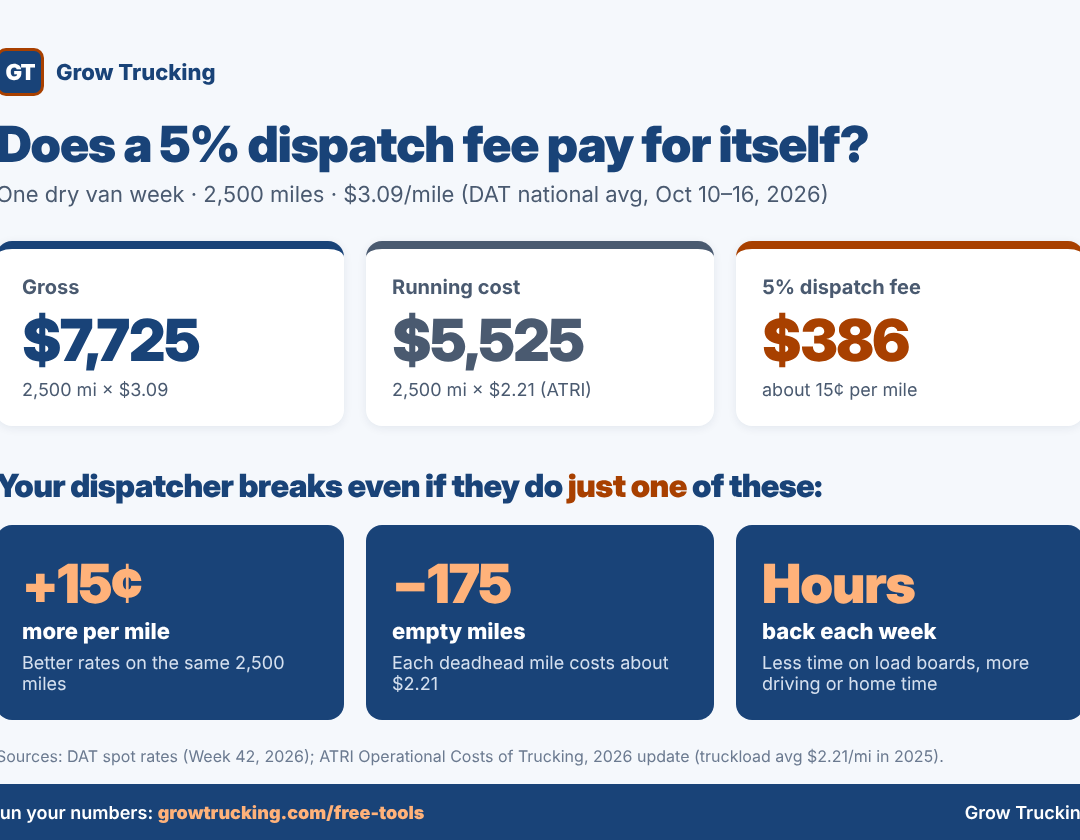
Truck dispatch services are worth the fee when they add more money than they take. For example, on a dry van paying $3.09 a mile, a 5% fee costs about 15 cents a mile. Therefore, your dispatcher needs to win you at least that much through better rates, fewer empty miles, or fuller weeks.
Here's where those numbers come from, using the latest national data. For the week of October 10–16, 2026, the national average dry van spot rate was $3.09 a mile, according to DAT. Meanwhile, the American Transportation Research Institute (ATRI) found that truckload carriers spent $2.21 a mile to run a truck in 2025. In fact, that cost includes fuel, repairs, insurance, and driver pay.
Therefore, the gap between rate and cost is about 88 cents a mile, and that gap is your margin. Now compare what each fee takes from it:
A 5% fee is about 15 cents a mile.
An 8% fee is about 25 cents a mile.
A 10% fee is about 31 cents a mile.
When does the fee pay for itself?
The fee pays for itself once your dispatcher earns back more than they charge. For example, picture a dry van week of 2,500 miles at $3.09 a mile. That's $7,725 gross, so a 5% fee costs about $386. Therefore, to break even, your dispatcher must do at least one of the following things.
Get you about 15 cents more per mile.
Cut about 175 empty miles from your week.
Save you hours on load boards for driving or home time.
The second option works because each empty mile still costs about $2.21 to run, according to ATRI. Thus, 175 fewer deadhead miles saves about $386. However, a good dispatcher should beat the fee by a wide margin, not just break even. Additionally, you can run your own numbers with our dispatch savings calculator and cost per mile calculator.
A real example: one hotshot paid a higher fee and kept more
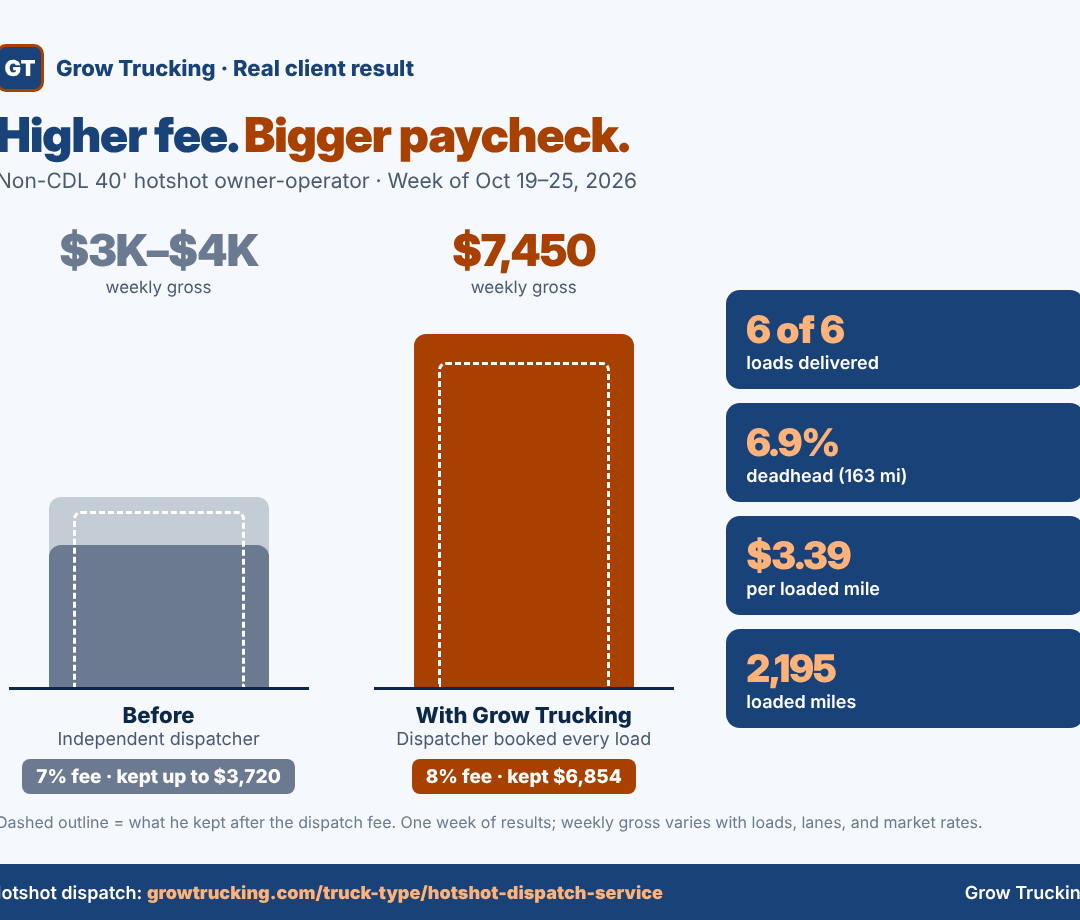
Here's a real case from the Grow Trucking dispatch desk. For example, one of our clients runs a non-CDL 40-foot hotshot. Before he came to us, he used an independent dispatcher who charged 7%, and he grossed about $3,000 to $4,000 a week.
We charge him 8%, which is a higher fee. However, during the week of October 19–25, 2026, our dispatcher booked every load, and he grossed $7,450. Here's how his results compare to his old dispatcher:
| Before (other dispatcher) | With Grow Trucking | |
|---|---|---|
| Dispatch fee | 7% | 8% |
| Weekly gross | $3,000–$4,000 | $7,450 |
| Fee paid | $210–$280 | $596 |
| Kept after the fee | $2,790–$3,720 | $6,854 |
So why did that week work so well? Here are the main reasons, based on his load sheet and weekly summary:
He completed all 6 of his 6 booked loads.
He ran only 163 empty miles, or 6.9% deadhead.
He earned $3.39 per loaded mile on 2,195 miles.
He hauled light freight, with most loads at 6,000 lbs or less.
In fact, he paid about $300 more in fees than in his old dispatcher's best week, but he kept about $3,100 more in his pocket. That's the real test of any dispatcher, and it matters far more than the fee percentage.
However, this is one strong week, not a promise. In his first weeks with us, he still booked most loads himself, and his gross swung from $900 to $4,400. The big jump came once our dispatcher took over every load. You can see how we work with hotshots on our hotshot dispatch page.
When might you not need a dispatcher?
You might not need a dispatcher if you already have steady freight at good rates. For example, drivers with a dedicated lane, direct shipper contracts, or a lease with a carrier often get enough loads without help. Moreover, if you enjoy booking loads and your rates beat the market, a dispatcher may add little value.
You have steady direct shipper freight or a dedicated lane.
You're leased on to a carrier that supplies your loads.
You enjoy booking loads, and you're good at it.
Your rates beat the market average on our rate benchmarker.
However, a dispatcher usually helps most in your first year. New authorities often struggle to get set up with brokers, and they don't yet know which lanes pay well. That's where an experienced team can save you money, time, and stress.
Percentage or flat weekly fee: which is cheaper?
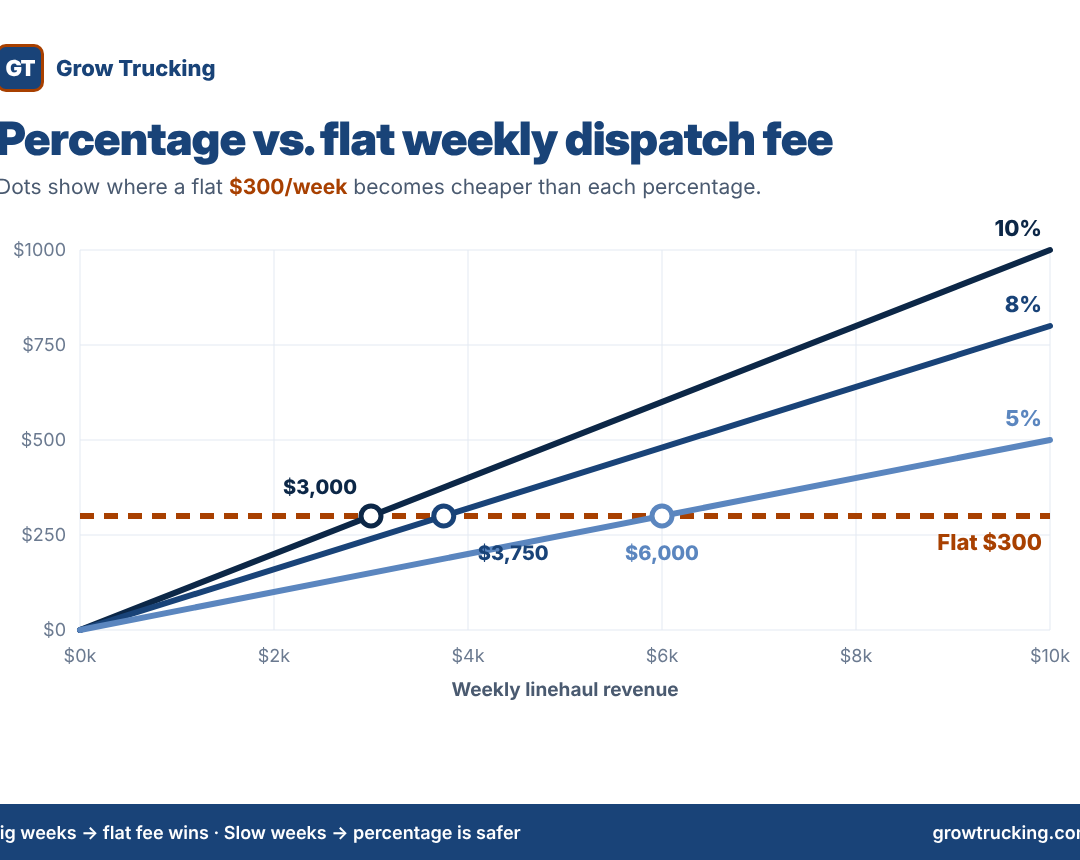
A flat weekly fee is usually cheaper than a percentage when you run big weeks. In contrast, a percentage is cheaper when your weeks are slow or part-time. For example, a flat $300 fee beats a 5% fee once your weekly linehaul goes above $6,000, and it beats an 8% fee above $3,750.
Here is how a flat $300 weekly fee compares to a percentage at different revenue levels:
| Weekly linehaul | 5% fee | 8% fee | 10% fee | Flat fee |
|---|---|---|---|---|
| $3,000 | $150 | $240 | $300 | $300 |
| $5,000 | $250 | $400 | $500 | $300 |
| $6,000 | $300 | $480 | $600 | $300 |
| $8,000 | $400 | $640 | $800 | $300 |
The break-even math is simple: divide $300 by the fee percentage. Therefore, a flat fee beats a 10% fee above $3,000 a week. Thus, if you run hard every week, a flat fee usually wins. However, if you take time off or run part-time, a percentage is the safer choice.
What should a fair dispatch contract include?
A fair dispatch contract spells out the exact fee, every extra charge, and how you can cancel. It also protects your right to turn down any load and makes sure the broker pays you directly. Therefore, get every term in writing before you share your MC number or load board logins.
The exact fee, and whether it applies to linehaul or the full rate.
Every extra fee, or a clear line saying there are none.
A cancel policy with no long lock-in, ideally one week's notice.
Your right to refuse any load.
Payment rules: the broker pays you or your factor directly.
The logins they need, and how you remove their access.
What are the red flags of a bad dispatch service?
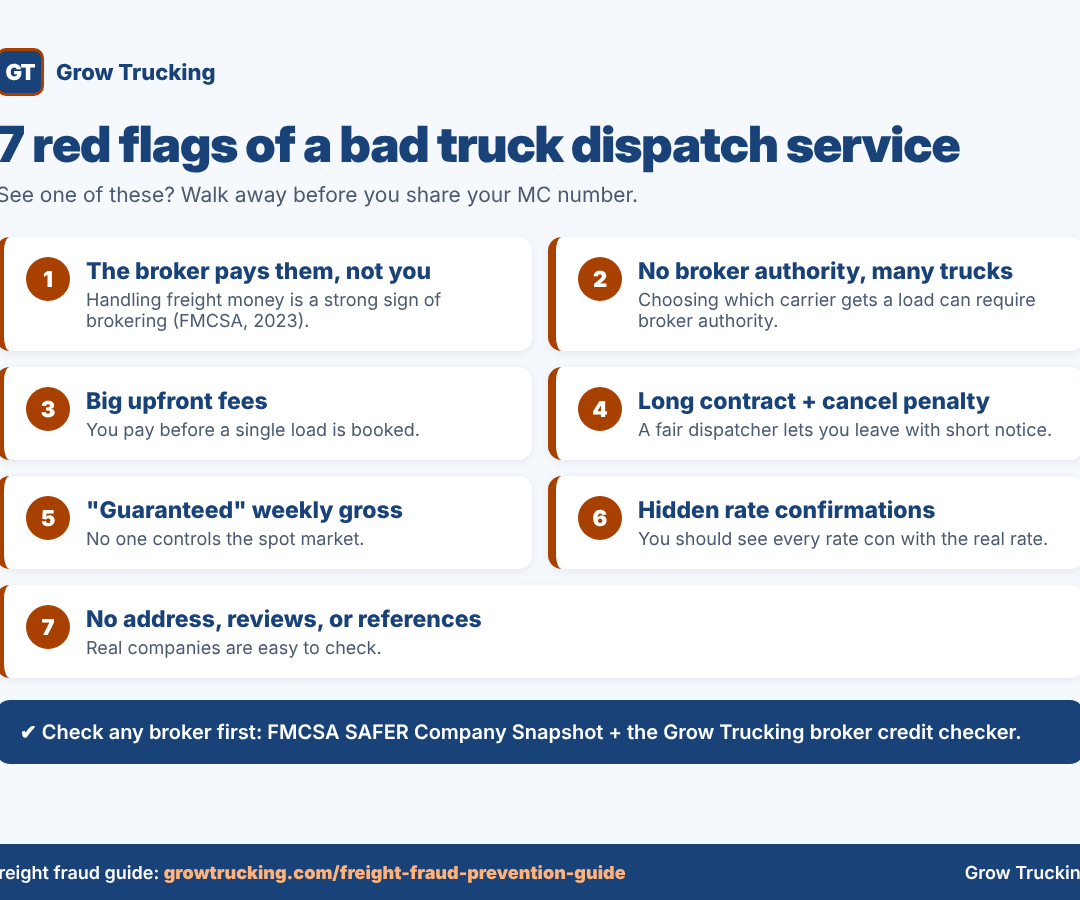
The biggest red flags are dispatchers who collect broker payments, charge big upfront fees, or hide rate confirmations. Most truck dispatch services are honest; however, freight fraud is real, and some so-called dispatchers act like unlicensed brokers. Therefore, if you see any of the signs below, walk away before you share your MC number.
The broker pays the dispatcher instead of you.
They dispatch many trucks for the same freight without broker authority.
They demand big upfront fees before booking a load.
They lock you into a long contract with a cancel penalty.
They promise a "guaranteed" weekly gross.
They won't show you the rate confirmation.
They have no real address, reviews, or references.
For example, the first two flags come from the FMCSA's June 2023 guidance on dispatch services. According to that guidance, handling money between shippers and carriers strongly suggests brokering. Moreover, choosing which carrier gets a load can count as brokering, and that requires broker authority.
Before you haul for any broker, look them up. For example, you can check broker authority on the FMCSA SAFER Company Snapshot. Additionally, you can use our broker credit checker and read our freight fraud prevention guide.
How does Grow Trucking dispatch owner-operators?
Grow Trucking dispatches owner-operators with clear fees and no long contracts. Our fee comes out of linehaul only, not fuel surcharge or accessorials, and we charge no signup fee. Additionally, you can cancel any week, choose a percentage or a flat $300 weekly fee, and see every rate confirmation.
We dispatch dry vans, reefers, flatbeds, hotshots, and box trucks. For example, you can see how we planned Midwest lanes and home time in our box truck owner-operator case study. Also, if you want one person who knows your truck and your lanes, ask about a dedicated dispatcher.
Conclusion: Key Takeaways
Overall, the right dispatcher should put more money in your pocket than they take out, every single week. Here's a quick summary of the most important points from this guide:
Most dispatchers charge 5–10% per load or $150–$400 per week.
A 5% fee on a $3.09 dry van rate is about 15 cents a mile.
A good dispatcher beats the fee with better rates, fewer empty miles, and time.
A flat $300 fee beats 5% above $6,000 in weekly linehaul.
Walk away if the broker pays the dispatcher instead of you.
Want to know if Grow Trucking can beat our fee on your lanes? Get a free dispatch quote from our team today. We'll review your recent loads and tell you honestly whether we can help.
Frequently Asked Questions
How much do truck dispatchers charge owner-operators?
Most truck dispatchers charge owner-operators 5% to 10% of each load, or a flat $150 to $400 per week. However, box trucks and hotshots usually pay the higher end of that range. Additionally, before you sign, ask about setup, tech, and paperwork fees, because those add-ons can raise your real cost.
Is it worth paying a truck dispatcher?
Yes, it's worth paying a truck dispatcher when they earn you more than the fee. For example, one of our hotshot clients moved from a 7% dispatcher to our 8% fee. Moreover, he grossed $7,450 in one week and kept $6,854 after the fee, compared to $3,000–$4,000 gross before.
Can a new authority use a dispatch service?
Yes, a new authority can use a dispatch service, and many do in their first year. In fact, a good dispatcher helps you complete broker setups and find brokers that work with new MC numbers. Consequently, you can avoid long empty weeks while you build a track record with brokers.
Does a truck dispatcher need broker authority?
Sometimes, a truck dispatcher does need broker authority. According to FMCSA's 2023 guidance, a dispatcher who chooses which carrier gets a load, or who handles freight payments, may be acting as a broker. Therefore, ask any dispatcher how they assign loads, and make sure the broker always pays you directly.
Which is better, a flat dispatch fee or a percentage?
A flat dispatch fee is better when you run big, steady weeks. In contrast, a percentage is better when your weeks are slow or you run part-time. For example, a flat $300 fee beats a 5% fee once your weekly linehaul goes over $6,000, and it beats 8% above $3,750.
Can I fire my dispatcher at any time?
You can fire your dispatcher at any time if your contract allows it. Therefore, you should pick a dispatcher with no long-term contract and a short notice period, such as one week. Also, change your load board passwords and remove their access as soon as you end the agreement
Sources: DAT spot rates for Oct. 10–16, 2026 (via AJOT); ATRI "An Analysis of the Operational Costs of Trucking: 2026 Update" (via Transport Topics); ATA Trucking Trends (via FleetOwner); FMCSA dispatch service guidance, June 2023 (via Overdrive); FMCSA SAFER; Truck Dispatch Experts 2026 rate guide; Grow Trucking pricing page.
How we put this together
We wanted to know if a 5–10% dispatch fee pays for itself for one-truck owner-operators. We used DAT's national dry van spot rate for October 10–16, 2026 ($3.09 a mile) and ATRI's 2026 cost report ($2.21 a mile for truckload carriers in 2025). Then we worked out the fee for a 2,500-mile week. We compared published dispatch prices from Truck Dispatch Experts and Grow Trucking. We also read FMCSA's 2023 guidance on dispatch services and broker authority. Numbers checked October 28, 2026.
What we did
For the week of October 19–25, 2026, our dispatcher booked all 6 loads for a non-CDL 40-foot hotshot client. He grossed $7,450 on 2,195 loaded miles at $3.39 a mile, with 6.9% deadhead (163 miles). We charged 8% ($596). Before Grow Trucking, he grossed $3,000–$4,000 a week with a 7% dispatcher. On October 28, 2026, we also pulled DAT's Week 42 rates and ATRI's 2026 cost data to work the fee math.
Sources
- DAT spot truckload rates, Oct. 10–16, 2026 (Week 42), AJOT (data: DAT) (checked )
- FMCSA final guidance on dispatch services and broker authority, June 2023 (via Overdrive), Overdrive (checked )
- FMCSA SAFER Company Snapshot (government), FMCSA (checked )
- ATA Trucking Trends, carrier fleet sizes (via FleetOwner), FleetOwner (data: ATA) (checked )
- Truck Dispatch Experts, 2026 truck dispatch rates, Truck Dispatch Experts (checked )
- Grow Trucking pricing, Grow Trucking LLC (checked )
Free tools related to this article
Put the numbers from this article to work with free calculators and trackers.
- Weekly Profit Target CalculatorFind what your truck must gross each week to keep the profit you want, then check every Friday how the week went.
- Owner-Operator Earnings CalculatorProject weekly, monthly, and yearly take-home after taxes and expenses.
- Profit & Loss CalculatorA full P&L statement with revenue vs expense breakdown and a profit indicator.
- Dispatch Savings CalculatorCompare self-dispatching vs hiring a dispatcher — is it worth the fee?
Dispatch services that help with this

Waqas Ahmed Qazi
Senior Fleet Technology Analyst · 7+ years in trucking dispatch operations
Waqas Ahmed Qazi is a CS graduate, CEO, and Senior Fleet Technology Analyst at WAQ Technologies, a software company that builds dispatch and back-office tools for U.S. trucking carriers, including the load management platform used by US carriers. His work involves reviewing carrier dispatch agreements and freight operations data directly with clients across the industry.