Short answer
The average owner operator salary was about $71,800 in 2025, or roughly 76 cents per mile, according to ATBS. In October 2026, with diesel at $6.28, a 2,500-mile dry van week at $3.09 a mile nets about $2,080 before income taxes. Your rate per mile matters most.
Key takeaways
- ATBS put average owner-operator income at $71,800 in 2025.
- That is about 76 cents for every mile driven.
- Business costs run about $1.69 a mile with diesel at $6.28.
- A 2,500-mile dry van week at $3.09 nets about $2,080 before taxes.
- Set aside 25% to 30% of net pay for taxes.
The average owner operator salary was about $71,800 in 2025, according to the accounting firm ATBS. However, that number is an average across good and bad years. Your real take-home pay depends on your rate per mile, your miles, and your fuel bill. In this guide, we show the full math with October 2026 numbers.
Diesel jumped to $6.28 a gallon in October 2026, according to the US Energy Information Administration (EIA). Meanwhile, spot rates also climbed. Consequently, the old rules of thumb for owner operator salary don't work anymore. Below, we break down gross pay, every major expense, taxes, and what you actually keep each week.
What is the average owner operator salary after expenses?
The average owner operator salary after expenses was about $71,800 in 2025, according to ATBS client data reported by Freight-Waves. Those owner-operators drove about 95,000 miles a year on average. Therefore, they kept roughly 76 cents for every mile they drove, after paying for fuel, the truck, insurance, and repairs.
However, that average owner operator salary hides a wide range. For example, ATBS found the top third of owner-operators earned about $166,000. In contrast, many new carriers earn far less in their first year. Here is how the 2025 numbers break down:
| ATBS 2025 figure | Amount |
|---|---|
| Average owner-operator income | $71,800 |
| Average miles per year | About 95,000 |
| Income per mile driven | About $0.76 |
| Top third of owner-operators | About $166,000 |
| Average truck payment | $2,900 a month |
In addition, ATBS found that 34% of its clients had no truck payment at all. As a result, a paid-off truck is one of the biggest pay raises an owner-operator can give themselves.
How much does an owner-operator gross in a week?
An owner-operator running a dry van grosses about $6,800 in a typical 2,500-mile week right now. That assumes 2,200 loaded miles at DAT's national average spot rate of $3.09 a mile for October 10–16, 2026. However, reefer and flatbed pay more per mile, so your gross depends on your trailer.
Here are DAT's national averages for that same week:
Dry van: $3.09 a mile
Reefer: $3.66 a mile
Flatbed: $3.64 a mile
However, keep in mind these are spot rates, and they include fuel surcharge. In contrast, contract freight often pays less per mile but more steadily. Furthermore, you don't get paid for empty miles, so deadhead lowers your real rate per mile. You can see your own number with our deadhead miles calculator.
What expenses come out of an owner-operator's pay?
The biggest expenses for an owner-operator are fuel, truck and trailer payments, repairs, and insurance. According to the American Transportation Research Institute (ATRI), those costs added up to about $1.85 a mile before fuel in 2025, including driver pay. For an owner-operator, however, your salary is whatever is left after the business costs.
Therefore, we took ATRI's 2025 per-mile costs and removed driver wages, because that's your pay. Additionally, we updated fuel to October 2026 prices. Here is the result:
| Cost per mile | Amount | Source |
|---|---|---|
| Fuel | $0.86 | EIA diesel $6.28 ÷ 7.28 mpg |
| Truck and trailer payments | $0.40 | ATRI 2025 |
| Repair and maintenance | $0.22 | ATRI 2025 |
| Insurance | $0.11 | ATRI 2025 |
| Tires, tolls, permits | $0.10 | ATRI 2025 |
| Total business cost | $1.69 |

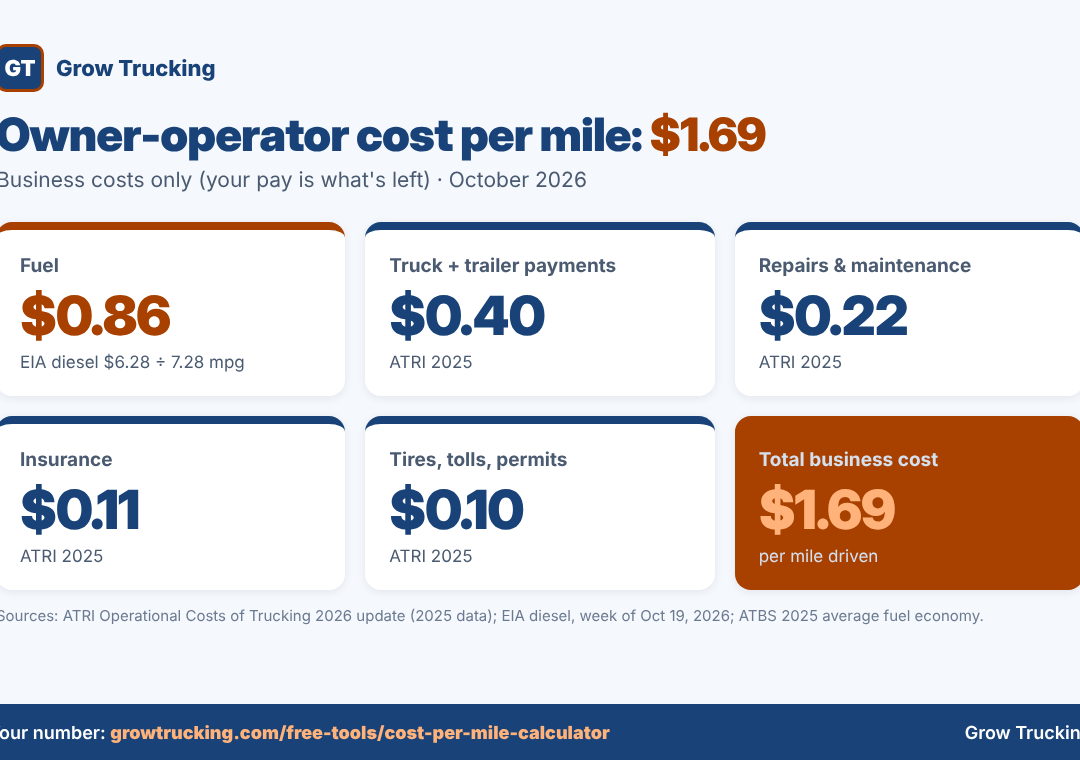
We used 7.28 miles per gallon because that was the average fuel economy ATBS reported for 2025. For example, if your truck gets better mileage, your fuel cost drops. Moreover, if your truck is paid off, you can remove most of the 40 cents for payments. To get your own number, use our cost per mile calculator.
How much does an owner-operator take home each week?
An owner-operator running a dry van takes home about $2,080 a week before income taxes in our October 2026 example. That's after fuel, truck payments, repairs, insurance, a 5% dispatch fee, and $150 for other costs like the ELD and phone. However, that number swings hard when rates go up or down.
Here is the full weekly math for 2,500 total miles, so you can see where the owner operator salary comes from:
| Line item | Amount |
|---|---|
| Gross (2,200 loaded miles × $3.09) | $6,798 |
| Business costs (2,500 miles × $1.69) | −$4,228 |
| Dispatch fee (5%) | −$340 |
| Other costs (ELD, phone, load board, accounting) | −$150 |
| Take-home before income taxes | $2,080 |
Meanwhile, look at what happens when the rate changes. For example, at $2.50 a mile, the same week leaves only about $848. In contrast, at $3.40 a mile, you keep about $2,729. Therefore, your rate per mile matters more than almost anything else.

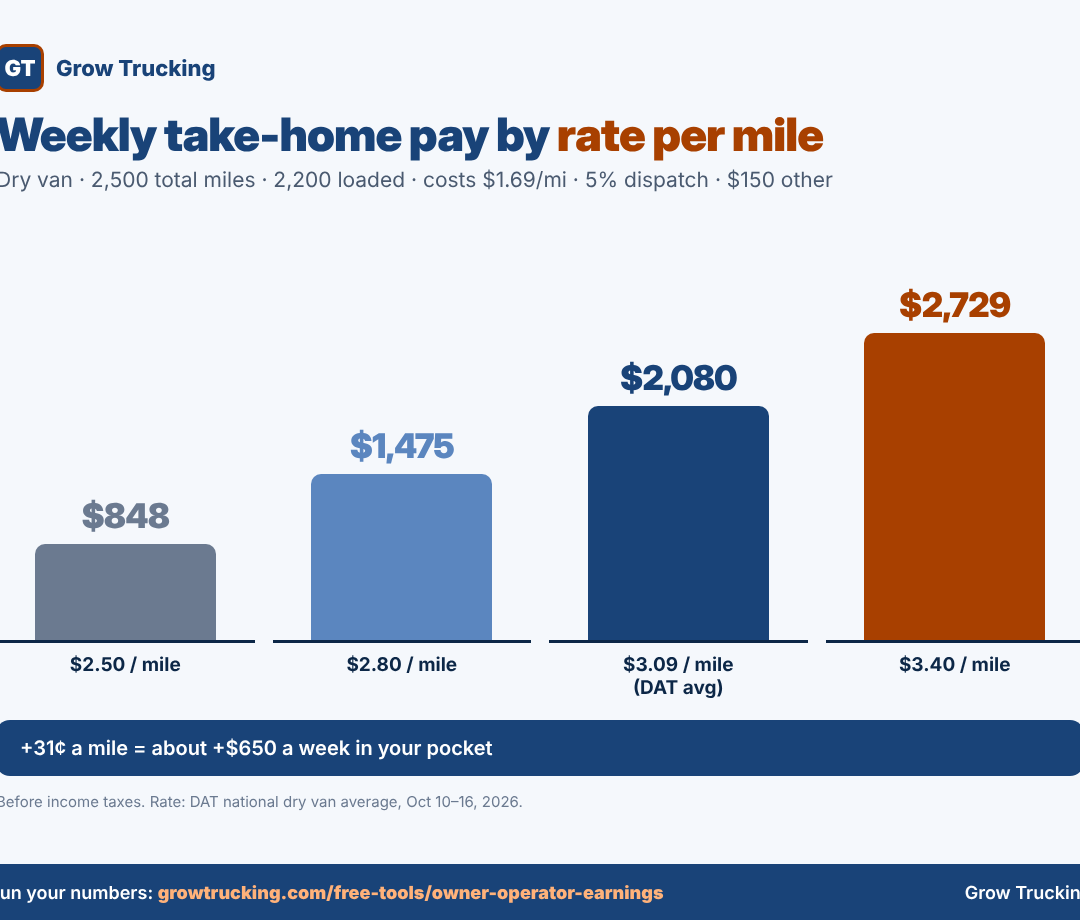
Over 48 working weeks, our example adds up to about $99,900 before income taxes. That's higher than the ATBS average for two reasons. First, our example runs 120,000 miles, compared to the 95,000-mile average. Second, fall 2026 spot rates are higher than most of 2025. Therefore, treat our example as a strong-market week, not a yearly promise.
How much does high diesel cut owner-operator pay?
High diesel cuts owner-operator pay by hundreds of dollars a week. According to the EIA, diesel cost $6.28 a gallon for the week of October 19, 2026, which was $2.66 more than a year earlier. At 7.28 miles per gallon, that adds about 36 cents to every mile you drive, or roughly $900 on a 2,500-mile week.
Fuel surcharge helps; however, it doesn't always cover the whole jump. For example, ATBS said many of its drivers were spending about $350 more per week on diesel in early 2026. In fact, spot rates already include fuel, so you must check your real cost per mile on every load.
Consequently, there are a few ways to fight back:
Use a fuel card with discounts at major truck stops.
Slow down a few miles per hour to improve fuel economy.
Plan fuel stops in lower-tax states.
Reject loads that don't cover your updated cost per mile.
Additionally, you can estimate any trip's fuel bill with our fuel cost calculator.
How much do owner-operators pay in taxes?
Owner-operators pay federal income tax plus a 15.3% self-employment tax on their net profit. On top of that, most states charge income tax too. As a result, many owner-operators set aside 25% to 30% of their net pay for taxes. Then they pay quarterly estimated taxes to the IRS to avoid penalties.
However, you can lower your tax bill legally. For instance, the IRS per diem rate for transportation workers is $80 a day inside the US starting October 1, 2026, according to IRS Notice 2026-60. In addition, truck payments, fuel, repairs, and insurance are all business expenses.
To plan ahead, try our quarterly tax estimator and per diem calculator. Moreover, talk to a tax pro who works with truckers, because every situation is different.
Do leased owner-operators make less than those with their own authority?
Leased owner-operators don't always make less than those with their own authority. In 2025, ATBS said income gains came from leased dry van, flatbed, and tanker owners. Meanwhile, independents with their own authority were down slightly. In fact, leased drivers often pay less for insurance and spend less time finding freight.
On the other hand, own authority gives you more control over rates and lanes. Here is a quick comparison:
Leased on: lower insurance and steady freight, but the carrier takes a cut.
Own authority: you keep the full rate, but you carry more costs and risk.
For example, a leased owner-operator might pay $3,000 to $5,000 a year for insurance. In contrast, a new authority often pays $12,000 to $20,000 or more, according to AtoB's 2026 insurance guide.
How can owner-operators raise their take-home pay?
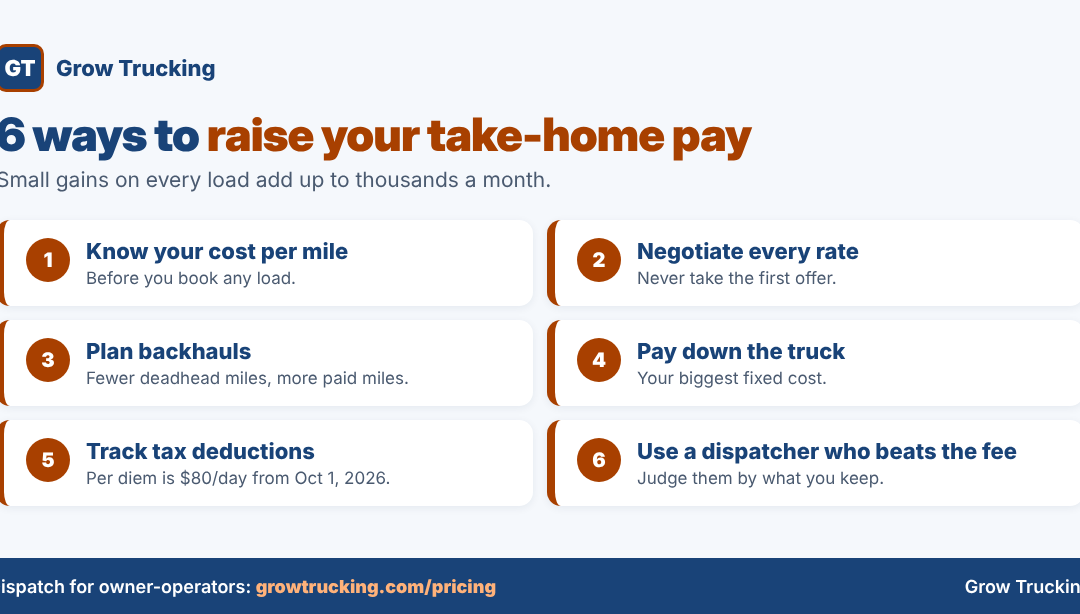
Owner-operators raise their take-home pay by earning more per mile, running fewer empty miles, and cutting costs that don't add value. In our weekly example, adding just 31 cents a mile raised take-home pay by about $650. Therefore, small gains on every load add up to thousands of dollars each month.
Here are the moves that raise your owner operator salary the most:
Know your cost per mile before you book any load.
Negotiate every rate instead of taking the first offer.
Plan backhauls so you run fewer deadhead miles.
Pay down the truck to cut your biggest fixed cost.
Track per diem and every business expense for taxes.
Use a dispatcher who earns more than their fee.

For example, one of our hotshot clients went from $3,000–$4,000 a week with a 7% dispatcher to $7,450 in one week with Grow Trucking at 8%. You can read the full math in our guide to truck dispatch services for owner-operators. Additionally, you can test your own numbers with our owner-operator earnings calculator.
Conclusion: Key Takeaways
Overall, your owner operator salary is simply what's left after the truck gets paid. Here's a quick summary of the most important numbers from this guide:
ATBS put the average owner-operator income at $71,800 in 2025.
That works out to about 76 cents for every mile driven.
Business costs run about $1.69 a mile with diesel at $6.28.
A 2,500-mile dry van week can net about $2,080 before taxes.
Set aside 25% to 30% of net pay for taxes.
Want to see what your truck could earn with better loads? Get a free dispatch quote from Grow Trucking. Meanwhile, we'll review your lanes and tell you honestly whether we can help.
Frequently Asked Questions
What is a good salary for an owner-operator?
A good owner operator salary is anything above the 2025 ATBS average of $71,800. However, the top third of owner-operators earned about $166,000, according to ATBS. Therefore, if you keep your costs low and your truck loaded, a six-figure take-home is possible in a strong freight market.
How much do owner-operators make per mile after expenses?
Owner-operators made about 76 cents per mile after expenses in 2025, based on ATBS income and mileage data. For example, $71,800 divided by about 95,000 miles comes to roughly $0.76. However, high diesel prices in 2026 can cut that number unless your rates rise to match.
Do owner-operators make more than company drivers?
Owner-operators can make more than company drivers, but they also carry more risk. According to ATRI, fleets paid company drivers about 82 cents a mile in wages in 2025. In comparison, ATBS owner-operators averaged about 76 cents a mile, though top owner-operators earned much more.
How many miles does an owner-operator drive per year?
An average owner-operator drove about 95,000 miles in 2025, according to ATBS. However, that was down about 4% from the year before. Meanwhile, many solo owner-operators who run hard every week log 110,000 to 120,000 miles, which raises both their gross and their costs.
How much should an owner-operator save for taxes?
Most owner-operators should save 25% to 30% of their net profit for taxes. Therefore, that covers the 15.3% self-employment tax plus federal and state income tax. Additionally, you should pay quarterly estimated taxes to the IRS, and you should track per diem to lower your bill.
How we put this together
We wanted to show what an owner-operator really keeps after expenses in fall 2026. We used ATBS's 2025 income data (via FreightWaves and Overdrive), ATRI's 2025 cost-per-mile breakdown (via FleetOwner), DAT's national spot rates for October 10–16, 2026, and EIA's diesel price for October 19, 2026. We removed driver wages from ATRI's costs and updated fuel to current prices at ATBS's 7.28 mpg average. Numbers checked October 28, 2026.
What we did
On October 28, 2026, we rebuilt ATRI's per-mile costs with current diesel and modeled a 2,500-mile dry van week at four rate levels ($2.50, $2.80, $3.09, $3.40). We also compared the result with a real Grow Trucking hotshot client who grossed $7,450 in the week of October 19–25, 2026.
Sources
- Owner-operator income, ATBS 2025 data, FreightWaves (checked )
- ATRI cost-per-mile breakdown by category, 2026 update, FleetOwner (checked )
- DAT spot rates, Oct. 10–16, 2026, AJOT (checked )
- EIA diesel price, week of Oct. 19, 2026, IndexBox (data: EIA) (checked )
- IRS Notice 2026-60, special per diem rates, IRS (checked )
- Owner-op income up in 2025 (ATBS), Overdrive (checked )
- Owner-operator truck insurance cost statistics 2026, AtoB (checked )
Free tools related to this article
Put the numbers from this article to work with free calculators and trackers.
- Fuel Cost CalculatorPlan fuel stops, optimize fill strategy, and estimate DEF costs for your trip.
- Fuel Range and Stop PlannerSee how far your tank takes you, where to fuel on a trip, and whether to fill up here or wait for a cheaper stop.
- Fuel Surcharge CalculatorFigure FSC using the DOE method, flat CPM, or a percentage of linehaul with rate tables.
- Cost Per Mile CalculatorKnow your exact CPM — fixed, variable, and break-even rate.
Dispatch services that help with this

Waqas Ahmed Qazi
Senior Fleet Technology Analyst · 7+ years in trucking dispatch operations
Waqas Ahmed Qazi is a CS graduate, CEO, and Senior Fleet Technology Analyst at WAQ Technologies, a software company that builds dispatch and back-office tools for U.S. trucking carriers, including the load management platform used by US carriers. His work involves reviewing carrier dispatch agreements and freight operations data directly with clients across the industry.